

This article is reviewed by the UsedUltra Senior Equipment Inspection Team. Lead Inspection Engineer Chris (12 years of pre-owned industrial equipment assessment; 1,500+ CNC machine tools inspected, including 200+ covering Mikrosa, Okamoto, Studer, Jung and Chevalier grinding machines) is accountable for the figures below. Every price and specification quoted here was read directly from UsedUltra's published listings. All prices are published as reference prices and are not real-time quotations.
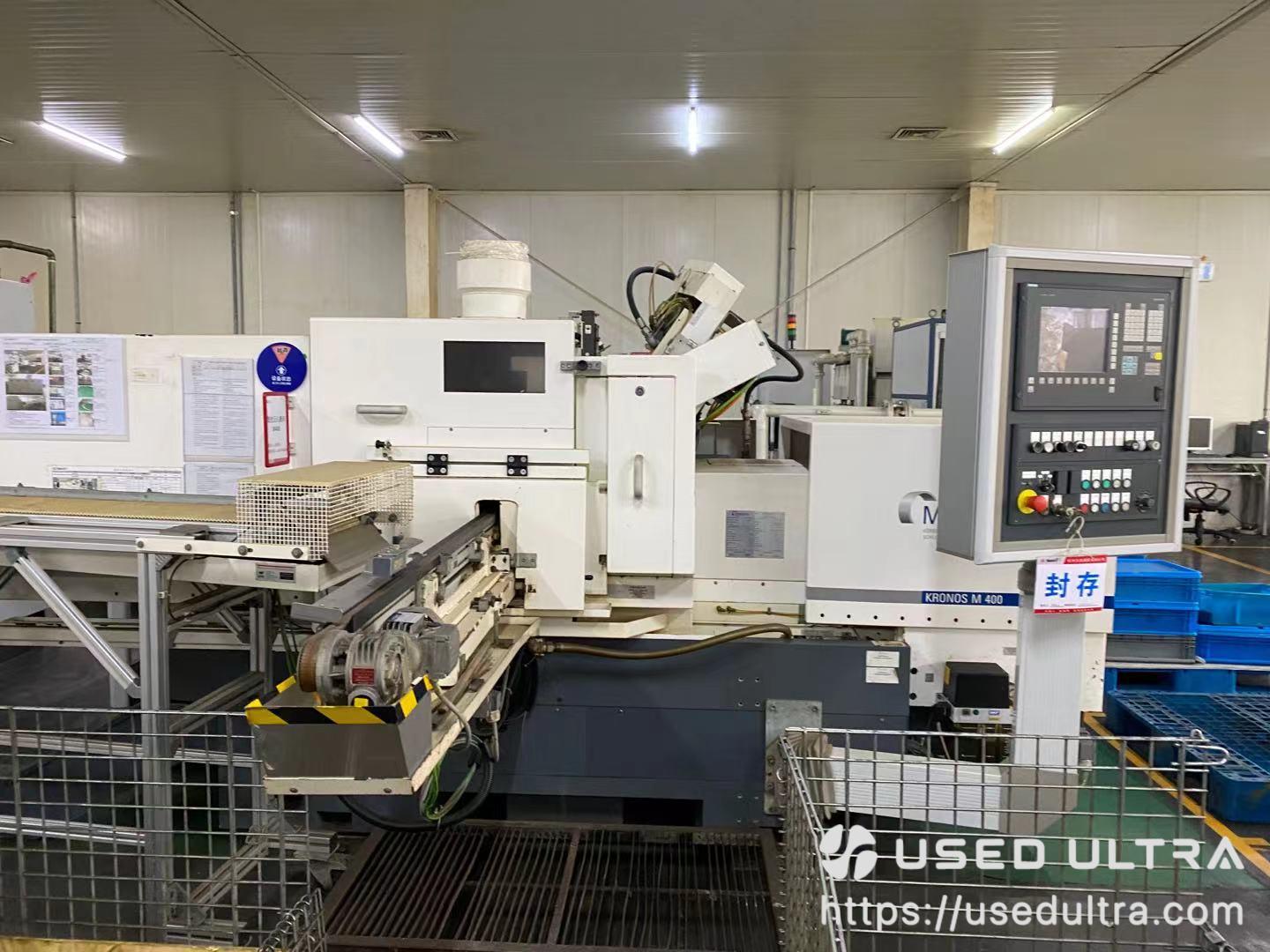
Core answer: Among the 93 used grinding machines we currently have published, a Mikrosa KRONOS M 400 centerless grinding machine carries a published reference price of $308,824 — against a median of $65,000 for used cylindrical grinders and $149,000 for internal/ID-OD machines. The gap is not brand mystique — it is wheel drive power (37/51 kW against 7.5/9 kW), 6 CNC axes, a 395 mm maximum plunge length, and CBN capability to 90/120 m/s. Centerless machines are bought for a single high-volume job and kept for decades, so comparatively few reach the secondary market — and that structural scarcity is what holds the price.
What Do 93 Published Grinding Machine Prices Show?
Used machine pricing is usually discussed in vague ranges because most platforms hide their prices. Ours are published as reference prices, so the distribution can be read directly. Current published reference prices by machine type:
| Grinding type | Lowest | Median | Highest |
|---|---|---|---|
| Cylindrical / universal | $6,000 | $65,000 | $250,000 |
| Roll | $80,000 | $100,000 | $120,000 |
| Mirror | $120,000 | $120,000 | $120,000 |
| Vertical | $95,000 | $147,500 | $398,000 |
| Internal / ID-OD | $25,000 | $149,000 | $308,826 |
| Rotary surface | $68,000 | $184,000 | $1,076,471* |
| Slideway / guideway | $27,941 | $254,706 | $650,000 |
| Centerless | $308,824 | $308,824 | $308,824 |
| Surface | $38,625 | $312,264 | $630,000 |
| Gear | $90,000 | $394,118 | $622,353 |
| Profile | $425,731 | $444,082 | $462,432 |
| Thread | $450,000 | $450,000 | $450,000 |
| Wafer (semiconductor) | $428,352 | $464,176 | $500,000 |
Every figure above is a reference price, not a quotation. As the individual listings state: “Used machine prices fluctuate with the market — this price is for reference only and is not a real-time quote.” Use the table to understand the shape of the market, then confirm the actual price for the specific machine before you commit.
One thing stands out immediately: centerless sits in the top tier of the grinding market, closer to gear and profile grinders than to the cylindrical machines most buyers start by shopping for.
Why Do Centerless Grinding Machines Command a Premium?
Three structural reasons, all visible in the inventory above.
1. Used supply is thin. Centerless machines are bought for one job — high-volume, through-feed or plunge grinding of cylindrical parts without fixturing — and the shops that buy them keep them for decades. A machine bought for one dedicated job and kept for decades is, by construction, resold rarely — so when one does come to market it competes against very little. That follows from how these machines are used, not from a seasonal dip.
2. They are built heavier than their size suggests. The Mikrosa KRONOS M 400 weighs approximately 11 tons and stands about 2,300 mm high. A Studer KC33 1000U in the same inventory weighs about 5,000 kg. More than double the mass buys the rigidity that centerless grinding requires, because the workpiece is supported by the regulating wheel and the rest blade rather than between centres.
3. The accuracy specification is tighter. Centerless machines are specified with tolerances that leave no room for a rebuild: spindle taper concentricity 0.005 mm, spindle axial play 0.005 mm, dressing-slide straightness 0.003 mm over 300 mm, dressing-slide parallelism 0.010 mm over 300 mm. Those are the accuracy figures published for the Mikrosa platform, and they are the benchmark a used machine of this class should be inspected against.
Which 6 Specifications Actually Move a Centerless Grinding Machine's Price?
If you are comparing two centerless machines, these six numbers — not the brand badge — separate them.
| # | Specification | The Mikrosa KRONOS M 400 | Why it moves the price |
|---|---|---|---|
| 1 | Grinding wheel drive power | 37 / 51 kW | The single biggest tier separator. A Studer S33 in the same inventory drives 8 kW; a KC33 1000U, 7.5 / 9 kW. Four to six times the power means heavier cuts and real throughput, and it changes the electrical service you must provide. |
| 2 | CNC-controlled axes | 6 axes | More axes means simultaneous wheel dressing and compensation rather than single-axis infeed. Machines with fewer axes cannot hold the same envelope on complex profiles. |
| 3 | Maximum plunge grinding length | 395 mm | Sets the longest part you can grind in a single plunge. Below your typical part length, the machine is simply wrong regardless of price. |
| 4 | Grinding wheel dimensions | 610 × 400 × 304.8 mm, minimum usable 460 mm | Wheel mass drives both material removal rate and how long between wheel changes. The gap between new (610 mm) and minimum usable (460 mm) — 150 mm — is your remaining wheel budget. |
| 5 | Peripheral speed ceiling | 63 m/s standard, 90 / 120 m/s with CBN | CBN-capable machines cost materially more, because high-speed operation demands different spindle bearings, guarding and coolant delivery. Buy this capability only if your work needs it. |
| 6 | Regulating wheel and drive | 350 × 400 × 152 mm, minimum usable 280 mm; 5–450 rpm infinitely variable; 5.7 kW | The regulating wheel sets the workpiece rotation speed, and infinitely variable control is what lets one machine cover a range of diameters without mechanical changeover. |
The MIKROSA range is a useful place to see the platform in practice. Centerless is a narrow category by nature — if it is what your process needs, the market will not hand you ten options to compare.
Centerless vs Cylindrical vs Internal: What Does the Same Money Buy?
The most useful comparison is not centerless against centerless, but across types at two price tiers. Our inventory offers:
| Machine | Type | Center height | Max workpiece | Key capability | Reference price |
|---|---|---|---|---|---|
| Mikrosa KRONOS M 400 | Centerless | — | 395 mm max plunge (workpiece diameter not published) | 6 axes, 37/51 kW, CBN to 120 m/s | $308,824 |
| STUDER KC33 1000U | Universal cylindrical | 175 mm | 120 kg @ 1,000 mm | 1,000 mm between centres, internal spindle 40,000 rpm | $150,000 |
| STUDER S33 | Universal cylindrical | 175 mm | 150 kg | X travel 370 mm, 8 kW | $150,000 |
An honest read: at roughly twice the money, the Mikrosa buys throughput on round parts at volume and nothing else. The two Studers buy flexibility — different diameters, internal and external features, long shafts. If you cannot name the part number and annual volume you intend to run, a centerless grinder is the wrong purchase at any price. In our experience, that is the most expensive mistake buyers make in this category.
For a wider view of the categories themselves, start from our used grinding machines index, or go directly to external cylindrical and internal cylindrical.
How Do You Read a Published Machine Price Critically?
Publishing prices is only useful if buyers know how to read them. We found three same-model price spreads in our own grinding inventory — and we would rather you spot them yourself than be surprised later.
| Model | Listings | Published prices | Spread |
|---|---|---|---|
| Ichikawa RCB-402 rotary surface | 3 | $68,000 / $120,000 / $1,076,471 | 15.8× |
| Voumard 110 internal | 4 | $135,000 / $140,000 / $250,000 / $280,000 | 2.1× |
| Kellenberger RS 175 1000 cylindrical | 2 | $30,000 / $70,000 | 2.3× |
A 15.8× spread on one model number is not a market signal — it is far more likely a data-entry error. So are most spreads above roughly 3× on an identical model. The practical rules:
- Treat any single listed price as a reference figure, not a valuation. Ask for the machine's serial and order number and confirm the price attaches to that specific asset.
- When the same model appears at several prices, the variation usually tracks condition and configuration — control generation, wheel and spindle condition, remaining consumables. A 2× spread can be real. A 15× spread is not.
- Confirm the order number is unique to the machine you are being quoted. Order number, or serial, is the machine's identity. If the documents you receive put one order number against two prices, stop and ask which asset each price belongs to.
What Does the Sticker Price Leave Out?
The published reference price covers the machine, ex-works. Budget separately for:
- Remaining wheel life. On the Mikrosa, grinding-wheel minimum usable diameter is 460 mm against 610 mm new, and the regulating wheel 280 mm against 350 mm. Those are consumables you inherit on day one.
- Spindle and geometry verification. Insist on micron-level measurements before payment — the accuracy figures are in the table above. A report that says only "spindle OK" has not inspected the machine.
- Rigging, export packing and freight. An 11-ton machine is a project, not a parcel.
- Import duty, inspection and inland transport at destination. Our analysis of landed cost on published machine prices works through how those stack onto the ex-works figure.
- Reconditioning and first-year consumables. The Okamoto grinding machine reconditioning and 12-month ROI study works through what that budget realistically looks like.
FAQ
What is a realistic price range for a used centerless grinding machine?
For a machine comparable to the Mikrosa KRONOS M 400 in our inventory — 6 CNC axes, 37/51 kW wheel drive, 395 mm plunge length — the published reference price is $308,824. Older, mechanically fed centerless machines with lower wheel power trade far below that, typically in the same band as high-end cylindrical grinders. Be sceptical of any centerless price quoted without the wheel drive power and axis count attached; those two numbers explain most of the variation.
Why do used centerless grinding machines hold their value so well?
Because supply is structurally thin across the whole secondary market. Centerless machines are bought for a single job — high-volume through-feed or plunge grinding of round parts — and the shops that buy them tend to keep them for decades, so they surface for resale far less often than cylindrical or surface grinders. That scarcity, rather than brand cachet, is what holds the price. It also changes the buying question: it is rarely "which of five should I buy" but "is this one right for my part" — which is why the specification block carries more weight here than a model name does.
Is a used centerless grinding machine harder to inspect than a cylindrical one?
In some respects, yes. The accuracy chain includes two spindles and two dressing slides rather than one, so the inspection report needs eight geometry readings — concentricity and axial play on each of the two spindles, plus straightness and parallelism on each of the two dressing slides. Published acceptance values on the Mikrosa are 0.005 mm for spindle concentricity and axial play, 0.003 mm over 300 mm for dressing-slide straightness. A report that gives you a single "spindle OK" line has not inspected a centerless machine.
Does CBN capability justify the extra cost?
Only if your production mix needs it. Standard peripheral speed on the Mikrosa is 63 m/s, rising to 90/120 m/s with CBN. High-speed CBN grinding buys substantially higher removal rates and longer wheel life, but it also demands the right guarding, coolant delivery and spindle specification. If your volumes are moderate or your materials varied, the premium buys capability you will not use — and it is priced in.
How much of the price should I attribute to the brand?
Less than most buyers assume. On a centerless grinder, the specification block — wheel drive power, axes, plunge length, wheel size, speed ceiling, regulating-wheel control — explains the price far better than the badge. Two machines of different makes with the same six numbers will land in a similar price band. Two machines of the same make with different numbers will not.
All figures reflect UsedUltra listings as published. Prices shown are reference prices — as the listings state, used machine prices fluctuate with the market and are not a real-time quote. Availability and machine condition change without notice, and the same-model spreads documented above are real records in our inventory, not market estimates. Verify against the specific machine's detail page and a physical inspection before committing.