

Reviewed by the UsedUltra Senior Equipment Inspection Engineering Team
Reviewer credentials: Chief Inspection Engineer Chris (12 years of used industrial equipment appraisal; 1,500+ CNC machines inspected, including 200+ covering Okamoto, Studer, Jung, and Chevalier)
Executive summary: Used Okamoto grinding machines typically sell for 20%–35% of a new machine's price. A verified inspection report confirms actual condition — spindle runout, guideway straightness, and grinding-test results. To break even within 12 months, total investment (sale price + transport and installation) must be less than the margin gained from moving grinding in-house over 12 months: payback period = total investment ÷ monthly margin gain; 12-month ROI = (12 × ΔM − T) ÷ T. Buy only what a verifiable inspection report backs up — unverified machines cost more than new ones once downtime and replacement are counted.
Why Buyers of Used Grinding Machines Lose Money: 3 Common Traps
Trap 1: High outsourced grinding costs and delivery hostage to suppliers. Grinding outsourced for die steel and heat-treated parts runs $11–17 per piece; in peak season lead times stretch past two weeks and order delivery is dictated by outside shops — you lose far more than the machining fee.
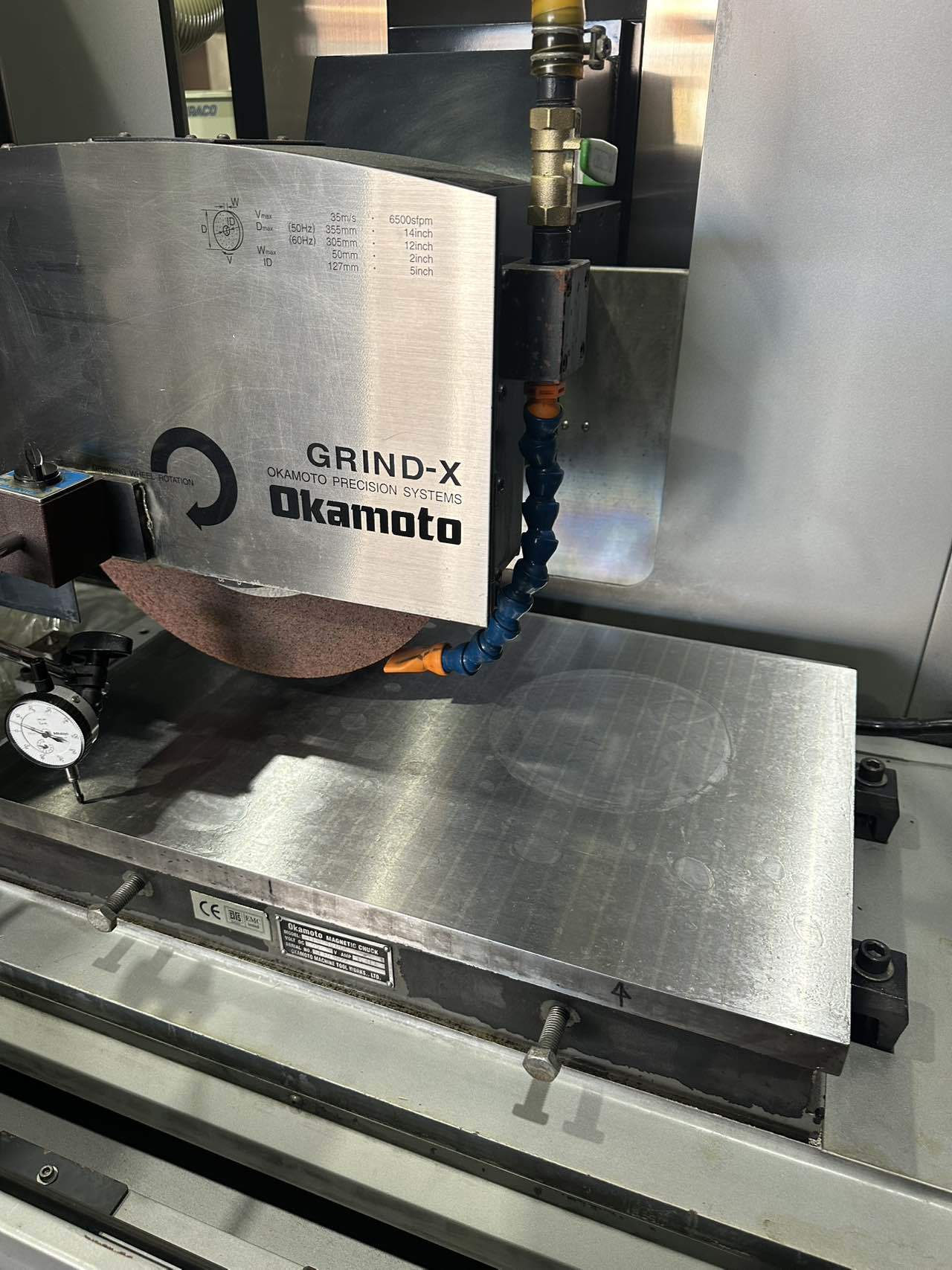
Trap 2: Information asymmetry — the same machine quoted at 3× different prices. A 2012 Okamoto PSG-63DX is quoted anywhere from $7,000 to $28,000. Sellers promise "precision like new" but provide no inspection report you can verify — you only see the sale price, not the real condition of the spindle bearings and guideways. If it arrives with a noisy spindle and Ra pushing past 0.8 μm, the "deal" becomes a loss.
Trap 3: "Too cheap to be true" — unverified machines fail after arrival. An unverified, as-is machine has no inspection report, no run-hours data, and no warranty. The first sign of trouble comes weeks after payment, and the cost of downtime and replacement wipes out everything you saved on the sticker price.
Okamoto Grinding Machines Model Comparison: PSG-63DX / PSG-84DX vs Domestic New Machines
All figures in standard industrial units:
| Parameter | Okamoto PSG-63DX (used, verified) | Okamoto PSG-84DX (used, verified) | Domestic new machine (M7130-type) |
|---|---|---|---|
| Table working surface (mm) | 620×350 | 800×400 | 1000×300 |
| Spindle motor (kW) | 3.7 | 5.5 | 4.0 |
| Spindle speed (rpm) | 1700 | 1700 | 1440 |
| Grinding flatness (mm) | ≤0.005 over full travel | ≤0.005 over full travel | ≤0.008 / 300 mm |
| Surface roughness Ra (μm) | ≤0.2 | ≤0.2 | ≤0.63 |
| New-machine reference price (US$) | 55,000–75,000 | 75,000–100,000 | — |
| Used sale price (US$) | 11,000–21,000 | 17,000–28,000 | — |
| Transport & installation (US$) | 1,000–2,000 | 1,200–2,500 | — |
| Total investment (US$) | 12,000–23,000 | 18,200–30,500 | 14,000–21,000 |
| Monthly margin needed to pay back in 12 months (US$) | 1,000–1,900 | 1,500–2,500 | 1,100–1,800 |
Note: Prices are market reference values converted at USD 1 ≈ CNY 7.2 and rounded; new-machine prices are subject to current quotations. Final figures should be confirmed against UsedUltra's current inspection reports and quotes.
What a Verified Inspection Report Covers
Before any price discussion, require an inspection report that certifies these items:
| Inspection item | Verified value | Why it matters |
|---|---|---|
| Spindle radial runout | ≤3 μm | Directly drives Ra and grinding quality |
| Guideway straightness | ≤5 μm/m | Drives flatness over table travel |
| Grinding test specimen Ra | ≤0.3 μm | End-to-end proof of grinding performance |
| Flatness over full travel | ≤0.005 mm | The spec buyers actually need |
| Run hours & service records | Documented | Basis for residual-value judgment |
How to Price a Used Okamoto Grinder: Residual Value, Verification & ROI Formula
Residual Value: Three Factors — Age, Spindle Runout, and Guideway Straightness
To price a used Okamoto grinding machine, don't start with "market rate." Evaluate three factors, each backed by verifiable inspection data: age × operating condition sets the base residual value; spindle radial runout and guideway straightness set the condition ceiling. Rule of thumb: with straight-line depreciation of roughly 6%–10% per year, a 10-year-old machine retains 30%–55% of new-machine value (salvage floor included). If spindle runout exceeds 3 μm or guideways show scoring or uneven wear, discount accordingly, then take another 10%–15% negotiating discount. If the seller can't provide an inspection report, treat the machine as "unknown condition" and assume the worst. A 3× spread in quotes isn't about the machine — it's about inspection standards.
The 12-Month Payback ROI Formula
Let P = sale price, D = transport and installation. Then total investment T = P + D.
Let Q = monthly output, u₀ = outsourced cost per piece, u₁ = in-house cost per piece. Then monthly margin gain ΔM = Q × (u₀ − u₁).
Payback period (months) = T ÷ ΔM ≤ 12, i.e. T ≤ 12 × ΔM12-month ROI = (12 × ΔM − T) ÷ T × 100%
Run this before buying: the monthly margin gain must cover T ÷ 12. If the machine can't pay back in 12 months, walk away or renegotiate.
Verification Before You Pay: Test Specimen & Laser Interferometer Rechecks
Confirm the reported condition before you pay: grind a test specimen (Φ80 hardened die steel, rechecked Ra ≤0.3 μm, flatness ≤0.006 mm), recheck spindle runout ≤3 μm, and run a second precision recheck after a 2-hour warm-up. A reputable dealer (e.g., UsedUltra) delivers the machine with its inspection report — laser interferometer data, test-cut records, measured spindle runout — and lets you verify it on site.
Real Case Study: $17,000 Used Okamoto PSG-63DX, Payback in ~1.5 Months
Customer background: A precision mold-components shop in Zhejiang, China — 20 CNC machines plus 2 grinders, 40% of grinding outsourced at $11.8 per piece, 1,800 pieces outsourced per month, outsourced lead times stretching to 14 days in peak season.
Bottleneck: Outsourced grinding cost roughly $21,300/month, with poor consistency (Ra fluctuating 0.3–0.8 μm) and rising rework complaints.
Solution: Purchased a 2012 Okamoto PSG-63DX at $16,000 — condition verified by inspection report (spindle runout 2.8 μm, guideway straightness 4.2 μm/m, test-specimen Ra 0.25 μm, full run-hours record). No rebuild needed; the machine was sold tested and verified. Transport and installation $1,000. Total investment T ≈ $17,000.
12-month results:
- Grinding precision: Ra stable at 0.2–0.35 μm, flatness 0.004–0.006 mm, confirmed on delivery via test specimen;
- In-house cost $5.3/piece (incl. depreciation allocation), margin gain Δu ≈ $6.5 per piece ($11.8 − $5.3);
- Monthly margin gain ΔM = 1,800 × $6.5 ≈ $11,700/month;
- Payback = $17,000 ÷ $11,700 ≈ 1.5 months;
- 12-month cumulative margin ≈ $140,400; ROI = (140,400 − 17,000) ÷ 17,000 × 100% ≈ 726%;
- Annual unplanned downtime 1.2%, below the industry average of 3%–5%.
FAQ: Used Okamoto Grinding Machines — Price, Verification & Payback
Is a used Okamoto grinding machine worth buying? How does it compare with a same-price domestic new machine?
A: Decide case by case, in three steps.
- Evaluate the process value: for small-batch, high-precision die-steel grinding, a verified used Okamoto wins (higher precision ceiling, stable resale value); for high-volume rough grinding of ordinary steel, a domestic new machine is less hassle.
- Compare the 12-month totals: use the ROI formula in Section 3 to compute T and ΔM for both options; buy whichever pays back first.
- Check verification: buy only from a supplier who provides an independent, re-verifiable inspection report (e.g., UsedUltra) with data written into the contract — never buy from photos.
How can I verify the true condition of a used Okamoto grinding machine? (4-step check)
A:
- Read the inspection report: confirm spindle runout ≤3 μm, guideway straightness ≤5 μm/m, and test-specimen Ra ≤0.3 μm are all documented.
- Measure on site: use a laser interferometer on V/flat guideways and a runout gauge on the spindle to verify the report.
- Grind a test piece: grind a Φ80 disc and measure flatness; above 0.008 mm means the condition claims are wrong.
- Check run hours and service records: documented history is the basis for the residual-value judgment.
Where can I buy used grinding machines with a verified inspection report?
A:
- Use a dedicated used-machine dealer with an in-house inspection engineering team (e.g., UsedUltra — 1,500+ machines inspected) rather than a classifieds listing.
- Require the inspection report before purchase and have the acceptance test written into the contract.
- Verify warranty coverage: a 12-month warranty on spindle bearings, guideways, and hydraulics protects against hidden defects.
- Ask for a customer reference with a documented payback case in an industry similar to yours.
How do I negotiate the price of a used Okamoto grinding machine? What's the discount room?
A: Negotiate on inspection data, not gut feel.
- First require the three-factor data (spindle runout, guideway straightness, test-specimen Ra).
- Deduct by findings: runout >3 μm → deduct $2,500–3,500; guideways showing wear → deduct $1,700–2,500; missing run-hours/service records → deduct $2,800–4,900.
- Final deals typically close 15%–30% below the asking price when condition defects are documented.
- If the seller is missing the inspection report or factory accuracy data, negotiate another 5% off.
How do I guarantee 12-month payback on a used Okamoto grinding machine?
A: Three contract clauses, non-negotiable:
- Verification clause: test specimen + laser interferometer recheck; the inspection report must match the machine on delivery.
- Warranty clause: 12-month warranty on spindle bearings, guideways, and hydraulic components; the seller bears any defects in that window.
- Payback test up front: run the ROI formula (T ≤ 12 × ΔM) in writing before signing, using a conservative 70% of projected monthly margin; if it doesn't pass, don't buy.