

Reviewed by the UsedUltra senior machine-inspection engineering team — lead inspection engineer Chris, 12 years in used industrial equipment appraisal, 1,500+ CNC machine tools inspected, including 200+ Okamoto, Studer, Jung, and Chevalier grinders.
Published 2026-09-18 · Last updated 2026-09-18
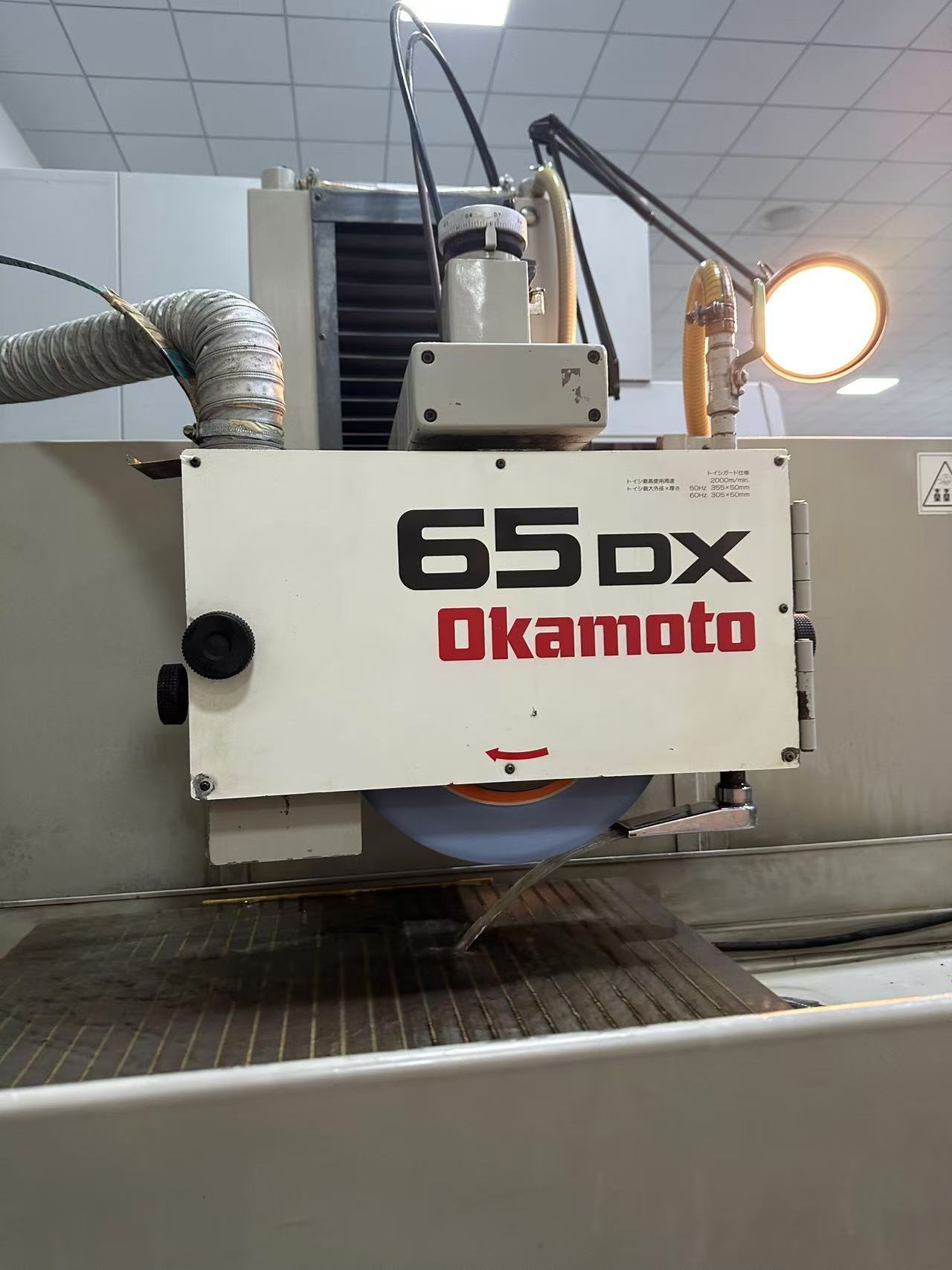
Core answer: Across the six used Okamoto surface grinders in the current inventory, asking prices ran from $83,529 to $630,000 FOB Japan — and table size explains almost none of that spread. A 650 × 500 mm PSG65DX was priced at $83,529, while a smaller 600 × 400 mm PSG64GX was priced at $312,264. The $228,735 difference buys a 2024 build and a current-generation platform, against a machine described as over a decade old — not more table. Buyers searching for Okamoto CNC are looking at exactly this class of machine, but the label deserves scrutiny: Okamoto's own product literature describes the GX class as a PLC-controlled automatic-cycle machine and never uses the word CNC. On top of FOB, budget +5.4% to +14.1% net in India (after GST credit), +5.4% to +21.2% net in Mexico, about +10.7% net in the UAE, and in Indonesia a compliance calendar that can run 1–12 months before the machine is cleared to ship at all.
Why Used Okamoto Surface Grinder Prices Are So Easy to Misread
Failure 1 — FOB pricing hides 10–35% of the landing cost
A buyer budgets against the FOB number, then discovers at the port that duty, surcharge, and tax add 10–35%. By then the freight is sunk, the negotiating position is gone, and the overrun is unavoidable. The landed-cost section below exists to close this gap.
Failure 2 — "DX" and "GX" do not mean CNC
They are not CNC designations. Okamoto's suffix vocabulary describes a generation and configuration family, not the presence of a numerical control. A buyer who reads a suffix as a capability claim ends up comparing generations while believing they are comparing controls. In the listings below, PSG65DX names no controller at all, while its GX-generation sibling — on a smaller table — asks 3.7× the price; that gap is set by age and generation, not by a control.
Failure 3 — The hour meter is not spindle-on time
A machine's displayed counter is not cutting time. When a 2024-built machine is listed as "unused stock" while its counter reads 3,526 h, the listing is contradicting itself — and the buyer cannot tell from the page alone which half to believe.
Okamoto Surface Grinder Prices: Six Verified Listings
All six machines below were live on the UsedUltra Okamoto CNC inventory page on Prices are asking prices in USD, not transacted prices. Hours are as displayed ("Processing Time"), which is not spindle-on time.
| Model | Table (mm) | Grinding wheel (mm) | Wheel speed / spindle | Control | Displayed hours | Weight (kg) | Asking price (USD) |
|---|---|---|---|---|---|---|---|
| PSG65DX | 650 × 500 (chuck 600 × 500 × 85) | Ø255 / Ø305 × 38 × 127 | 1500 / 1800 rpm · 3.7 / 4 kW | Not named | 3,256 h | — | 83,529 |
| PSG64GX | 600 × 400 | 355 × 50 × 127 (50 Hz) / 305 × 50 × 127 (60 Hz) | Not stated | Listed as CNC upper/lower axis | 3,526 h | 2,900 | 312,264 |
| PSG64CA | 605 × 400 | φ355 × 38 × φ127 | Not stated · 5.5 / 4 kW | Not named | 300–350 h | 4,500 | 323,529 |
| ACC84GX | 800 × 400 | 305 × 38 × 127 | 3000 rpm · 3.7 / 4.2 kW | GRIND-X precision system | 4,632 h | 3,900 | 332,529 |
| PSG104CA2 | 1400 × 300 | Ø305 × 50 × Ø127 | 2500 rpm (motor spindle) | FANUC 32i-B / 32i-MB, XYZC 4-axis | 6,989 h | 5,600 | 462,432 |
| MOLD-4015NC | 4050 × 1550 (chuck 4000 × 1500 × 110) | Ø510 × 100 × Ø203.2 | 22 kW · max table load 105.8 kN | FANUC | 6,527 h | ~30,000 | 630,000 |
What buyers mean by "Okamoto CNC"
The phrase Okamoto CNC is used loosely in the used market, and that looseness costs buyers money, because it describes at least three different machines:
- A genuinely CNC-controlled grinder. PSG104CA2, with a FANUC 32i-B / 32i-MB control on XYZC four axes at $462,432, and MOLD-4015NC, with FANUC at $630,000. PSG104CA2's CA2 suffix decodes to Okamoto's CNC surface-and-profile class, so the control matches the name.
- An automatic-cycle machine that is not CNC, but gets called one. PSG64GX at $312,264 is described on its listing as having "CNC-controlled upper and lower axis functions" — yet Okamoto's own literature for the GX class describes a PLC controller running automatic cycles and never uses the words CNC or NC. PSG65DX at $83,529 is the same story one generation earlier. Both are automatic machines; neither contours.
- A machine whose control is simply unstated. PSG64CA at $323,529 and ACC84GX at $332,529 name no controller brand, though ACC84GX references a "GRIND-X precision system."
The price gap between category 1 and categories 2 and 3 is 3.7× — on a smaller table. That gap is real, but it is not bought by a CNC control. Treat "Okamoto CNC" in any listing title as a claim to be verified, not a specification to be relied on. The full Okamoto CNC inventory can be filtered by model series, and the control field is the first column worth reading.
What actually drives the price: age, condition, and generation — not table size
Sort the table by table area and the price column refuses to cooperate. PSG65DX offers 0.325 m² of table for $83,529. PSG64GX offers 0.24 m² — 26% less table — for $312,264, or 3.7× the price.
First driver: age and condition. PSG64GX is a 2024 machine listed as unused stock. PSG65DX is described on its own listing as "well maintained for more than ten years." That is roughly a decade of remaining service life separating two machines of similar footprint — the largest single visible difference between them.
Second driver: generation. PSG64GX carries the GX marker; PSG65DX carries the older DX marker. GX is the current automatic-cycle platform: automatic reversing saddle feed, two-step downfeed for rough and fine grinding, and automatic spark-out with wheel-head retract. DX already had AC servo infeed, digital position readout, and selectable grinding cycles. Moving from DX to GX buys panel ergonomics, self-diagnostics, and repeatability — not new capability.
Where the listings mislead. PSG64GX is described on its listing as having "CNC-controlled upper and lower axis functions." Okamoto's own literature for the GX class describes a PLC controller and never uses the words CNC or NC. In this context "CNC" is the seller's shorthand for an automatic grinding cycle, and it is precisely the kind of loose labelling that makes series-level comparison unreliable. The price gap does not require a CNC control to explain it.
The machines that genuinely are CNC-controlled in this set are PSG104CA2 and MOLD-4015NC. PSG104CA2's CA2 suffix decodes to Okamoto's CNC surface-and-profile class — the former DXNC series, column type — and its FANUC 32i-B / 32i-MB control on XYZC four axes is consistent with that reading. They ask $462,432 and $630,000.
The practical rule: when comparing two Okamoto quotes, subtract remaining life first, generation second, and table size third. Buyers who compare on table size alone systematically overpay for small current-generation machines and systematically undervalue large older ones. Buyers who compare on a listing's own "CNC" claim are comparing a word.
Landed Cost of a Used Okamoto Grinder: India, Indonesia, UAE and Mexico
The arithmetic below uses the PSG65DX at $83,529 FOB throughout, with an assumed $4,500 freight and insurance component for a Japan-origin consolidated move (reported Japan→India container rates exceeded $4,000 per box in 2026 and have been volatile). Freight is the most quote-dependent input in this table — treat it as an assumption, not a rate.
India — BCD, SWS, and creditable IGST
India applies Basic Customs Duty (BCD) on the Chapter 84 tariff line, a Social Welfare Surcharge (SWS) calculated on the BCD amount, and IGST on the aggregate. Published guidance on the BCD rate diverges: one source quotes 0–7.5% for machine tools, another quotes 7.5–15% for industrial equipment generally. The rate depends on the specific tariff line and notification, so model both ends rather than trusting one figure.
| Component | BCD @ 0% | BCD @ 7.5% |
|---|---|---|
| FOB Japan | $83,529 | $83,529 |
| Freight + insurance (assumption) | $4,500 | $4,500 |
| CIF value | $88,029 | $88,029 |
| BCD | $0 | $6,602 |
| Social Welfare Surcharge (10% of BCD) | $0 | $660 |
| Value for IGST | $88,029 | $95,291 |
| IGST @ 18% | $15,845 | $17,152 |
| Total cash at import | $103,874 | $112,443 |
| Net cost after IGST credit | $88,029 (+5.4%) | $95,291 (+14.1%) |
India also requires a Chartered Engineer Inspection Certificate covering residual life and depreciated value, with a commonly cited minimum residual life of five years, plus a pre-shipment inspection certificate from an approved agency. Note the asymmetry: the more of your cost that sits in IGST, the less it matters to you, because you reclaim it. The BCD and SWS you never see again.
Indonesia — the constraint is the calendar, not the tariff
Indonesia's regime for used capital goods is permit-first, under Minister of Trade Regulation No. 24 of 2025. For goods in HS chapters 84, 85, and 90, direct-use companies may import machines up to 20 years old — comfortably covering most Okamoto surface grinders in circulation. The binding constraint is procedural:
- An API-P importer registration tied to a valid NIB is required.
- Prior import approval from the Ministry of Trade must be obtained before shipment. Validity runs 1 to 12 months, capped at one year.
- Supporting documents include a commitment not to resell or scrap the machine within the age limit, and where applicable a calibration certificate from the exporting authority with a sworn Indonesian translation.
- A pre-shipment inspection proving the machine is usable and not scrap is mandatory, performed by KSO SCISI (Sucofindo–Surveyor Indonesia). The importer arranges and pays for it.
- Industry sources reported in May 2026 that Indonesia moved to full SNI certification with strict nameplate matching — model, serial number, voltage rating, and safety markings must correspond exactly to the documents, with discrepancies triggering detention of 10+ working days. Treat this as reported and in flux; verify current status with BSN before committing.
Cost this honestly: Indonesia's duty and PPN figures vary by tariff line and should be confirmed with your broker. The quantifiable Indonesia cost is carrying time. An approval window that can run up to a year means capital parked in a machine you cannot deliver: at an 8% annual cost of capital on an $88,000 CIF machine, that is roughly $590 per month of pure carry before the spindle has turned once. Price it into your offer.
UAE — the lowest-friction destination
The UAE applies the GCC common external tariff, commonly 5% ad valorem on machine tools, with no used-machinery age regime comparable to Indonesia's. Import VAT of 5% applies and is generally recoverable for registered businesses. Confirm both the rate and the specific tariff line with a broker — the GCC schedule has several lines within Chapter 84.
| Component (at 5% duty) | USD |
|---|---|
| CIF value | $88,029 |
| Duty @ 5% | $4,401 |
| Net cost after VAT credit | $92,430 (+10.7%) |
Mexico — model the tariff band, don't assume a rate
Mexico's general import tax (arancel) on machinery is quoted as ranging from 0% to 25% depending on tariff fraction and origin, with IVA at 16% applied to the customs value plus the tariff. IVA is generally creditable. Used machinery additionally requires an appraisal (avalúo) and a SEMARNAT non-contamination certificate; certain machinery types require a permiso previo from the Secretaría de Economía, and importers must be on the Padrón de Importadores.
Because the band is wide, model it as a sensitivity rather than a point estimate:
| Arancel | Duty | Base for IVA | IVA @ 16% | Total cash | Net after IVA credit |
|---|---|---|---|---|---|
| 0% | $0 | $88,029 | $14,085 | $102,114 (+22.2%) | $88,029 (+5.4%) |
| 5% | $4,401 | $92,430 | $14,789 | $107,219 (+28.4%) | $92,430 (+10.7%) |
| 15% | $13,204 | $101,233 | $16,197 | $117,430 (+40.6%) | $101,233 (+21.2%) |
Which costs are recoverable, and which are not
This single distinction reverses the destination ranking for most buyers, so it deserves to be stated plainly:
| Cost | Recoverable? | Practical effect |
|---|---|---|
| India — IGST (18%) | Yes, for a registered business | Reduces India's true cost by up to 19 percentage points |
| India — BCD + SWS | No | Permanent cost, and the main India variable |
| Indonesia — PPN | Yes, for a registered PKP | Confirm current standard rate with your broker |
| UAE — import VAT (5%) | Yes, for a registered business | The UAE's only recoverable component |
| Mexico — IVA (16%) | Yes, for a registered business | Reduces Mexico's true cost by up to 17 percentage points |
| Mexico — arancel | No | Permanent cost, and the main Mexico variable |
| Freight, insurance, inspection fees, avalúo | No | Permanent cost in every destination |
The four destinations compared
| Destination | Net cost after tax credit (same $83,529 machine) | Binding constraint | Pre-shipment inspection |
|---|---|---|---|
| India | +5.4% to +14.1% | BCD rate on the specific tariff line | Chartered Engineer Inspection Certificate required |
| UAE | +10.7% | Tariff-line classification | None specific |
| Mexico | +5.4% to +21.2% | Tariff fraction; permit for certain types | Avalúo + SEMARNAT non-contamination certificate |
| Indonesia | Fiscal cost broker-confirmed; add ~$590/month carry | Import approval must precede shipment (1–12 months) | Mandatory, KSO SCISI, paid by importer |
The UAE is the cheapest to land. India and Mexico can be nearly as cheap net when the tariff line behaves and you are registered to reclaim tax. Indonesia is the only one of the four where the machine's arrival date, not its price, is the variable you cannot control — so plan backwards from the approval.
Worked Example: One Grinder, Four Landed-Cost Outcomes
This is a cost model, not a quoted or transacted deal. Its purpose is to show how one $83,529 machine becomes four different offers, using the arithmetic and compliance timelines documented above.
Scenario: a mold shop needs one 650 × 500 mm class surface grinder, holds a $140,000 total budget, and can accept a 6-month delivery window.
- Ex-UAE. Land and clear in the UAE at about +10.7% net. A $140,000 ceiling leaves substantial headroom against an $83,529 FOB machine — the option that preserves the most budget for chucks, tooling, and commissioning.
- Ex-India. At BCD 0% the machine nets +5.4%, cheaper than the UAE. At BCD 7.5% it nets +14.1%, more expensive than the UAE. The same machine, to the same buyer, swings by nearly $7,300 on a tariff-line detail settled before the machine ever ships. Confirm the line first.
- Ex-Mexico. The spread across the tariff band reaches $13,200 on the net figure. With avalúo and SEMARNAT documentation on top, this is the destination where a broker's classification work pays for itself most visibly.
- Ex-Indonesia. Even with an attractive fiscal outcome, the 1–12 month approval window means the machine plausibly sits idle for a third of a year. On a 6-month planning horizon this route is schedule-infeasible and should be rejected on that ground rather than negotiated down on price.
The conclusion is deliberately narrow: the destination ranking is decided by documentation and calendar, and only then by price.
Current asking prices and verified operating hours for every machine cited above are published on the Okamoto CNC inventory page. Prices there move as stock turns, so re-check the listing before you build an offer on any figure in this article.
Frequently Asked Questions About Used Okamoto Grinder Costs
Is a DX or GX Okamoto a CNC machine?
No — not from the suffix alone. Okamoto's suffix vocabulary (CA, DX, GX, and so on) identifies configuration and generation families, not the presence of a numerical control. In the six listings verified on 2026-09-18, PSG65DX named no controller at all, while its GX-generation sibling PSG64GX asked $312,264 against the PSG65DX's $83,529 — a 3.7× gap on a machine with a smaller table, explained by age and generation rather than by any CNC control. PSG64GX's own listing calls it "CNC-controlled," but Okamoto's literature for the GX class describes a PLC controller and never uses the word CNC. Before comparing any two Okamoto prices, obtain in writing: (1) the control manufacturer and model, (2) the number of controlled axes, and (3) whether the control is original or retrofitted. A retrofit changes both the price and the serviceability picture.
A 2024 machine shows 3,526 hours but is described as unused — which is right?
Neither, until a document resolves it. 3,526 hours since a 2024 build implies roughly 3.5 to 5.4 hours per calendar day, which fits light production use and does not fit genuinely unused stock. Note that this specific listing labels itself both "Used / Unused Stock Machine" and "used / surplus inventory machine" — the contradiction is in the listing's own wording. Most grinder counters accumulate power-on time including warm-up and setup, so the figure is an upper bound on cutting time rather than a measure of wear. Request the original shipping invoice, the customs entry record, or a manufacturer service certificate. If none exists, treat the machine as carrying an unresolved hour discrepancy and negotiate accordingly — don't walk away on the counter alone, and don't pay a near-new premium on the description alone.
How much of the import tax can I actually recover?
Roughly the VAT/GST/IVA/PPN portion, and essentially none of the duty. India's IGST at 18% is generally creditable for a registered business, while BCD and SWS are not. That is why India's net figure ranges from +5.4% to +14.1% while its gross cash figure ranges from +24.4% to +34.6% — the gross number overstates true cost by a wide margin. Model the net-after-credit figure when comparing destinations, and confirm credit eligibility with a tax advisor before committing.
What happens if an Okamoto fails Indonesia's pre-shipment inspection?
The machine does not ship. The inspection is performed by KSO SCISI (Sucofindo–Surveyor Indonesia), arranged and paid for by the importer, and exists to prove the machine is usable and not scrap. Failing it stalls the shipment — which is exactly why the inspection must be sequenced before the balance payment, not after. Two safeguards: (1) make the balance payment conditional on a passed pre-shipment inspection report, and (2) reconcile the machine's nameplate against the commercial documents (model, serial number, voltage rating, safety markings) before the inspector arrives, since reported 2026 enforcement treats nameplate discrepancies as grounds for detention. Because Indonesia's import approval must also precede shipment, run approval and inspection in parallel, not in series.
Should I buy from a Japanese dealer or a regional reseller?
It depends on which risk you are better equipped to absorb. A Japan-based source typically means stock from the Japanese domestic market, which generally carries better maintenance records and lower hours than machines that have already passed through a secondary market. Only one of the six listings above states that provenance explicitly; the rest show Japan as origin only. The trade-off is that you carry the freight, the inspection, and the import approval yourself. Buying regionally shifts that compliance burden to the reseller and shortens your timeline, at the cost of a margin and often of documentation quality. If you have a broker and can absorb a 1–12 month approval window, the Japan route is usually cheaper. If your production line is waiting, pay the regional margin. If you cannot verify the control configuration yourself, buy from whoever will put it in writing.
All prices and stock status cited in this article were read from live listings on 2026-09-18 and are subject to change without notice. India's duty rates are presented as ranges because published guidance diverges; confirm the applicable rate for your specific tariff line with a licensed customs broker before relying on any figure here. Indonesian import rules reflect Minister of Trade Regulation No. 24 of 2025 and reported 2026 amendments; verify current requirements with Indonesian authorities. UAE duty and Indonesia's fiscal rates were not confirmed against a primary source and must be verified with a broker. This article is technical guidance, not legal, tax, or customs advice.