

This article is reviewed by the UsedUltra Senior Equipment Inspection Team. Lead Inspection Engineer Chris (12 years in used industrial equipment appraisal, 1,500+ CNC machine tools inspected) is accountable for every technical determination below. Every figure quoted here was read from the three live listings in the UsedUltra electrical discharge category on 2026-09-23 and is reproduced exactly as published.
Core answer: Three used Makino sinker EDMs are listed at $64,624 (EDGE3), $57,824 (EDGE3i) and $56,924 (EDNC85). Both cheaper machines out-specify the dearest. The EDGE3i matches the EDGE3 exactly on travels (450 × 300 × 320 mm) and worktable (600 × 450 mm), publishes a 40 A generator, an 800 kg workpiece limit, a C-axis and an EROWA chuck, and costs $6,800 less. The EDNC85, at $900 below the EDGE3i, carries 3.7× the travel envelope, 3.75× the workpiece capacity and 3× the roughing current. The EDGE3 and the EDGE3i both display exactly 6,728 h. Start with the two cheaper machines, and make the EDGE3 justify its $6,800.
What Do These Three Used Makino Sinker EDMs Cost in 2026? $64,624, $57,824, $56,924
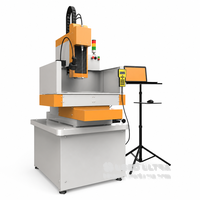
All three are Makino die-sinking machines currently in the UsedUltra SED CNC electrical discharge machines category. All three are listed as Japanese origin. All three are powered by a Makino MGH-family control or a CNC EDM control, at 5,000 mm/min rapid on every one of them.
The Three Machines Side by Side: 16 Specifications Compared
| Specification | Makino EDGE3 | Makino EDGE3i | Makino EDNC85 |
|---|---|---|---|
| Reference price | $64,624 | $57,824 | $56,924 |
| Machine type | CNC sinker EDM | CNC sinker EDM | CNC sinker EDM, listed as a mirror EDM |
| Travel X × Y × Z | 450 × 300 × 320 mm | 450 × 300 × 320 mm | 800 × 500 × 400 mm |
| Worktable | 600 × 450 mm | 600 × 450 mm | 800 × 500 mm |
| Work tank internal | Not published | 800 × 550 × 350 mm | 1,400 × 900 × 500 mm |
| Max workpiece weight | Not published | 800 kg | 3,000 kg |
| Max electrode weight | Not published | 50 kg | 200 kg |
| Max machining current | Not published | 40 A | 120 A |
| C-axis | Not published | Included | Not published |
| Electrode chuck | Not published | EROWA | Not published |
| Dielectric capacity | Not published | 380 L | 800 L |
| Filters | Not published | 2 pcs | 2 pcs |
| Control | MGH-5 | "CNC EDM control system" | Makino MGH series |
| Rapid traverse | 5,000 mm/min | 5,000 mm/min | 5,000 mm/min |
| Condition stated | Used / pre-owned | Used / pre-owned | Used, approx. 90% new |
| Recorded hours | 6,728 h | 6,728 h | 7,658 h |
Two things stand out before any analysis. The EDGE3 row is mostly empty, and it is the most expensive machine in the table. And the EDGE3 and the EDGE3i show the same 6,728 h.
Price per Litre of Travel: $356 vs $1,339 vs $1,496
Read the price column against the capability column:
| Price per unit of capability | Makino EDGE3 | Makino EDGE3i | Makino EDNC85 |
|---|---|---|---|
| Travel envelope | 43.2 L | 43.2 L | 160.0 L |
| Price per litre of travel | $1,496 | $1,339 | $356 |
| Price per kg of workpiece capacity | Not published | $72 | $19 |
| Price per amp of roughing current | Not published | $1,446 | $474 |
The EDNC85 costs 4.20× less per litre of travel than the EDGE3 and 3.81× less per kilogramme of workpiece capacity than the EDGE3i. On roughing current it is 3.05× cheaper per amp.
None of that makes the EDGE3 or the EDGE3i bad machines. It makes them small machines. A 450 × 300 × 320 mm envelope with an 800 kg workpiece limit is a real class of machine, and there are jobs it does better than a 160 L sinker does. What the arithmetic rules out is the idea that the higher price buys more capability. In this set it buys less.
Why Does the EDGE3 Cost $6,800 More Than the EDGE3i on the Same Travels?
This is the sharpest question in the comparison, because the two machines are otherwise the same size.
Same Travels, Same Table, $6,800 Apart
The EDGE3 and the EDGE3i both publish 450 × 300 × 320 mm travels and a 600 × 450 mm worktable. They are the same envelope to the millimetre. The price difference is $6,800, in favour of the EDGE3i.
That is not a small gap on a machine of this size. It is 10.5% of the EDGE3's asking price, spent on a machine that carries the same travels and the same table.
What the EDGE3i Publishes That the EDGE3 Does Not: Nine Fields
The EDGE3i publishes, and the EDGE3 does not:
- maximum machining current (40 A)
- maximum workpiece weight (800 kg)
- maximum electrode weight (50 kg)
- work tank internal dimensions (800 × 550 × 350 mm)
- dielectric fluid capacity (380 L)
- filter count (2)
- tank opening mechanism (automatic up/down)
- C-axis (included)
- electrode chuck type (EROWA)
The EDGE3 publishes its travels, its worktable, its control (MGH-5), its rapid traverse speed and an application list. That is a legitimate set of facts, and it is also the set you would collect without putting a machine on a bed and measuring it. Read the two side by side and the EDGE3i is the better-documented machine on every line where the two differ.
The EDGE3i has one weak line of its own: its control is logged as "CNC EDM control system" with no model number, where the EDGE3 names an MGH-5 and the EDNC85 names an MGH series. Generator generation is what sets achievable finish and roughing efficiency on a sinker, so that is a question to put to the seller rather than infer.
Max Machining Current: 40 A vs 120 A, and the EDGE3 Publishes No Figure
Current class caps how fast the machine can rough metal out. Two of the three publish it:
| Machine | Max machining current | Price | Price per amp |
|---|---|---|---|
| Makino EDGE3i | 40 A | $57,824 | $1,446 |
| Makino EDNC85 | 120 A | $56,924 | $474 |
| Makino EDGE3 | Not published | $64,624 | — |
Use the number carefully. Current and removal rate are not in a straight-line relationship. The rate depends on the generator's efficiency, the electrode material and area, and the flushing strategy. What is safe to say is that a 3× current class is a step change in which jobs are economic. A 120 A generator will rough a large cavity at a cost per cubic centimetre that a 40 A machine cannot reach with any electrode strategy. For small precision work the reverse holds, because the 40 A machine's finer control resolution is the thing you actually wanted.
Max Workpiece Weight: 800 kg vs 3,000 kg
Weight capacity is a hard physical limit, and the two figures that exist are 800 kg (EDGE3i) and 3,000 kg (EDNC85). The EDGE3 publishes nothing.
The tank is the other half of the same constraint, and it is the half buyers forget. The workpiece has to be submerged, so the tank's internal dimensions and depth decide what fits even when the weight is within limits. The EDGE3i's tank is 800 × 550 × 350 mm. The EDNC85's is 1,400 × 900 × 500 mm, close to twice the linear size in every direction. A 700 kg part on the EDGE3i is inside the weight limit, but if it is taller than the tank's internal depth it still will not machine.
C-Axis and the EROWA Chuck: Documented on One Machine Only
Only the EDGE3i states "C-Axis: Included." On a sinker, a C-axis rotates and indexes the electrode. It changes the job class rather than the job speed: multi-cavity work, indexed features, helical and threaded forms, and better flushing in deep ribs where a static electrode cannot clear debris. Without it you are limited to plunge work along Z.
The EDGE3i is also the only one of the three naming an EROWA electrode chuck, qualified in the listing itself as "based on machine photos." Treat the chuck as a question to confirm, and treat the C-axis as a question to ask explicitly, because the presence or absence of either one is invisible in the price.
Cost per Amp of Roughing Current: EDGE3i $1,446 vs EDNC85 $474
Put the three derived figures next to each other and the shape of the set is clear.
The EDGE3 is the most expensive machine and publishes none of the three denominators. Its travel envelope is the same as the EDGE3i's, so its $1,496 per litre is simply the EDGE3i's envelope at a $6,800 higher price. On the figures available, the EDGE3 is the least efficient purchase of the three.
The EDGE3i is the small precision machine. At $1,446 per amp it is the most expensive way to buy roughing capacity in this set, and that is the correct price for what it does. You do not buy a 40 A machine for roughing throughput. You buy it for control resolution, and the C-axis and the EROWA chuck are the parts of the specification that say so.
The EDNC85 is the volume machine. $474 per amp, $356 per litre, $19 per kilogramme of workpiece capacity. On every denominator it publishes, it is the cheapest of the three by a factor between 3 and 4.
What Specs Does Each Listing Publish? EDGE3i, EDNC85 and EDGE3
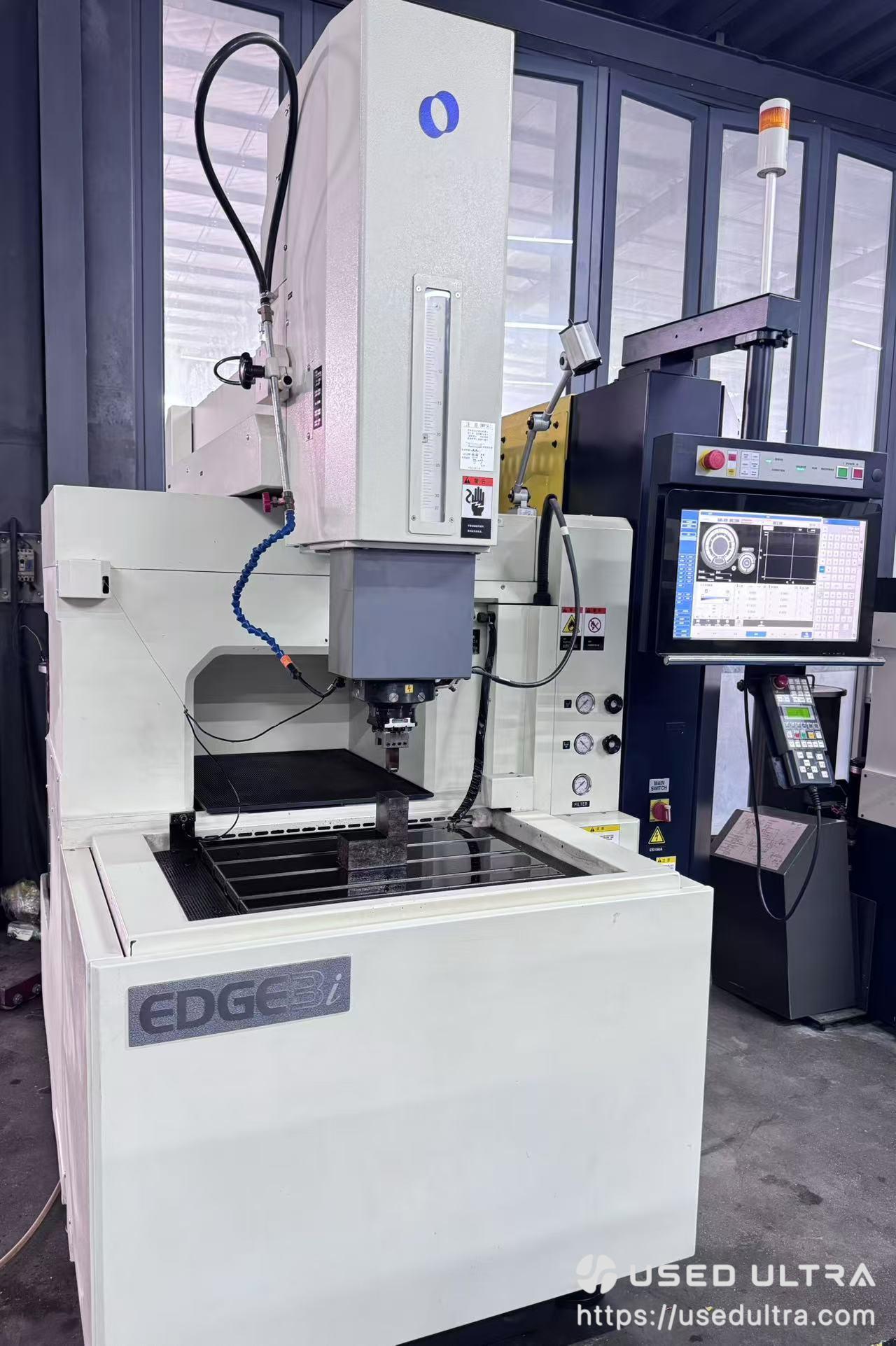
Makino EDGE3i, $57,824: 40 A, 800 kg, C-Axis
450 × 300 × 320 mm travel · 600 × 450 mm worktable · 40 A max machining current · 800 kg workpiece · 50 kg electrode · C-Axis included · EROWA chuck · 800 × 550 × 350 mm tank · 380 L dielectric · automatic up/down tank · 2 filters · 6,728 h
The best-documented machine of the three, and $6,800 cheaper than the EDGE3 on identical travels and an identical table. It is the only one stating a C-axis. It publishes workpiece weight, electrode weight, tank dimensions, dielectric volume, filter count, current class and its tank opening mechanism.
Its weak line is the control, logged only as "CNC EDM control system." Ask which generator it is. On a sinker the generator generation sets the achievable finish and the roughing efficiency, and it is the one field in this listing that does not answer the question.
Makino EDNC85, $56,924: 120 A, 3,000 kg, Mirror EDM
800 × 500 × 400 mm travel · 800 × 500 mm worktable · 1,400 × 900 × 500 mm tank · 3,000 kg workpiece · 200 kg electrode · 120 A available current · 800 L dielectric · Makino MGH series control · automatic up/down tank · 2 filters · 7,658 h
The largest and most powerful of the three, and at $56,924 the cheapest. A 120 A generator, a 3,000 kg workpiece limit, a 200 kg electrode capacity and an 800 L dielectric tank make this the machine for large molds, die-casting inserts and heavy work. Its listing names mirror finish EDM among its suitable processes and states a condition of "used, approximately 90% new."
Two cautions. The listing publishes no surface roughness value, so "mirror finish EDM" is a process description rather than a measured result. Ask for the achievable roughness figure in writing, with the generator model. And the same table gives two different table dimensions.
It carries the highest recorded hours of the three at 7,658 h, 930 h more than either EDGE machine.
Makino EDGE3, $64,624: the Highest Price, the Thinnest Spec Sheet
450 × 300 × 320 mm travel · 600 × 450 mm worktable · Makino MGH-5 control · 5,000 mm/min rapid · 6,728 h
The highest reference price in the set, on a machine the same size as the EDGE3i. The published specification contains no maximum workpiece weight, no work tank dimensions, no maximum machining current, no maximum electrode weight and no dielectric capacity. It does publish the control system (MGH-5), the travels, the worktable and the rapid traverse speed, and it lists application areas across plastic mold manufacturing, die and tool making, automotive parts, electronics and general precision machining.
A five-line specification at the top price in the set is not by itself a reason to reject the machine. The EDGE3 platform is a well-known Makino sinker, and a well-documented example in good condition can justify the number. It is a reason to demand the missing lines before you treat $64,624 as a starting point. This listing also shares its 6,728 h figure with the EDGE3i.
Which of the Three Should You Ask About First? Travel and C-Axis Decide
Work down these three questions in order. Each one eliminates a machine rather than ranking them.
If Your Largest Part Fits in 450 × 300 × 320 mm
Then the EDGE3i and the EDGE3 are both candidates on size, and the EDGE3i wins on everything else that is published. It costs $6,800 less, and it is the only one of the three documenting a C-axis and an EROWA chuck. Two of the three cannot be separated on travel or table at all, so the separation has to come from the specification the EDGE3 did not publish. Ask the EDGE3's seller for the same list. If they can produce it and it beats the EDGE3i's, the $6,800 has a case. If they cannot, it does not.
If It Does Not Fit, or Weighs More Than 800 kg
Then the EDNC85 is the only one of the three that can take the part, and it happens to be the cheapest of the three. Its 800 × 500 × 400 mm travels, 1,400 × 900 × 500 mm tank and 3,000 kg workpiece limit are not comparable to the EDGE machines' 800 kg. They are a different class of machine.
This is the part of the comparison worth repeating: the largest machine in the set is not the most expensive one. That is unusual enough in used machinery that it should be verified rather than assumed.
If You Need a C-Axis: One Documented Option Among the Three
Then the EDGE3i is the only documented option among the three, and the question becomes whether a C-axis is worth 3.7× less travel envelope and 3× less roughing current to you. On the prices as listed, the EDGE3i is $900 more than the EDNC85. That $900 buys a C-axis, an EROWA chuck and a smaller machine. Whether that trade is correct depends entirely on your drawings, and on nothing in the price column.
The Decision in One Paragraph: EDGE3i, EDNC85, Then EDGE3
If your parts fit a 450 × 300 × 320 mm envelope and you need a C-axis, ask about the EDGE3i first. If they do not fit, or they weigh more than 800 kg, the EDNC85 is the only one of the three that takes them, and it costs less than the other two. The EDGE3 is the machine you ask about last, and only after its seller produces the specification lines the listing omits. Nothing about the three prices supports the assumption that the dearest machine is the most capable.
Frequently Asked Questions About Used Makino Sinker EDM Machines
What does SED mean in EDM, and how does it differ from wire EDM?
SED is the trade shorthand for sinker electrical discharge machining (SEDM), the die-sinking or ram form of EDM. A shaped graphite or copper electrode is plunged into the workpiece under dielectric fluid and erodes a cavity whose form is the electrode's negative. It is the process that makes 3D cavities and blind pockets, as distinct from wire EDM, which cuts 2D profiles with a travelling wire, and small-hole EDM drilling, which cuts start holes with a tubular electrode. All three Makino machines in this comparison are SED. The used SED CNC electrical discharge machines category carries twelve listings in total, and the used Makino sinker EDM machines page carries the rest of the Makino stock.
Which of the three is the best value?
On the published figures, the EDNC85. It costs $7,700 less than the EDGE3 and $900 less than the EDGE3i, while carrying 3.7× the travel envelope, 3.75× the workpiece capacity and 3× the roughing current. That is a statement about capability per dollar, not a recommendation. If your largest part fits in a 450 × 300 × 320 mm envelope and needs a C-axis, the EDGE3i is the right machine and the EDNC85 is simply too big to be a substitute. Value only means something against a part.
Why is the EDGE3 more expensive than the EDGE3i when they are the same size?
The listings do not say. The two machines publish identical travels and an identical worktable, and the EDGE3i publishes more capability on every line where the two differ, including a C-axis, an EROWA chuck and a 40 A generator. A $6,800 gap on two otherwise identical envelopes has to come from somewhere the listing does not show: build year, generator model, electrode-change history or condition. None of the three publishes a build year, so that is the first question. Until the EDGE3's seller produces those lines, the price difference is unexplained rather than justified.
Can a used Makino sinker EDM machine cut hardened steel?
Yes. All three are sinker EDMs, and the process removes material by controlled spark erosion rather than with a cutting edge, so workpiece hardness does not determine machinability. You can sink a cavity into tool steel after heat treatment, which avoids the distortion risk of hardening a finished mold, and you can do it with no cutting force on the part, so thin walls, fine ribs and delicate features survive. Geometry is what limits a sinker. An undercut is not possible with a straight-plunge electrode, because the electrode must retract along its plunge axis. And every cavity shape needs its own electrode, so electrode cost and wear are part of the job economics.
How many hours is too many on a used sinker EDM machine?
There is no single number, and this set shows why. The recorded figures are 6,728 h (EDGE3), 6,728 h (EDGE3i) and 7,658 h (EDNC85). The two EDGE machines share an identical figure, which is the first thing to resolve, because whichever one cannot be photographed is unverified. Before you judge any of the three on hours, ask for the power-on hours and the cutting hours separately plus the hour-meter photograph. On EDM, power-on time includes tank filling, threading and setup, so it is not cutting time. And a precision machine used gently is not the same asset as a machine that ran production shifts, which is why the electrode-change history is worth as much as the counter.
Do these used EDM prices include freight, duty or inspection?
No. Every figure in this article is a reference price, the price published against that unit's listing page on 2026-09-23. Freight, export crating, insurance, destination rigging, inspection and any import duty or tax are all quoted separately. Duty turns on country of origin, and all three of these listings state Japan. Confirm that against the nameplate before the invoice is raised, because the ERP origin field and the nameplate do not always agree on this site.
Are there other used Makino sinker EDMs available?
Yes. These three are three of the four Makino sinkers in the electrical discharge category as read on 2026-09-23. The fourth, the Makino EDNC65 at $49,412, is outside the scope of this comparison. The category carries twelve listings in total, six of them sinkers, and the used Makino sinker EDM machines page carries additional Makino inventory. Prices and stock change without notice, so confirm current price and availability before you plan around any figure in this article.
All prices, specifications, hour figures and stock quantities cited in this article were read from the three live listings in the UsedUltra electrical discharge category on 2026-09-23 and are reproduced as published. All prices are reference prices: used machine prices follow the market, and every figure is the price published against that unit on the date above, a reference for budgeting rather than a fixed quote. Prices and stock change without notice. The Makino EDGE3 and EDGE3i listings both state the same 6,728 h figure, and the Makino EDNC85 listing states two different table dimensions; both should be confirmed against the machine's nameplate and an inspection report before any payment. Hour figures are reproduced exactly as the listings show them and are not equivalent across listings: ask for source-on and cutting hours separately, in writing, for every machine. This article is technical guidance, not legal, tax or customs advice; confirm rules of origin and applicable duty with a licensed customs broker.