

This article is reviewed by the UsedUltra Senior Equipment Inspection Team. Lead Inspection Engineer Chris (12 years of pre-owned industrial equipment assessment; 1,500+ CNC machine tools inspected, including 200+ covering Okamoto, Studer, Jung and Chevalier grinding machines) is accountable for the sizing figures below. Specifications quoted here were transcribed from the seller documentation published on each individual machine listing, and nameplate data are re-checked at final inspection. Prices are published as reference prices and are not real-time quotations.
Core answer: Four numbers decide whether a surface grinding machine suits your part. The worktable or chuck has to be larger than your part's diagonal, and across the current listings it runs from 1,025 × 485 mm to 8,000 × 2,500 mm. The table load rating runs from 150 kg to 10,800 kg, and it is the figure buyers most often forget. Wheel surface speed must be calculated rather than guessed: a Ø305 mm wheel at 2,000 rpm turns at 31.9 m/s, and a Ø760 mm wheel at 1,100 rpm at 43.8 m/s. Both have to stay under the maximum marked on the wheel itself. Spindle power, from 7.5 kW to 22 kW, sets the depth of cut you can take. Get all four right and the machine fits your work. Get one wrong and you have bought a rebuild.
Which Type of Surface Grinding Machine Do You Need?
A surface grinding machine holds the workpiece on a table or a magnetic chuck and cuts with the edge or the face of a rotating abrasive wheel. Five configurations sit under that one name, and they behave nothing alike. Work out which one you are shopping for before you compare anything else.
| Configuration | How it works | Example in the current listings |
|---|---|---|
| Reciprocating (saddle-type) | Rectangular table traverses under a horizontal-spindle wheel | Okamoto PSG65DX |
| Rotary table | Round table or chuck turns under the wheel | Okamoto PRG6DX, Nagase RG500 |
| Gantry / double column | Wheel head rides a bridge across a wide table | Okamoto MOLD-4015NC, Sumitomo double column |
| Guideway / slideway | Long-bed machine built for ways and rails | DANOBAT SGC256, Favretto ME/U200 |
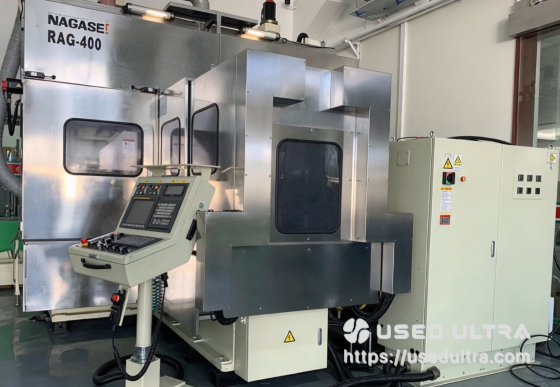
| Form / precision | CNC machine for profiles, slots and index work | Nagase RAG-400, NAGASE SGC-104 |
Once the type is settled, four numbers decide the rest. Buyers who compare brands instead of numbers are the ones who end up with the wrong machine. An Okamoto and a Nagase of the same table size do the same work. A 1,025 × 485 mm machine and a 4,050 × 1,550 mm machine do not, whatever is written on the column.
The four numbers, and the range they cover across the surface grinding machines currently listed:
| The number | What it limits | Range across published listings |
|---|---|---|
| Worktable / chuck size | Largest part you can mount | 1,025 × 485 mm to 8,000 × 2,500 mm (rectangular tables; rotary chucks from Ø500 mm) |
| Table load capacity | Heaviest part you can mount | 150 kg to 10,800 kg |
| Wheel surface speed | Which materials and removal rates are available | 23.9 m/s to 43.8 m/s |
| Spindle motor power | Depth of cut per pass | 7.5 kW to 22 kW |
There is a fifth number worth asking about: the minimum setting unit, the smallest increment the downfeed can command. It is rarely published as a machine-specific figure, so ask for it in writing rather than assuming it from the machine class.
The same arithmetic governs the other grinding classes. On a centerless grinding machine the regulating wheel and the plunge length replace the table and the chuck, but nothing else changes.
How Large a Worktable Do You Need?
Table and Chuck Sizes Across the Listings: 1,025 × 485 mm to 8,000 × 2,500 mm
| Machine | Machine class | Worktable / chuck | Max table load | Reference price |
|---|---|---|---|---|
| Okamoto PRG6DX | Rotary surface | Ø600 mm magnetic chuck | 150 kg | $70,000 |
| Nagase RG500 | Mirror surface, rotary | Ø500 mm electromagnetic chuck | — | $120,000 |
| Nagase RAG-400 | Precision form (CNC) | 1,025 × 485 mm | 350 kg incl. jig | $300,000 |
| Okamoto MOLD-4015NC | Gantry surface | 4,050 × 1,550 mm; chuck 4,000 × 1,500 × 110 mm | 10,800 kg | $630,000 |
| Sumitomo double column | Double column / gantry | 2,500 × 8,000 mm | — | — |
| DANOBAT SGC256 | Guideway / gantry | 8,000 × 2,500 mm | 32 t | $254,706 |
Read the model name against the numbers before you look at the price. The 1,025 × 485 mm precision form machine and the 8,000 × 2,500 mm guideway machine are both sold as surface grinders, and they share almost nothing else.
Machine weight scales by about 10 times, from roughly 3,000 kg on the Okamoto PRG6DX to roughly 30,000 kg on the MOLD-4015NC. Table load rating scales faster: 150 kg against 10,800 kg is a factor of 72.
Frame weight and load rating are different specifications, and the load rating is the one that limits what you can put on the table.
Why the Part Diagonal Sets the Table Size
Size the table against the diagonal of the part, not its length. A part listed as 650 × 500 mm has a diagonal of 820 mm, so it will not fit inside a 650 × 500 mm grinding envelope. It sits diagonally, past the table edge, where the wheel cannot reach the corners.
Two corrections apply on top of that diagonal.
- Wheel overhang. The wheel has to clear the part at both ends of the pass. A table sized exactly to the part diagonal leaves no room for the wheel to run off the work, and the ends of the part come out unground.
- Fixture height. A magnetic chuck uses up vertical capacity. On the Okamoto MOLD-4015NC the standard chuck is 4,000 × 1,500 × 110 mm, so 110 mm of wheel-head travel is gone before the part is even loaded.
Table Travel Is a Separate Number
A machine can publish a worktable size and no separate figure for how far the table actually strokes. The two numbers do different jobs. The table size tells you whether the part fits. The travel tells you whether the wheel can clear it at both ends of the pass.
Ask for the travel figure separately. If the seller quotes only one number, it is usually the table size, and a machine that cannot stroke clear of the part grinds a step at each end of every pass.
Which Magnetic Chuck and Table Load Rating Do You Need?
Chuck Size and Load Capacity: 150 kg to 10,800 kg
Machines are usually sold with a chuck already fitted, and the chuck is usually smaller than the table. Two examples from the current listings:
| Machine | Worktable | Chuck fitted | Max load |
|---|---|---|---|
| Okamoto MOLD-4015NC | 4,050 × 1,550 mm | 4,000 × 1,500 × 110 mm | 10,800 kg |
| Okamoto PRG6DX | Ø600 mm rotary | Ø600 mm magnetic chuck | 150 kg |
Load capacity is the number that fails quietly. A machine can be large enough for a die block and still be rated below its weight.
The MOLD-4015NC is rated 10,800 kg. The Nagase RAG-400 is rated 350 kg including the jig. The Favretto ME/U200 is rated 1,500 kg without the magnetic chuck. Those qualifiers matter, because they move the real limit by hundreds of kilograms.
Rotary Chuck or Rectangular Chuck: Ø600 mm vs 4,000 × 1,500 mm
A rotary chuck is continuous. The table turns under the wheel, so grinding time scales with diameter instead of stroke length. On the Okamoto PRG6DX the table rotates at 20–150 rpm, and the wheel head positions across the chuck face at a front-to-back feed of 200–2,400 mm/min.
That suits round, ring-shaped and circular-symmetry parts. It is the wrong choice for a long rectangular guideway, which needs a reciprocating table and a long stroke.
What Wheel Surface Speed Does Your Material Need?
Wheel Diameter and Spindle Speed: Ø250 mm at 2,000 rpm to Ø760 mm at 1,100 rpm
Wheel diameter and spindle speed are published as a pair, and neither means much on its own.
| Machine | Wheel | Wheel speed | Computed surface speed |
|---|---|---|---|
| Nagase RAG-400 | Ø250–305 × 25 × Ø76.2 mm | max 2,000 rpm | 26.2–31.9 m/s |
| Okamoto MOLD-4015NC | Ø510 × 100 × Ø203.2 mm | 980 r/min | 26.2 m/s |
| Sumitomo double column | Ø760 × 100 × Ø305 mm | 600–1,100 min⁻¹ | 23.9–43.8 m/s |
How to Calculate Peripheral Speed
Surface speed is the speed of the abrasive at the point of contact. It is not a published field on most listings, so work it out:
v (m/min) = π × D (m) × n (rpm), then divide by 60 for m/s.
Take the Nagase RAG-400 at its largest wheel: π × 0.305 × 2,000 = 1,916.4 m/min, or 31.9 m/s.
Take the Sumitomo gantry at its top speed: π × 0.760 × 1,100 = 2,626.4 m/min, or 43.8 m/s.
Run that calculation on every candidate machine before you commit. The result is the lowest wheel rating you are allowed to buy. A machine that has to run at 43.8 m/s cannot be fed a wheel rated for less.
Wheel Speed Limits: 35 m/s Standard, 45 m/s High-Speed
Most vitrified-bonded wheels carry a maximum peripheral speed of 35 m/s. The marking on the wheel blotter is the authority here, not the machine's specification sheet. Above that figure you are into high-speed wheels and reinforced guarding, and for CBN a different order of cost.
Calculate at the top spindle speed, not the nominal one. The Sumitomo shows why. The same Ø760 mm wheel runs at 23.9 m/s at 600 rpm and 43.8 m/s at 1,100 rpm.
A machine whose top speed works out above 35 m/s is not unusable, but it commits you to buying wheels rated for that speed, and to keep buying them. If a calculation lands in the 40 m/s range, put the question to the seller in writing.
At that speed the wheel rating, the guard rating and the spindle's own maximum all have to agree. A published speed range that goes beyond the machine's original guarding will not survive the first inspection.
How Much Spindle Power Do You Need?
Spindle Motor Power: 7.5 kW to 22 kW
| Machine | Spindle motor | Published finish or accuracy claim |
|---|---|---|
| Okamoto PRG6DX | 7.5 kW, 4-pole | Rotary surface, light-to-medium stock removal |
| Nagase RG500 | 11 kW, 4-pole | Mirror finishing, approx. 0.5 μm flatness published |
| Okamoto MOLD-4015NC | 22 kW | Large mould plates and die blocks |
Spindle power does not make a machine accurate. It sets how much material you can take off per pass without burning the wheel or the work. A 7.5 kW spindle will produce a fine finish on a small part. It will not rough out a 4,000 mm mould plate in a working day.
Match power to the stock you have to remove, and treat finish as a separate specification.
Downfeed Resolution and Minimum Setting Unit: 0.0001 mm to 0.01 mm
The minimum setting unit is the smallest commanded increment on the vertical axis. It separates machines that are precise from machines that are controllable, and it is the least consistently published figure in this class. The values below are what the individual listings state, not a property of the machine type.
| Machine | Minimum setting unit, as stated on the listing |
|---|---|
| Okamoto MOLD-4015NC | 0.0001 mm |
| Nagase RG500 | 0.0001 / 0.001 / 0.01 mm (selectable, not a single value) |
The RG500 figure is a three-step selector rather than one number, so quoting it as 0.0001 mm resolution would overstate the machine. A 0.0001 mm resolution on a machine that drifts by microns as it warms up is a specification you pay for and never use.
Ask what the machine holds after a two-hour warm-up, and whether the column is thermally controlled. Where the documentation gives an accuracy figure, such as the approx. 0.5 μm flatness published for the Nagase RG500, treat it as a test condition and not as a guarantee for your part.
Reciprocating or Rotary Table?
The two configurations solve different problems.
| Reciprocating table | Rotary table | |
|---|---|---|
| Example | Okamoto PSG65DX, NAGASE 156 | Okamoto PRG6DX, Nagase RG500 |
| Lengthwise motion | Table traverses under the wheel, 0.3–25 m/min published on the PSG65DX | Table rotates, 20–150 rpm on the PRG6DX |
| Best for | Long, flat, rectangular work such as guideways, plates and ways | Round, ring and circular-symmetry work |
| Setup | Magnetic chuck, part clamped flat | Chuck or fixture, max load 150 kg on the PRG6DX |
| Limitation | Stroke length caps part length | Chuck diameter caps part diameter |
Where both are available, the shape of the work decides, not the volume. A rotary machine removes the stroke entirely: the wheel grinds continuously as the table turns. That is also why rotary machines depend on speed control. Without constant peripheral speed control the cutting speed rises from the centre of the chuck to the rim, and the finish varies across the part.
Neither rotary nor small reciprocating machines will do for long guideway work. Guideway and slideway machines run to 2,500 × 8,000 mm on the Sumitomo double column and 8,000 × 2,500 mm on the DANOBAT SGC256, which carries a 32 t table load.
How Do You Verify a Machine's Specifications Before You Pay?
Paper specifications are the seller's transcription of the machine's documentation. They make a shortlist, not a condition report. Three measurements on site decide whether the numbers hold up.
| What to measure | Instrument | What it tells you |
|---|---|---|
| Spindle radial runout | Dial test indicator on a mounted test bar | Whether the wheel will run true at working speed |
| Table flatness and wheel-head parallelism | Straight edge and indicator, or precision level | Whether the machine can hold a flat part at all |
| Slideway wear and backlash | Indicator against a loaded slide, traversed both ways | Where the accuracy went, and what a rebuild costs |
What a full inspection records for each of the three checks:
- Spindle radial runout, measured at the wheel flange with the spindle at working temperature. It is recorded as a single figure in μm and compared against the machine's documented tolerance where one exists. A cold reading proves nothing.
- Table flatness, measured on a 12-point pattern across the chuck or table surface rather than at three convenient spots. Publish the maximum deviation across the pattern, not the average.
- Slideway condition, read as backlash with the slide traversed both ways under load. A machine with a good spindle and a worn slideway grinds a taper, not a flat.
One caution about published prices. When a listing's price looks out of line with the machine's size class, do not read it as a bargain. Ask for the maintenance and rebuild records, the wheel and spindle service history, and the current geometric test sheet before you treat that figure as a baseline.
Price and condition are separate questions, and only one of them can be checked from a web page. The same applies when you read used Okamoto surface grinder prices. The specification block explains the spread between machines far better than the badge on the column does.
What Does a Wrong Sizing Decision Cost You?
Two worked examples, using the published figures above.
Worked Example: a 300 × 200 mm Mold Plate
Part diagonal: √(300² + 200²) = 360.6 mm. Add wheel clearance at each end of the traverse, roughly one 50 mm wheel width, and you need about 460 mm of table in the traverse direction.
Two machines clear it: the Nagase RAG-400 at 1,025 × 485 mm and the Okamoto MOLD-4015NC at 4,050 × 1,550 mm. A machine with a 300 × 150 mm table would not, because the wheel could not clear the part and the corners would be out of reach.
The failure is usually not a crash. The machine grinds the middle of every part and leaves the corners low, and you find out after the first customer reject.
Worked Example: a 1,200 mm Guideway
A 1,200 mm part needs more than 1,200 mm of table. Allow the wheel to clear at both ends plus spark-out, and the practical requirement is about 1,400 mm of usable travel.
The Sumitomo double column at 2,500 × 8,000 mm and the DANOBAT SGC256 at 8,000 × 2,500 mm both clear it with room to spare. No rotary machine in the list does at any price. A 1,025 mm table cannot be lengthened, and the guideway cannot be shortened.
Frequently Asked Questions
How do I calculate grinding wheel surface speed?
Multiply π by the wheel diameter in metres by the spindle speed in rpm to get metres per minute, then divide by 60 for metres per second. For a Ø305 mm wheel at 2,000 rpm: π × 0.305 × 2,000 = 1,916.4 m/min, or 31.9 m/s. Always calculate at the machine's top spindle speed rather than its nominal one.
Does a bigger worktable mean a more accurate machine?
No. Table size governs the part envelope. Accuracy comes from the spindle, the slideway condition and thermal control. The Okamoto MOLD-4015NC publishes a 0.0001 mm minimum setting unit on a 4,050 × 1,550 mm table. The Nagase RG500 publishes the same 0.0001 mm resolution on a Ø500 mm chuck. Size and precision are separate specifications, and you pay for each of them.
Can I grind a part larger than the magnetic chuck?
Only where the part can be supported outside the magnetic field and still held safely. Parts that overhang the chuck need a fixture, and fixture height comes out of the vertical travel.
On the Okamoto MOLD-4015NC the standard chuck is 110 mm thick, so 110 mm of wheel-head travel is used up before a part is loaded. Where a part overhangs, ask for the effective grinding diameter, which is smaller than the chuck's nominal diameter.
What table load capacity do I need for a heavy die block?
Weigh the part, add the fixture, then read the qualifier on the listing. Capacities across the listings run from 150 kg to 10,800 kg, and the qualifiers matter. The Nagase RAG-400 is rated 350 kg including the jig. The Favretto ME/U200 is rated 1,500 kg without the magnetic chuck. Compare your loaded weight against the qualified figure, never the headline one.
Is a rotary table surface grinder better for production?
For round and circular-symmetry parts, yes. Continuous rotation removes the stroke. The Okamoto PRG6DX turns its table at 20–150 rpm, and its Ø600 mm chuck is rated to 150 kg. For long rectangular work it is the wrong machine. You need a reciprocating table with enough stroke, and above roughly 1,500 mm of part length you need a purpose-built guideway or slideway machine.
Specifications quoted here were transcribed from the seller documentation published on each individual machine listing, and prices are shown as reference prices. As the listings state, used machine prices fluctuate with the market and are not a real-time quote. Availability and machine condition change without notice. Every figure in this guide is a shortlist criterion, not a condition report. Verify against the specific machine's detail page and a physical inspection before committing.