

Reviewed by UsedUltra's senior equipment inspection engineering team. Lead reviewer: Chris (12 years in pre-owned industrial equipment assessment, 1,500+ CNC machines inspected, specializing in Japanese precision machining centers and grinding machines).
The Decision Problem
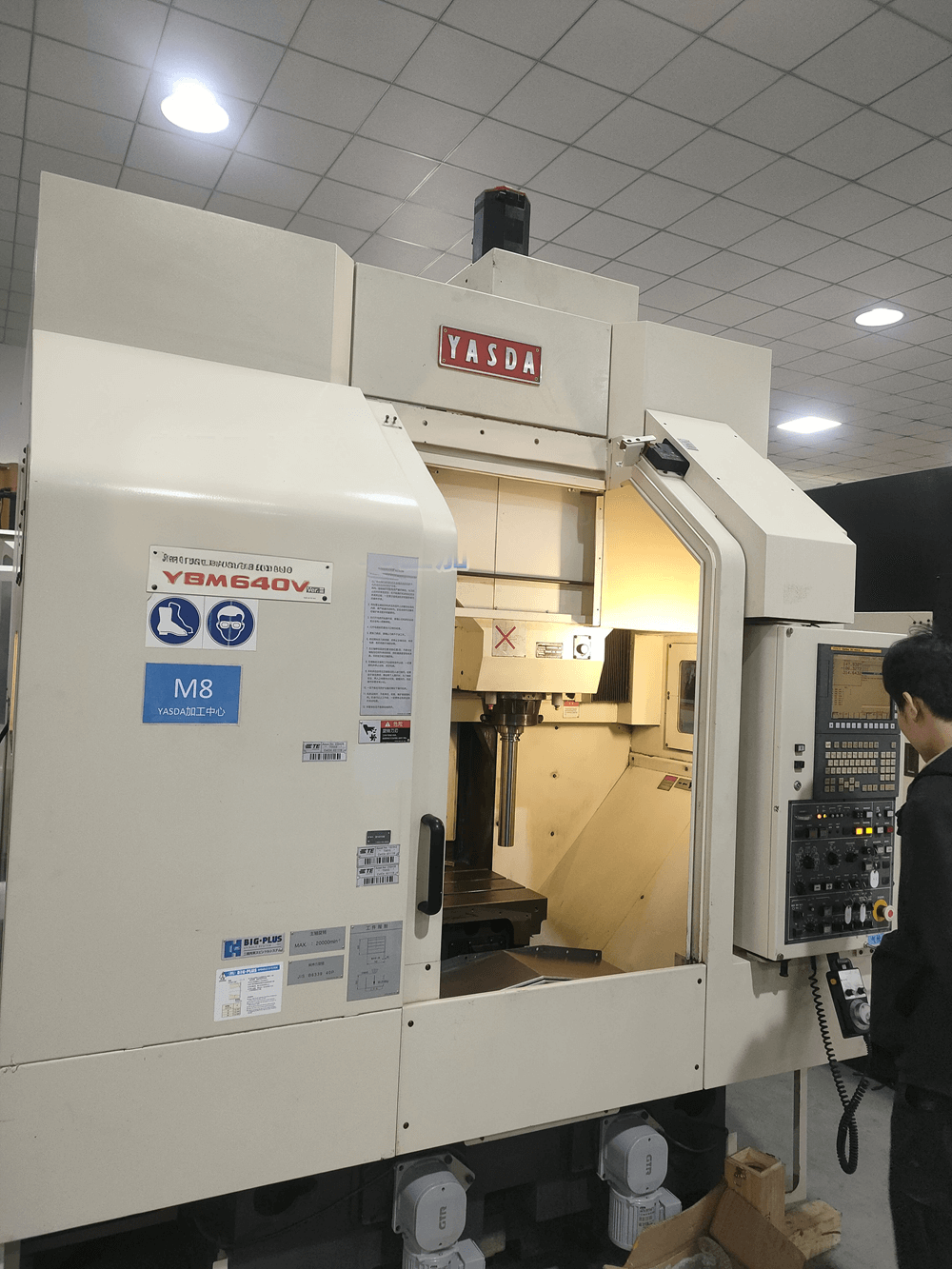
If you're shopping for a used high-precision Japanese machining center, you've likely narrowed your list to two candidates: the Yasda YBM-640V and the Makino V33i. Both come from Japan's top-tier machine tool builders. Both command premiums over general-purpose VMCs. Both hold their value on the used market.
But they are not interchangeable.
The most expensive mistake buyers make is treating them as direct competitors. A mold shop that bought a Yasda for high-speed production milling overpaid for precision it never used. A precision jig shop that bought a Makino for ±0.002mm boring work couldn't hold tolerance and lost contracts.
The distinction is not about which machine is "better." It is about which machine fits your specific combination of accuracy requirement, cutting profile, and ownership capability.
Side-by-Side Spec Comparison
Yasda YBM-640V vs Makino V33i — Core Specifications
| Dimension | Yasda YBM-640V | Makino V33i |
|---|---|---|
| Machine Class | Vertical Jig Borer / Ultra-Precision Machining Center | Vertical High-Speed / High-Precision Mold Machining Center |
| Table Size | 700 × 450 mm | 750 × 450 mm |
| Travels X/Y/Z | 600 × 400 × 350 mm | 650 × 450 × 350 mm |
| Spindle Speed | 24,000 rpm (std); 30,000 rpm (opt) | 20,000 rpm (std); 30k-40k (opt) |
| Spindle Taper | BBT40 (high rigidity); opt HSK-A63 | CAT40; opt HSK-A63 |
| Positioning Accuracy (ISO 230-2) | X/Y: 1.5μm, Z: 2.3μm | Industry estimated ±0.003-0.005mm (not officially published) |
| Repeatability | ±0.001mm (optical scale feedback) | Industry estimated ±0.002mm |
| Rapid Traverse | 20,000 mm/min | 20,000 mm/min |
| ATC Capacity | 30 tools (opt 40/60/90) | 25 tools (opt 40/60) |
| Max Tool Diameter | 100 mm | 80 mm |
| Max Workpiece Load | 300 kg | 300 kg |
| Machine Weight | 8,000 kg | ~6,500-7,000 kg (industry estimate, not published) |
| Control System | Fanuc 31i-B5 + Yasda OpeNe V2 | Makino Professional 6 (SGI.5 servo control) |
| Guideway Type | Hand-scraped box guideways (traditional hybrid) | Linear guide rails — core-cooled ball screws |
| Thermal Management | Yasda Thermal Distortion Stabilizing System | Core-cooled ball screws, temp-controlled saddle |
| Typical Used Year | 2010-2018 | 2012-2020 |
| Used Price Range | $80,000-180,000 | $50,000-120,000 |
| Replacement Value (New, est.) | ~$280,000-400,000 | ~$200,000-300,000 |
| Typical Industries | Precision molds, medical devices, aerospace jigs | Die & mold, automotive, aerospace structures |
Note: New replacement prices are industry estimates, not manufacturer list prices. Makino V33i weight is an industry estimate as no official figure has been published.
What the Specs Tell You
The most striking difference is positioning accuracy: Yasda's ISO 230-2 published spec of 1.5μm (0.0015mm) X/Y is in a different category from Makino's estimated 3-5μm. But that doesn't automatically make the Yasda the right choice — it depends entirely on your application.
The second big difference is machine weight: the Yasda is 15-25% heavier (8,000 kg vs ~6,500-7,000 kg). This extra mass comes from the Mehanite cast iron construction and hand-scraped box guideways, providing superior vibration damping — critical for sub-micron finishing but unnecessary for general production milling.
The third difference is control philosophy: the Yasda uses a standard Fanuc 31i-B5 with Yasda's OpeNe V2 interface, while the Makino uses its proprietary Professional 6 with SGI.5 (Super Geometric Intelligence) servo control — purpose-built for high-speed mold machining cycles that would require extensive CAM programming on a generic Fanuc.
Technical Deep Dive: Three Key Decision Dimensions
Dimension 1: Accuracy — Do You Need Sub-Micron Positioning?
Yasda's approach: The YBM-640V is a jig borer at its core. Jig borers are the highest-precision class of machine tools, designed not for material removal rate but for absolute positional trustworthiness. The ±1.5μm spec comes from:
- Hand-scraped box guideways: Yasda's traditional hybrid box guideways are hand-scraped at 25-30 contact points per square inch. This is the most labor-intensive guideway manufacturing method in existence — and the most durable. A hand-scraped guideway can be re-scraped to restore original accuracy. Linear guide rails cannot.
- Optical scale feedback: The YBM-640V uses optical scales on all axes for positional feedback, eliminating the errors introduced by ball screw pitch deviation and thermal expansion.
- Thermal Distortion Stabilizing System: Yasda's proprietary thermal management system compensates for heat-induced deviation. Measured data: spindle centerline shift <0.003mm after 4 hours continuous running.
Makino's approach: The V33i is optimized for production accuracy — the precision you can maintain while cutting metal at high speeds. Key technologies:
- Core-cooled ball screws: Coolant circulates through the center of all three ball screws, removing heat at the source. Temperature-controlled bearing supports and motor mounting areas prevent thermal drift during long cutting cycles.
- SGI.5 servo control: Super Geometric Intelligence servo control provides smooth corner contouring at high feed rates. In practical terms, this means better surface finish on complex 3D mold surfaces without reducing cutting speed.
- Linear guide rails: The V33i uses linear guides on all axes. They are faster, lower friction, and require less maintenance than box ways — but they cannot match the long-term accuracy retention of hand-scraped box ways.
Decision rule:
| Your accuracy requirement | Correct choice |
|---|---|
| Consistently need ±0.002mm or better positioning | Yasda YBM-640V |
| Need ±0.003-0.005mm, but production throughput matters more | Makino V33i |
| Working with tolerances ±0.01mm or looser | Neither — consider a general-purpose VMC to save 40-60% |
| Need long-term accuracy retention (>10 years) | Yasda YBM-640V — re-scrapable guideways |
Dimension 2: Cutting Profile — What Are You Machining and How?
Yasda's strength: Absolute precision for finishing operations — jig boring, precision hole positioning, fine finishing. The YBM-640V excels when the primary requirement is where the tool goes, not how fast it gets there.
Makino's strength: High-speed machining of hardened steels — direct mold machining (HSM), trochoidal milling, high-speed finishing. The V33i excels when the primary requirement is material removal rate combined with acceptable precision.
| Application scenario | Better fit | Why |
|---|---|---|
| Precision mold cavity finishing (hardened steel, Ra0.4 required) | Makino V33i | SGI.5 + high-speed spindle deliver better surface finish at higher feed rates |
| Jig boring / precision hole positioning (±0.002mm true position) | Yasda YBM-640V | Jig borer DNA + optical scale feedback |
| General production milling (aluminum, steel, 3-axis work) | Makino V33i | Better suited to production cycle times |
| Electrode machining (graphite/copper) | Both acceptable | Makino has dedicated graphite version (V33i Graphite) |
| Hard milling (HRC 50+ direct machining) | Makino V33i | Higher spindle speed options, mold-specific control cycles |
| Precision boring + tapping | Yasda YBM-640V | Superior positional stability over long cycles |
Dimension 3: Total Cost of Ownership
| Cost Category | Yasda YBM-640V | Makino V33i | Notes |
|---|---|---|---|
| Purchase price (used) | $80,000-180,000 | $50,000-120,000 | Yasda carries 50-80% premium |
| Annual preventive maintenance | $3,000-8,000 | $4,000-6,000 | Yasda guideway inspection needs specialized knowledge |
| Spindle repair (if needed) | $8,000-15,000 | $5,000-10,000 | Makino spindle repair is more common = lower cost |
| Control system parts | Fanuc — widely available | Makino-specific — less common in general market | Fanuc availability advantage for Yasda |
| Guideway reconditioning (lifecycle) | $8,000-15,000 (once per 10-15yr, re-scraping) | $3,000-6,000 (linear rail replacement as needed) | Cost trade-off: scrapable vs replaceable |
| Resale liquidity | Good but slower — specialist buyer pool | Very good — higher market volume | Makino easier to resell |
| Depreciation per 1,000h | ~2-3% | ~3-5% | Yasda holds value better |
Key TCO insight: The Yasda's higher purchase price is partially offset by slower depreciation and the long-term re-scrapability of its guideways. However, the Makino's lower upfront cost and higher market liquidity make it the lower-risk choice for first-time buyers.
Inspection Differences: What to Check on Each
While the five-factor scoring system applies to both machines, the inspection priorities differ:
Yasda YBM-640V Inspection Priorities
- Hand-scraped guideway condition (highest priority): Check remaining scraping marks on all three axes. If the original scrape pattern is completely worn away, re-scraping is needed ($8,000-15,000).
- Spindle accuracy: Dial indicator on test bar — radial runout should be <0.003mm. The spindle is the most expensive single repair item.
- Optical scale function: Check for "position error" alarms on startup. If the scales are faulty, accuracy is compromised.
- Thermal stabilization check: Run at operating speed for 30 minutes; temperature rise over 20°C is a concern for a precision-class machine.
- Coolant system condition: Despite the precision class, verify no coolant leaks and proper chip evacuation.
Makino V33i Inspection Priorities
- Spindle taper condition (highest priority): Check the pull-stud bore for wear. Pull-stud bore wear is the most common issue on high-speed Makino spindles — repair $3,000-8,000.
- Tool changer repeatability: Run 5-10 tool change cycles. Listen for abnormal noise and check for position inconsistency.
- Ball screw condition: Check backlash on all axes. The V33i's high-speed profile accelerates ball screw wear faster than on Yasda machines.
- SGI.5 control verification: Power on and check alarm history. Verify software version and request control backup.
- Core cooling system: Check coolant level and flow for the core-cooled ball screw system.
Industry Application Cases
Case 1: Mold Shop Chooses Makino V33i Over Yasda
| Item | Details |
|---|---|
| Background | Mid-size mold shop in East China, producing injection molds and die-cast dies, ~$3M annual revenue |
| Technical constraint | 80% of molds require only ±0.01mm tolerance (Makino easily covers). Only 20% require <±0.005mm |
| Options | Yasda YBM-640V (2014, 1,200h, $145,000) vs Makino V33i (2015, 6,800h, $85,000) |
| Decision | Chose Makino V33i — saved $60,000. Shop had no precision jig boring requirements that justified the Yasda premium |
| 12-Month results | Hand polishing reduced 35% (50h→32h per mold). Monthly throughput up 22%. Payback: 14 months |
Principle validated: Don't pay for precision you won't use. The Makino's ±0.003mm capability covered 100% of their mold work. The Yasda's ±0.0015mm would have been redundant precision.
Case 2: Precision Jig Shop Chooses Yasda YBM-640V
| Item | Details |
|---|---|
| Background | Precision jig and fixture manufacturer in Shanghai, serving aerospace and medical device customers |
| Technical constraint | Required consistent ±0.002mm true position on jig boring operations. Existing VMCs produced a 15% scrap rate on precision work |
| Options | Considered both Makino V33i ($95,000, 2016, 4,500h) and Yasda YBM-640V ($135,000, 2013, 2,800h) |
| Decision | Chose Yasda YBM-640V — the $40,000 premium was justified by the application's sub-3μm positioning requirement |
| 18-Month results | Scrap rate dropped from 15% to 1.2%. New contracts secured based on Yasda's certified accuracy. Additional annual revenue from precision work: ~$65,000/year |
Principle validated: When your product requires a specific accuracy, buy the machine that guarantees it. The Yasda's $40,000 premium paid for itself within 8 months through scrap reduction alone.
FAQ Section
Q: Is the Yasda YBM-640V really 2x better than the Makino V33i just because it costs 2x more?
A: No. The 50-80% price premium reflects the Yasda's fundamentally different manufacturing approach, not a proportional performance advantage for all applications.
- What the premium buys: Hand-scraped box guideways reconditionable over decades, jig-borer-level positioning accuracy (1.5μm vs 3-5μm), and excellent resale value retention. These matter for precision jig boring, ultra-precision mold work, and long-term asset value.
- What the premium does NOT buy: Higher cutting speed, better surface finish, faster cycle times, or easier operation. In production milling, the Makino V33i is often the faster machine.
- Verdict: If your parts require ≤3μm positioning, the Yasda is worth every dollar. If your parts need ≤5μm positioning at higher throughput, the Makino is the better value. If your parts only need ±0.01mm, consider a general-purpose VMC — neither machine is the right choice.
Q: Which machine has lower operating costs?
A: The answer depends on which cost category you prioritize:
- Daily consumables (coolant, tools, filters): Comparable between both machines.
- Preventive maintenance: Makino is slightly less expensive. The Yasda's guideway inspection requires specialized knowledge.
- Major repairs (spindle, ball screws): Makino parts are more readily available and generally less expensive due to higher market volume.
- Long-term accuracy restoration: The Yasda has an advantage — hand-scraped guideways can be re-scraped ($8,000-15,000 once per 10-15 years). The Makino's linear guides must be replaced ($3,000-6,000 every 5-8 years under heavy use).
- Control system service: The Yasda's Fanuc 31i-B5 is a widely used standard — any electrician can service it. The Makino's Professional 6 is proprietary; repairs may require Makino-authorized technicians.
Overall: The Makino V33i has lower annual operating costs. The Yasda potentially has lower lifecycle costs if kept long enough to benefit from guideway re-scraping.
Q: Can the Makino V33i match Yasda's accuracy with the right programming?
A: No — the accuracy gap is a matter of machine design, not programming:
- Guideway architecture: The Yasda's hand-scraped box ways have inherently higher stiffness and damping than linear guide rails. This affects positioning stability under variable load conditions.
- Feedback system: The Yasda uses optical scale feedback on all axes. The Makino uses rotary encoder + ball screw feedback (standard on most VMCs). Optical scales measure actual table position directly, eliminating ball screw pitch errors.
- Thermal behavior: While the Makino has excellent thermal management (core-cooled ball screws), the Yasda's Thermal Distortion Stabilizing System plus symmetrical bridge structure provides measurably lower thermal drift over long cycles.
Bottom line: In a short run (30 minutes), both machines can achieve high precision. Over an 8-hour production shift with temperature changes, the Yasda will maintain ±0.002mm while the Makino will drift beyond it.
Q: Which machine is easier to resell?
A: The Makino V33i has significantly better resale liquidity:
- Market volume: Makino V33i used listings outnumber Yasda YBM-640V listings by roughly 3:1 on major platforms. More listings = more buyer awareness = faster sale.
- Buyer familiarity: Makino is a well-known brand in mold shops worldwide. Yasda is well-known to precision specialists but unfamiliar to general buyers.
- Price range: The V33i's $50,000-120,000 range attracts a larger buyer pool than the YBM-640V's $80,000-180,000 range.
- Geographic demand: Yasda demand is concentrated in China, Japan, and select precision markets. Makino demand is global.
If you anticipate selling within 5 years, the Makino is the lower-risk choice. If you plan to keep it 10+ years, the Yasda's slower depreciation makes the resale difference less relevant.
Q: What should a first-time buyer look for when inspecting each machine?
A: For a first-time buyer without access to full inspection equipment, focus on these accessible checks:
For Yasda YBM-640V:
- Nameplate check: Verify brand, model, and year match the listing. Look for JP origin marking.
- Startup test: Power on and check alarm history. Pay attention to any "absolute position error" alarms (scale feedback issues).
- Spindle sound: Run from 1,000 to 24,000 rpm with the door open. Listen for bearing noise at high speed.
- Inspection report: Ask for a third-party report with spindle runout data and positioning accuracy test results.
- Documentation: Request original import documents and any previous calibration certs.
For Makino V33i:
- Spindle taper check: Wipe the spindle taper with a clean white cloth. Check for discoloration or metal debris (signs of pull-stud wear).
- Tool change test: Manually run 5-10 tool changes. Listen for unusual noise and check cycle time consistency.
- Coolant condition: Check for degraded coolant — a strong indicator of overall maintenance culture.
- SGI firmware version: Note the Professional 6 software version. Verify it supports your required machining cycles.
- Operating hours: Cross-reference the control's power-on hours with the listing. Well-maintained V33i machines typically have <15,000h.