

This article is reviewed by the UsedUltra Senior Equipment Inspection Team. Lead Inspection Engineer Chris (12 years in used industrial equipment appraisal, 1,500+ CNC machine tools inspected) is accountable for every technical determination below. Every figure quoted here was read from the live UsedUltra EDM drilling category and the machine page it holds on 2026-10-12 and is reproduced exactly as published. A listing describes a machine. It does not certify one, and condition, wear and tooling are confirmed against the nameplate and the machine meters rather than against the page.
Core answer: A small-hole EDM machine, also sold as an EDM drilling machine or a hole popper, cuts the start holes a wire EDM needs and the small holes a twist drill handles badly. It removes metal with a fine solid electrode on a dedicated spindle instead of with a cutting edge, so hardened steel is no obstacle and the hole size follows the electrode. The electrode range published on the machine here is 0.08 mm to 0.25 mm, alongside travels of 120 × 150 × 300 mm, a 200 × 250 mm worktable, a 50 kg workpiece limit and an AEC automatic electrode changer. Depth is set by how well the debris is flushed, not by electrode length, so ask for the depth the seller ran and the state of the pump.
Which Jobs Belong on a Small-Hole EDM Machine?
Small-hole EDM (electrical discharge machining) sits between the wire and the drill. It covers work that a rotating cutting tool either cannot reach or cannot hold, and on hardened steel it is often the only practical option.
The type has its own category, used EDM drilling machine, which sits inside the wider electrical discharge machines listing.
Start Holes for Wire EDM: 0.08 mm to 0.25 mm Electrodes
A wire machine cannot begin a cut in solid metal. Every closed internal profile, whether it is a punch outline, a die insert or a mold core, starts from a hole drilled through the workpiece. On soft steel a twist drill can make that hole. On hardened steel the wire cut cannot be run until the hole exists, and the hole cannot be drilled, so the hole is made by EDM.
The start hole also has to be big enough for the wire to pass and for the wire to be threaded through it. Electrode diameter and wire diameter are therefore read together.
The electrode range published on the machine here is 0.08 mm to 0.25 mm, and the wire machines in the same category publish wire diameters from 0.03 mm to 0.3 mm, so the top of the electrode range sits at the fine end of the wire range and the match has to be checked rather than assumed.
Small Holes in Hardened Steel: Where a Twist Drill Loses
A twist drill needs to be harder than the work and needs somewhere for the chips to go. Hardened tool steel removes both advantages at once, and a deep small hole gives the drill nowhere to clear.
EDM removes metal by spark, so workpiece hardness does not set the limit and no chips are pushed against the wall of the hole. That is why hardened inserts, punches, dies and molds are drilled this way after heat treatment rather than before it.
Vent, Cooling and Injector Holes: Under a Tenth of a Millimeter
The published electrode range starts at 0.08 mm, which is below the diameter most shops will attempt with a twist drill. Vent holes in a mold, cooling passages, fuel-injector orifices and similar fine work sit in that range, and the automatic electrode changer published on this machine is what keeps a production run of small holes going without an operator standing over it.
Removing a broken tap belongs in the same group. A tap that snaps inside a finished part is a hole to be burned out around a core that no drill can grip.
Where Does a Wire EDM Start Hole Go, and How Big?
Position matters more than the hole itself, because the start hole is a means to a wire cut and not a finished feature. Two rules decide where it lands.
The first is that the hole has to sit inside the profile the wire will cut, so the slug can be separated and removed once the cut closes. A start hole outside the profile leaves the wire with nothing to release. On a profile with no natural entry from the edge of the plate, the start hole is the only entry there is.
The second is clearance from the finished surface. The wire leaves the start hole and travels to the profile, and the path it takes is not the finished edge.
Place the hole far enough from the cut line that the approach and the burn-in at the hole do not touch the face you are keeping, and close enough that the wire does not have to travel across the part to reach the profile. In a mold insert or a punch, that usually means the hole is placed in material that is going to be removed anyway.
Hole size follows from the same logic. The hole has to pass the wire and allow it to be threaded, and automatic threading is less forgiving of a tight hole than an operator feeding wire by hand. Where a shop runs an automatic wire changer, the start hole diameter and the wire diameter are chosen together, and both are worth confirming against the wire machine's published requirements before the hole is drilled.
The practical consequence is that a start hole is drilled conventionally while the steel is soft and burned by EDM once the part is hardened, and its position is fixed by the wire cut drawing rather than by the drilling machine. Where a shop drills before heat treatment to save a step, the hole is left with enough clearance that the movement caused by hardening cannot push it outside the profile. Ask for the drawing convention the previous owner used.
How Does a Small-Hole EDM Machine Remove Metal?
Two machines are sold under this name, and the electrode system is the specification field that tells you which one you are looking at.
Shanked Electrodes From 0.08 mm to 0.25 mm, Not Tubes
A high-speed hole popper feeds a hollow brass or copper-tungsten tube, spins it, and pumps dielectric down the middle of the tube so the debris leaves the hole through the electrode itself. Tube electrodes are made in larger diameters, and a hole popper is bought for speed on start holes that a wire can thread without difficulty.
The machine published in this category is the other kind. Sodick describes its electrode system as high-rigidity shanked electrodes from 0.08 mm to 0.25 mm, which means a solid electrode held on a rigid shank and changed by the automatic changer, not a tube with dielectric through it. Sodick states that the rigid shanked electrode is what keeps eccentricity to a minimum, and it is what makes the fine end of that range possible.
Both are hole drilling EDM machines and both make start holes. They differ in the electrode, in the diameters they cover, and in the flushing the electrode allows.
Hole Depth: Set by the Retract Cycle, Not by Electrode Length
A small hole fills with eroded particles faster than a large one, and the deeper it goes, the longer the path those particles travel to get out. Once the gap between electrode and workpiece fills, the electrode stops sparking against the wall and starts shorting against it.
Machines clear the gap with a retract cycle: the electrode lifts, dielectric flushes the hole, and the cut resumes. Depth on a machine like this is therefore set by the flushing strategy and the dielectric supply rather than by electrode length.
This is why two specification fields matter more than the electrode range on deep work. The first is the dielectric supply, and pump pressure, filtration and fluid condition are the questions to ask. The second is how the control manages the retract cycle against electrode wear, because a worn electrode produces a tapered hole rather than a straight one.
Workpiece Hardness: Conductivity Sets the Limit, Not Hardness
Nothing touches the workpiece, so there is no cutting force and no requirement that the tool be harder than the work. Conductivity is the requirement instead, and the whole workpiece has to be conductive for the circuit to close.
Two practical consequences follow. A small-hole EDM will burn through a hardened die insert and a soft aluminum part with the same electrode, and the choice of material is a matter of conductivity and thermal behavior rather than of tool life of the drill.
Which Specifications Decide Whether It Fits Your Work?
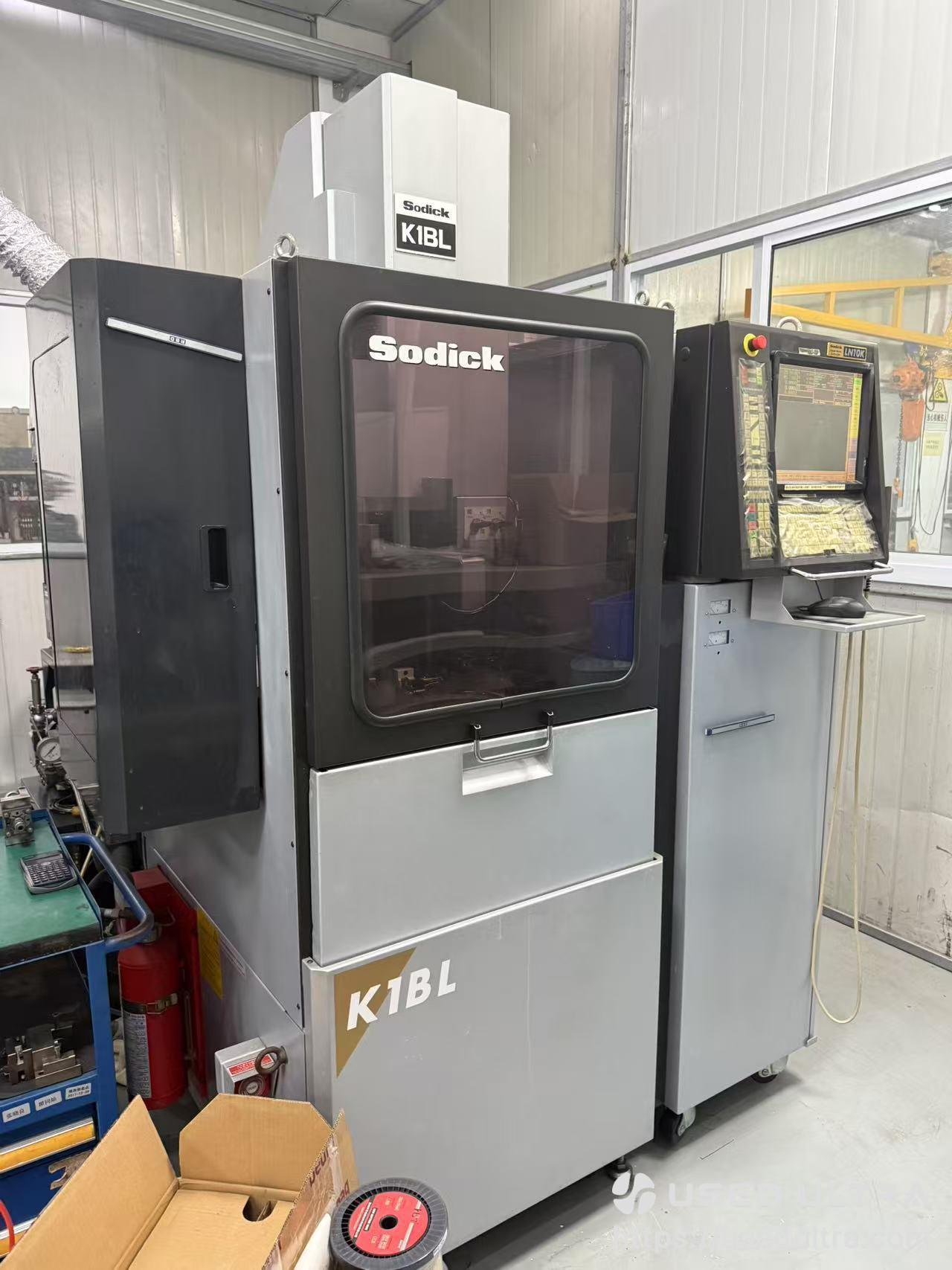
The machine published in this category is a Sodick K1BL on a Sodick LN10K linear servo controller. Its specification table sets out the fields a buyer should read in this order.
| Field | Published value |
|---|---|
| Machine | Sodick K1BL |
| Controller | Sodick LN10K linear servo controller |
| Axis travel X × Y × Z | 120 × 150 × 300 mm |
| Worktable | 200 × 250 mm |
| Maximum workpiece weight | 50 kg |
| Electrode range | 0.08 mm to 0.25 mm, shanked |
| Electrode system | AEC automatic electrode changer |
| Spindle drive | Linear motor |
| Machine dimensions | 1,600 × 1,530 × 2,305 mm, 2.45 m² of floor |
| Listing summary figure | Operating Time 5,039 h |
Sodick holds the rest of the Sodick EDM machines published alongside it.
Axis Travel: 120 × 150 × 300 mm
Z is the long axis at 300 mm, against 120 mm in X and 150 mm in Y. Sodick builds the spindle as the Z axis on a linear motor, so the 300 mm stroke carries the electrode, the workpiece and the fixture together.
Read the Z figure against the depth you need, and read X and Y against the size of the part and the fixture, not against the hole. A 120 × 150 mm table envelope is a real constraint on a large mold plate, and it is the field that rules this class of machine out most often.
Worktable and Workpiece Limit: 200 × 250 mm and 50 kg
The worktable published here is 200 × 250 mm and the workpiece limit is 50 kg. Both are small, and both follow from the same logic as the travels.
The workpiece limit is the one to check against your heaviest plate rather than your heaviest job, because a mold plate that is being drilled for water lines is a heavy block with small holes in it.
Electrode Range: 0.08 mm to 0.25 mm
The electrode range is the field that decides what the machine is for, and the wording of the field matters here: these are shanked electrodes, the solid type, not the tubes a high-speed hole popper feeds. The bottom of the range sets the smallest hole the machine can start with the tolerance that hole needs, and the top sets the largest.
Note what the field does not say. The finished hole is larger than the electrode by the spark gap, and the difference varies with the material, the generator settings and the wear on the day. Where the hole tolerance is tight, ask what electrode diameter and what gap the seller used to hold it, rather than reading the range as a hole range.
Envelope and Installation: 1,600 × 1,530 × 2,305 mm
The machine publishes dimensions of 1,600 × 1,530 × 2,305 mm, which is 2.45 m² of floor. The height is the number to notice, because it is taller than the door of a standard 20-foot container.
Confirm the container door height, the lift and the workshop doorway against 2,305 mm before the machine ships, and leave access space at the front for the electrode changer and the dielectric circuit.
FAQ
What is a small-hole EDM machine, and what else is it called?
Small-hole EDM, EDM drilling, hole popping and a hole popper are names used for two related machine types. A high-speed hole popper drills start holes with hollow tube electrodes in larger diameters; a micro-hole machine such as the one published here uses fine solid shanked electrodes from 0.08 mm to 0.25 mm. Both make the start holes that wire EDM cuts begin from, and the electrode system is the field that tells you which type you are looking at.
Can a small-hole EDM drill through hardened steel?
Yes. It removes metal with controlled sparks rather than with a cutting edge, so workpiece hardness does not set the limit and the hole is drilled after heat treatment rather than before. The workpiece still has to conduct electricity, and the material's thermal behavior still affects the cut.
How deep can a small-hole EDM go?
There is no fixed depth limit, because the constraint is debris removal rather than electrode length. As a hole deepens, the flushing path lengthens and the cut slows, and the machine's feed control has to compensate for electrode wear. Ask the seller for the deepest hole they ran, the electrode diameter used, and the dielectric pump pressure, rather than accepting a single depth figure.
Does a wire EDM need a separate hole-drilling machine?
For closed internal profiles, yes. A wire cannot start in solid metal, so the workpiece needs a start hole before the wire cut can run, or an edge the wire can enter from. Shops that cut closed profiles keep a hole-drilling machine beside the wire machine, or send the start-hole work out.
What electrode sizes does a small-hole EDM use?
The machine published here covers approximately 0.08 mm to 0.25 mm. The finished hole runs larger than the electrode by the spark gap, so match the electrode to the wire you intend to thread through the hole and to the hole tolerance you have to hold, and confirm both with the seller in writing.
Specifications and machine data shown on UsedUltra listing pages are indicative and are subject to inspection. Condition, tooling, wear and remaining service life are established by inspection, not by a listing. Confirm specifications, meters and nameplate data in writing before you commit to a purchase. Hour figures are not directly comparable between listings, so request both the power-on and the cut-time readings for each machine. This article is a technical reference and is not legal, tax or customs advice; for rules of origin and applicable duty, consult a licensed customs broker.