

Reviewed by UsedUltra's senior equipment inspection engineering team. Lead reviewer: Chris (12 years in pre-owned industrial equipment assessment, 1,500+ CNC machines inspected including 200+ CNC machines across Okamoto, Studer, Jung, Chevalier, and other brands). Data source: Specifications are taken from the actual units currently listed for sale on usedultra.com
Looking for a used Makino CNC? When your budget only reaches an entry-level new machine, a used Makino V56 or used Makino V99 delivers a verified precision foundation instead: both run 20,000 rpm high-speed spindles (V56: motorized spindle + BBT40; V99: HSK-A100), full-axis linear-scale closed-loop feedback, and Makino Professional 5 controls. A new machine at the same price wins on being factory-new, easier-to-learn controls, and in-warranty service support — but most use single-face-contact tooling and semi-closed-loop feedback. Bottom line: choose used Makino for precision-critical batch work and long-term accuracy retention; choose a new machine if you want simplicity and a fast payback.
1. Used Makino or a New Machine? 3 Traps to Know Before You Decide
Trap 1: The same budget buys an entry-level new machine — you can't buy rigidity off a spec sheet. Same-budget new machines are typically 1160-type BT40 VMCs at 12,000–15,000 rpm with no linear-scale feedback. For the same money, the used market offers imported machines with 20,000 rpm high-speed spindles, dual-face-contact tooling, and full-axis linear-scale closed-loop feedback. The difference isn't new-vs-old — it's the foundation of the spindle–tooling–scale precision chain. At high spindle speeds vibration amplifies: entry-level machines hold finish roughness at Ra 1.2–1.6 μm, forcing manual bench finishing that eats $8,000–11,000 of profit per machine per year.
Trap 2: Fear of a bad used import — a checklist-style acceptance lets the risk in. Signing and shipping without a real inspection (a single circle test and one position check) means you never verify the true state of that 20,000 rpm motorized spindle: bearing micro-vibration, whether the linear scales are within calibration, and dual-face-contact wear. Miss these, and summer thermal drift pushes batch dimensions out of tolerance with rework rates of 4–5% — usually erupting three months after delivery.
Trap 3: Compare resale curves, not just spec sheets. Equipment is a heavy asset on the balance sheet. New machines typically retain only 25–35% of value after five years and take 3–6 months to sell; used Makino machines trade quickly — an estimated 50–60% residual value after five years, sold within 1–2 months. Two machines with similar specs can differ by $14,000+ in five-year cash flow — a number few people calculate.
2. Used Makino CNC V56/V99 vs New Machines: Accuracy, Spindle Rigidity & Resale Value Compared
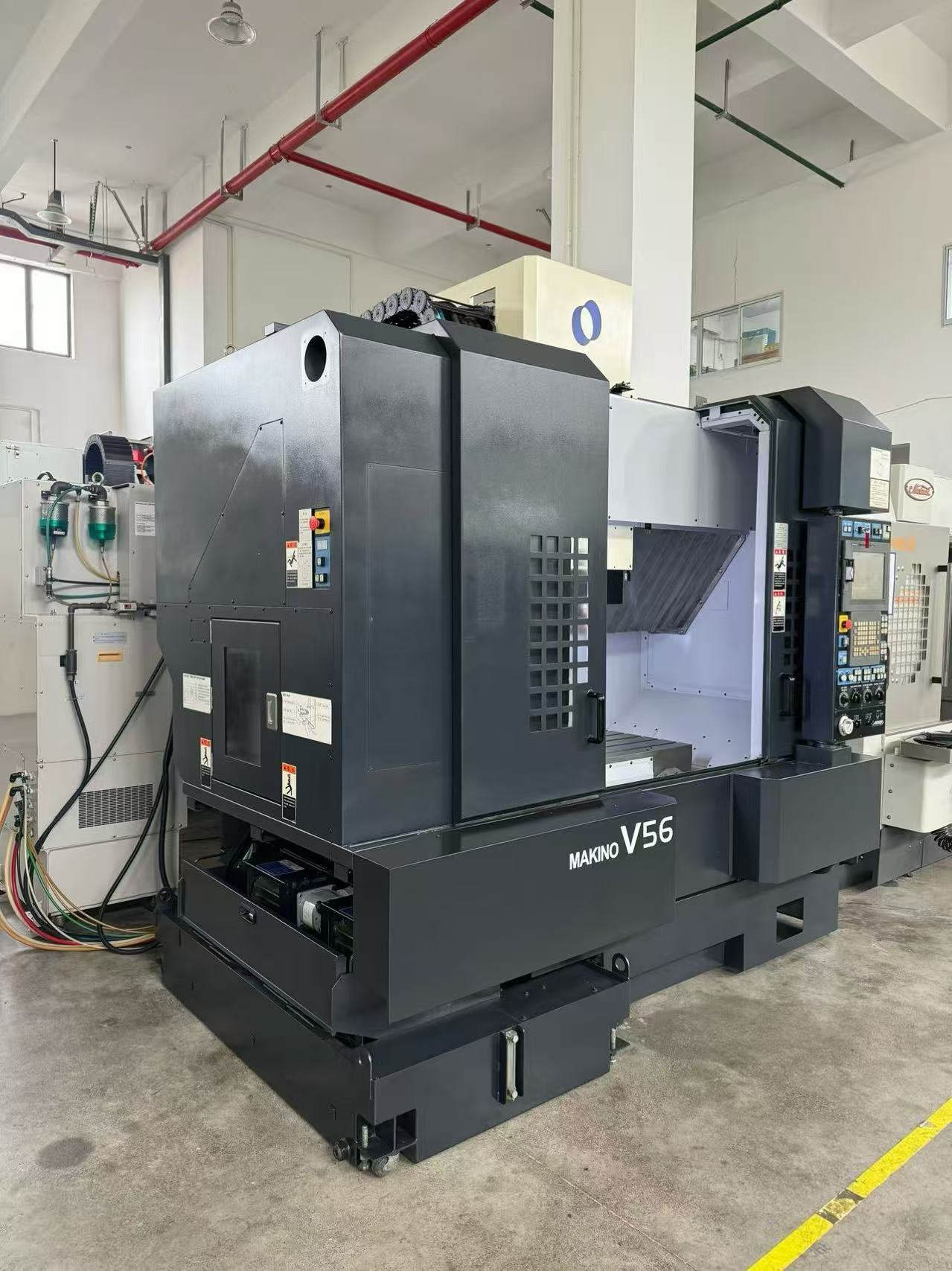
Used Makino CNC V56 (unit on sale)
| Parameter | Used Makino V56 (unit on sale) | New machine, same budget (typical reference) |
|---|---|---|
| CNC control | Makino Professional 5 | FANUC 0i MF / domestic control |
| Max spindle speed | 20,000 rpm (motorized spindle) | 12,000–15,000 rpm |
| Spindle taper | BBT40 (dual-face contact) | BT40 (single-face contact) |
| X/Y/Z travel | 900/550/450 mm | 1,100/600/600 mm (1160 type) |
| Table size | 1,050×500 mm | 1,200×600 mm |
| Max table load | 700 kg | 800–1,000 kg |
| Tool magazine | 15 tools (disc type) | 24 tools |
| Position feedback | Full-axis linear scales (closed loop) | Semi-closed loop (no scales) |
| Guideway design | 2 box guideways + 1 linear guide (gantry type) | All-linear, or 2-linear + 1-box |
| Key accessories | Laser tool setter, Marposs probe, chip conveyor, oil cooler | Basic chip removal |
| Hours on the spindle | 5,982 h | New |
| 5-yr resale value | Estimated 50–60% | Estimated 25–35% |
Used Makino CNC V99 (unit on sale)
| Parameter | Used Makino V99 (unit on sale) | New machine, same budget (typical reference) |
|---|---|---|
| CNC control | Makino Professional 5 | Domestic / European control |
| Max spindle speed | 20,000 rpm | 12,000 rpm |
| Spindle taper | HSK-A100 (dual-face contact) | BT50 (single-face contact) |
| Spindle motor | 22/18.5 kW | 18.5–22 kW |
| X/Y/Z travel | 1,500/1,000/800 mm | 1,500/800/700 mm (1580 type) |
| Table size | 1,800×1,000 mm | 1,700×800 mm |
| Max workpiece | 1,800×1,000×650 mm | — |
| Tool magazine | 30 tools | 24 tools |
| Position feedback | 3-axis linear scales (closed loop) | Semi-closed loop |
| Rapid traverse | 20/20/20 m/min | ~30 m/min |
| Machine weight | ~23 t | ~15–18 t |
| Key accessories | Through-spindle coolant, auto chip conveyor, laser tool setter, oil mist separator | Basic chip removal |
| Hours on the spindle | 1,427 h | New |
| 5-yr resale value | Estimated 50–60% | Estimated 25–35% |
Note: The V56/V99 columns are actual specs of the units listed on usedultra.com; the "new machine" column is a typical reference for machines in that price class — confirm against the manufacturer's datasheet. Positioning accuracy / repeatability are not published on either listing and must be verified on site with a laser interferometer.
2.1 Dual-face-contact spindles are the real rigidity divide: BBT40 vs HSK-A100
Conventional BT40/BT50 toolholders lock in through single-face (taper-only) contact. Under heavy cutting force, micro "nodding" occurs between spindle and toolholder. The V56 uses BBT40 (a "Big Plus" BT40 with both the taper and the flange face engaged), and the V99 uses HSK-A100 (a short-taper dual-face-contact interface) — both dual-face-contact designs with significantly higher radial and axial rigidity than same-size single-face-contact tooling. In practice: you can push heavier depths of cut without chatter, and finishing surfaces stay consistent. This is the physical basis for the Ra 0.4–0.6 μm finishing results used Makinos can hold.
2.2 The 20,000 rpm high-speed spindle: V56's motorized spindle and the V99's "big taper + high speed" combination
The V56 uses a motorized spindle (motor and spindle integrated): no belt losses, no transmission error, fast acceleration/deceleration, low vibration at high speed — ideal for high-speed finishing of aluminum parts and small precision molds. The V99 is rarer — a large HSK-A100 taper given 20,000 rpm, which means the bearing package, lubrication, and balancing are at a level that handles both heavy-torque roughing and high spindle speeds, backed by a ~23-ton structure aimed at medium-to-large mold contouring and large aluminum/steel parts. The common thread: both machines give you speed and rigidity together — something a same-budget new machine (which tends to favor one at the expense of the other) cannot match.
2.3 Full-axis linear-scale closed loop: accuracy is locked in by the loop, not claimed on paper
The V56 has full-axis linear scales and the V99 3-axis linear scales — position feedback comes directly from the table/spindle head's actual displacement (closed loop), not from the servo motor encoder's estimate (semi-closed loop). Ball-screw thermal growth and backlash are corrected in real time by the scales. This is the other half of long-term accuracy retention: a new machine can pass acceptance on day one, but a semi-closed-loop machine drifts as the screw heats up after months of service; a closed-loop machine locks that drift to micron level. Caution: on a used machine, verify scale reading error and cleanliness during acceptance — a dirty scale face voids the closed loop.
2.4 The economics of resale value: the premium for "verifiability"
Used Makinos command a premium because they come with a third-party reproducible acceptance data chain (ballbar roundness, laser-interferometer positioning, spindle vibration spectra) — buyers trust them, so they retain an estimated 50–60% of value over five years. New machines depreciate faster largely because a five-year-old machine can't be verified to any uniform standard, so buyers discount them. The resale gap is the market pricing verifiable accuracy — not brand loyalty.
3. Real-World Case: 12 Months with a Used Makino V56 — How Much Did Accuracy and Rework Improve?
The following case is a demonstration based on the actual V56 configuration; figures illustrate magnitude and are not operating records of this specific machine.
Customer background: A 3C structural-parts machining shop in South China. Its 12 production machines were standard 1160-type VMCs running two shifts on 6061 aluminum housings, with a print requirement of Ra ≤ 0.8 μm on finished faces.
Technical / cost bottleneck: Above 8,000 rpm the existing machines amplified vibration; finishing roughness sat at Ra 1.2–1.6 μm, requiring secondary bench finishing that ate roughly $8,000–11,000 of profit per machine per year. Summer spindle thermal drift pushed batch dimensions out of tolerance, driving rework to ~4.8% — about $13,000/month in bench-finishing labor and scrap.
Solution: One used Makino V56 (20,000 rpm motorized spindle, BBT40 dual-face contact, full-axis closed-loop scales). Acceptance included laser-interferometer calibration of all three axes, ballbar roundness error ≤3 μm, plus verification of scale reading error and spindle vibration spectra.
12-month quantified results:
- Finishing roughness stabilized from Ra 1.2–1.6 μm down to Ra 0.4–0.6 μm (≈60% improvement);
- Rework dropped from 4.8% to 0.6%; monthly bench-finishing and scrap cost fell from $13,000 to $1,500;
- Per-part finishing cycle time cut by 22% (fewer passes thanks to deeper high-speed cuts);
- Day/night shift dimensional consistency tightened from ±0.015 mm to ±0.004 mm (the closed-loop payoff);
- Over two shifts, machine utilization ran at 89%.
4. Used Makino V56/V99 FAQ: Inspection, Model Selection, Spindle Life, Spare Parts, and Accuracy
Q: How does acceptance for a used Makino V56/V99 differ from a new machine at the same price?
A: The difference comes down to two things — how many checks are run and whether thermal acceptance is included. Step-by-step:
- Standard new-machine acceptance: positioning accuracy (static laser-interferometer measurement), repeatability, spindle runout, and a test-cut part — all single cold-state measurements;
- Recommended used-Makino acceptance (buyer's checklist): ① ballbar roundness (two-axis circularity, checking backlash and squareness); ② laser-interferometer positioning + repeatability on all three axes; ③ a 2-hour warm-up rerun to confirm accuracy converges; ④ spindle vibration spectra (checks the 20,000 rpm motorized spindle's bearings); ⑤ linear-scale reading-error and scale-face cleanliness checks; ⑥ reviewing the machine's alarm history and servo gain parameters.
- Conclusion: a Makino deserves an extra half day of thermal and scale verification — that half day decides whether you bought accuracy or a decoration.
Q: Both the V56 and V99 run at 20,000 rpm — which is the better value at the same budget?
A: It depends on your workpieces:
- Small/medium parts, aluminum, small precision molds (finishing): pick the used Makino V56 — 900 mm X travel plus a motorized spindle makes high-speed finishing faster and cheaper to run;
- Medium-to-large molds, large aluminum/steel parts, fixtures: pick the used Makino V99 — 1,500 mm X travel, large HSK-A100 taper, 30 tools, and through-spindle coolant handle both heavy roughing and contouring;
- Only one machine for mixed work: the V99 is the more versatile single buy (roughing-focused, finishing with tool compensation) — but confirm your floor can take the ~23-ton machine and the rigging route.
Q: Won't the 20,000 rpm motorized spindle wear out faster? How do you judge its remaining life?
A: A motorized spindle is more delicate than a belt-driven one, but its life can be quantified:
- Check hours and duty: the V56 shows 5,982 h and the V99 1,427 h — both in the light-to-moderate duty range; motorized-spindle bearings typically last 15,000–20,000 h depending on lubrication and usage;
- Measure spindle vibration spectra at acceptance: bearing-defect sideband features indicate fatigue; sweep 500–10,000 rpm and compare;
- Verify the spindle cooling circuit: the V56 ships with an oil cooler — confirm circulation is healthy and the over-temperature alarm history is clean;
- Demand bearing part numbers and a balance report for any rebuild — if no report is available, negotiate as "suspected rebuilt."
Q: Can spare parts and service for a used Makino be handled in your shop?
A: Yes, with a plan. Key points:
- Mechanical parts — structures, guideways, ball screws — have a mature rebuild market; typical turnaround 2–4 weeks;
- Spindle assemblies, servo drives, and Professional 5 system boards are critical spares — confirm the supply chain at purchase (rebuilders often stock used original parts, 1–2 weeks lead time);
- Put "critical-spares inventory list + third-party service response time" into the contract so you're not waiting for parts during downtime.
Q: Is a used Makino with closed-loop linear scales actually more accurate than a new machine?
A: Closed loop is a necessary condition, not a guarantee — be precise about this:
- Linear-scale closed loop corrects ball-screw thermal growth and backlash in real time, so in principle positioning accuracy beats a semi-closed-loop machine under identical conditions — a structural advantage;
- But actual accuracy depends on: whether the scale error is within its calibration window, reading-head cleanliness, and whether the thermal-compensation model is active — all three must be measured at acceptance;
- So the accurate conclusion is conditional: a properly accepted closed-loop used machine generally holds long-term accuracy better than a same-price semi-closed-loop new machine; a closed-loop used machine that skipped acceptance may be worse than a new one. Specs are static — acceptance is where truth lives.