

Reviewed by usedultra Chief Technical Expert / Senior Engineer — Senior Engineer Chris (12 years in heavy machine tool engineering & remanufacturing)
1. The Real Pains of Buying a Used Slideway Grinder
Pain 1 — Outsourced guideway regrinding puts your production schedule out of your control. For a 4-meter bed, a specialist shop typically quotes US$18,000–24,000 per regrind with a 6–8 week queue, plus round-trip freight. With 2–3 beds in the pipeline at the same time, you pay six-figure outsourcing invoices every year — and you accept the vendor's queue as your own lead time.
Pain 2 — New-machine capex is 4–6× the used price, with a 12–18 month build slot. A comparable new European machine lands at US$2.2–3.0 million (before foundation and tooling). For a workshop that needs regrind capacity now, the payback logic of a used unit is fundamentally different. If you want to compare live models, operating hours, and stock of comparable used grinders on the market, browse Used Grinding Machines Overview: Models, Hours, Origin, Stock.
2. Technical Parameter Comparison & Selection Core
2.1 Specification Comparison Table
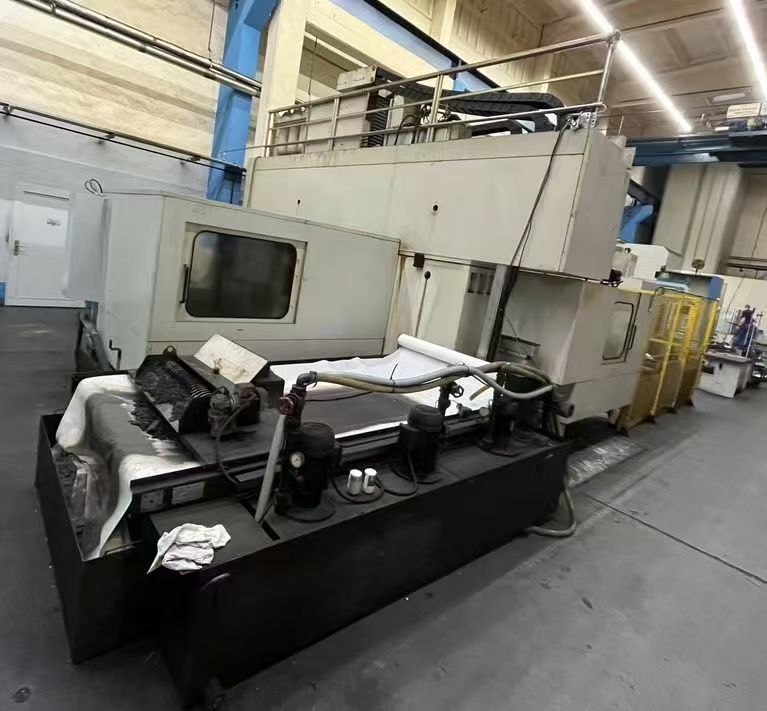
Column 1 is verified listing data (from the Favretto ME/U200 listing page: Italy origin, 6,425 operating hours, 1 unit in stock, US$650,000):
| Parameter | Favretto ME/U200 | Heavy class (6 m new) | Mid-range (domestic-class) |
|---|---|---|---|
| Table size (W × L) | 4,000 × 1,000 mm | 6,000 × 1,600 mm class | 1,600 × 630 mm class |
| Max. grinding L/W/H | 4,000 / 1,000 / 700 mm | 6,000 / 1,600 / 1,000 mm | 1,600 / 630 / 500 mm |
| Max. table load | 1,500 kg (without mag. chuck) | 3,000+ kg | ~800 kg |
| Spindle power | 22 kW (30 HP) | 37–45 kW | 11–15 kW |
| Grinding wheel | 508 × 203.2 × 100 mm @ 1,200 / 2,800 rpm | Ø600 class @ 1,000–1,500 rpm | Ø400 class @ 1,500–2,000 rpm |
| Table feed | 1–40 m/min | 1–30 m/min | 0.5–25 m/min |
| Min. feed (Y/Z) | 0.001 mm / 0.001 mm | 0.001 mm | 0.005 mm |
| Y-axis (cross) | Rapid 10 m/min; 0–2,000 mm/min stepless; 3–75 mm adjustable | Similar | Manual/intermittent |
| Z-axis (vertical) | Rapid 10 m/min; 700 mm effective / 750 mm total travel | 1,000 mm | 500 mm |
| B-axis (spindle swivel) | Circular-scale encoder feedback (CNC angle forming) | Direct-drive + angle encoder | Manual or none |
| Linear scales | Equipped (axis configuration to be verified on site) | Equipped | Optional |
| Footprint | 10,700 × 5,500 × 4,500 mm | 12,000 × 6,000 × 5,000 mm | 5,500 × 3,500 × 3,000 mm |
| Machine weight | 31,500 kg | 60,000+ kg | 12,000–15,000 kg |
| Installed power | ~70 kW | ~120 kW | ~45 kW |
Comparison-column values are industry-typical ranges, not a quote from any specific vendor; the ME/U200 column is actual listing data.
2.2 Why These Specs Matter for Guideway Regrinding (Technical Core)
Acceptance geometry: straightness, parallelism, and the 0.005 rule. Guideway regrinding acceptance relies on a dual system of geometric and positioning accuracy: straightness and parallelism are measured per ISO 230-1, while positioning accuracy is assessed per ISO 230-2. V-way and flat-way straightness is typically specified ≤ 0.005 mm/m, with full-4,000 mm accumulated values in the 0.015–0.02 mm band, and cross-guide parallelism ≤ 0.01 mm/m. Two attributes determine whether a used unit can still hit these: feed resolution and scale-based position feedback. The ME/U200's 0.001 mm minimum feed (Y/Z) plus its linear-scale configuration shows the motion chain itself is capable; the remaining variable is purely mechanical wear — resolved by the acceptance test.
What the B-axis circular encoder actually buys you. Form-grinding of angled guideways (V-profile, dovetail, compound-angle) requires the spindle head to be indexed and held at angle under load. A circular-scale (rotary encoder) on the B-axis upgrades this from "mechanical detent + trust" to closed-loop feedback — the CNC can form and dwell at ±30° swivel with encoder-verified position. For remanufacturers, this decides whether a machine is a "surface grinder with a tilted head" or a genuine CNC guideway-forming grinder — and this unit's CNC-function spec ("CNC forming of various guideway shapes and angles") directly confirms it.
The honest risks of a 6,425-hour unit. For a heavy machine tool, 6,425 hours is low-to-mid utilization, but wear assessment still must focus on three areas: flat- and V-way surfaces (repairable by re-scraping/regrinding — verify remaining casting allowance), spindle-bearing thermal drift (verify with a long warm-up + laser check), and hydraulic slide-bearing condition. Budget 3–5% of purchase price for consumables and re-scraping, and allow 1 inspection week before first production run.
3. Acceptance Procedure
Don't trust the nameplate on a used machine. This unit's listing supports full verification; the following procedure is what a mature buyer executes:
- Visual & nameplate verification — cross-check serial number against OEM records;
- Power-on & control-system check — alarms, axis homing, encoder counts on all axes including B;
- Axis motion & spindle run — full table sweep at 1–40 m/min, spindle at 1,200 and 2,800 rpm, temperature logging;
- Grinding-area & electrical-cabinet photo survey — coolant lines, scale covers, cable condition;
- Remote video inspection or optional third-party inspection — witness the full dynamic test on site.
Beyond the above, if you want the machine's OEM background, current available models, and configuration differences, browse Used Favretto Brand & Available Models Overview.
4. Real Industry Application Case
Client background: A heavy machine-tool builder in South China producing large gantry-machining-center beds (4 m class), regrinding 24 beds/year.
Bottleneck: Outsourced guideway regrinding at US$21,000/unit with a 6–8 week queue, monthly throughput capped at 2 units by the vendor's capacity; thermal distortion caused a 12% first-inspection rejection rate.
Solution supplied: Used Favretto ME/U200 CNC slideway grinder (6,425 hours verified, B-axis encoder checked on site) + a 20 °C ± 1 °C inspection bay + laser-interferometer acceptance.
12-month quantified results:
| Metric | Before (outsourced) | After (in-house, 12 mo) |
|---|---|---|
| Cost per regrind | $21,000 | $9,500 |
| Annual direct cost (24 units) | $504,000 | $228,000 |
| First-inspection rejection | 12% | 2.1% |
| Avg. regrind lead time | 6–8 weeks | 2–3 weeks |
| Monthly regrind capacity | 2 units | 4 units |
Calculated annual savings:
Direct saving = (21,000 − 9,500) × 24 = $276,000/yrRejection saving = (0.12 × 24 × 21,000) − (0.021 × 24 × 9,500) ≈ $55,700/yrTotal annual benefit ≈ $331,700/yrSimple payback = $650,000 ÷ $331,700 ≈ 1.96 years
Secondary benefits: regrind capacity up 100% (2→4 units/month, removing the outsourcing bottleneck), lead time down ~60% (median 7→2.5 weeks). The freed capacity can take on incremental orders — revenue this model does not even count.
5. FAQ
Q: What grinding precision can a used Favretto ME/U200 actually hold?
A:
- Design capability (linear scales + 0.001 mm feed): straightness ≤ 0.005 mm/m, parallelism ≤ 0.01 mm/m, surface finish Ra 0.4–0.8 μm (finish pass to Ra 0.2 μm).
- Used-unit reality: achievable precision is wear-limited — certify per ISO 230-1/230-2.
- Enabling conditions: re-scrape the ways first, warm up 45–60 min, hold 20 °C ± 1 °C. Under these, the 4,000 mm class meets typical OEM guideway regrinding drawings.
Q: How do I measure straightness and parallelism during on-site acceptance?
A:
- Require a laser interferometer to measure the full 4,000 mm per ISO 230-1 (not a 1 m sample);
- Test V-way straightness (horizontal + vertical planes), flat-way straightness, and cross-guide parallelism separately;
- Run a 2-hour spindle warm-up first, logging thermal drift every 30 min;
- Take at least 3 forward/return passes, and have the supplier sign the tolerance sheet before release.
Q: What does the B-axis circular encoder actually do for V-profile / angled guideway forming?
A:
- It closes the loop on ±30° spindle-swivel positioning — the CNC senses the actual angle, not the detent position;
- It enables V-, dovetail-, and compound-angle profiles in one clamping setup, replacing manual-head mechanical setups;
- For remanufacturers, it upgrades the machine from a "surface grinder" to a guideway-forming grinder — the core function that justifies this price class.
Q: A 31.5-ton machine — what foundation and rigging are needed before installation?
A:
- Footprint: 10,700 × 5,500 mm plan (leave 0.6–0.8 m service clearance around), 4,500 mm height;
- Foundation: based on the 10.7 × 5.5 m footprint, the machine's average bearing pressure is only ~0.54 t/m², but accounting for dynamic loads and local concentrations, design for bearing capacity ≥ 0.1 MPa with a 600–800 mm reinforced-concrete slab, isolated from adjacent vibration sources, anchor points per OEM leveling layout;
- Rigging: crane rated ≥ 40 t at the rigging radius, or a controlled multi-jack slide-in; have a structural engineer verify the load path from rigging point to slab;
- Power: ~70 kW installed; confirm busbar/transformer headroom plus compressed-air and coolant circuits.
To verify this machine's full technical specs (wheel size, axis travels, feed rates, installed power), see Favretto ME/U200 Complete Technical Specifications & Datasheet.
Q: How do I assess remaining life and rebuild cost on a 6,425-hour used slideway grinder?
A:
- Wear audit (1 inspection week): spindle-bearing runout, way-scrape condition, ballscrew/scale backlash, hydraulic system pressure and contamination;
- Typical rebuild scope (at this utilization level): re-scrape or regrind ways, replace seals, service scales/encoders — budget 3–5% of purchase price;
- Decision rule: if dynamic acceptance passes and thermal drift is stable after warm-up, the machine's second life exceeds 10 years in regrind service — heavy slideway grinders run slow, rigid, low-cycle duty that is gentle, keeping their load far below design life.