

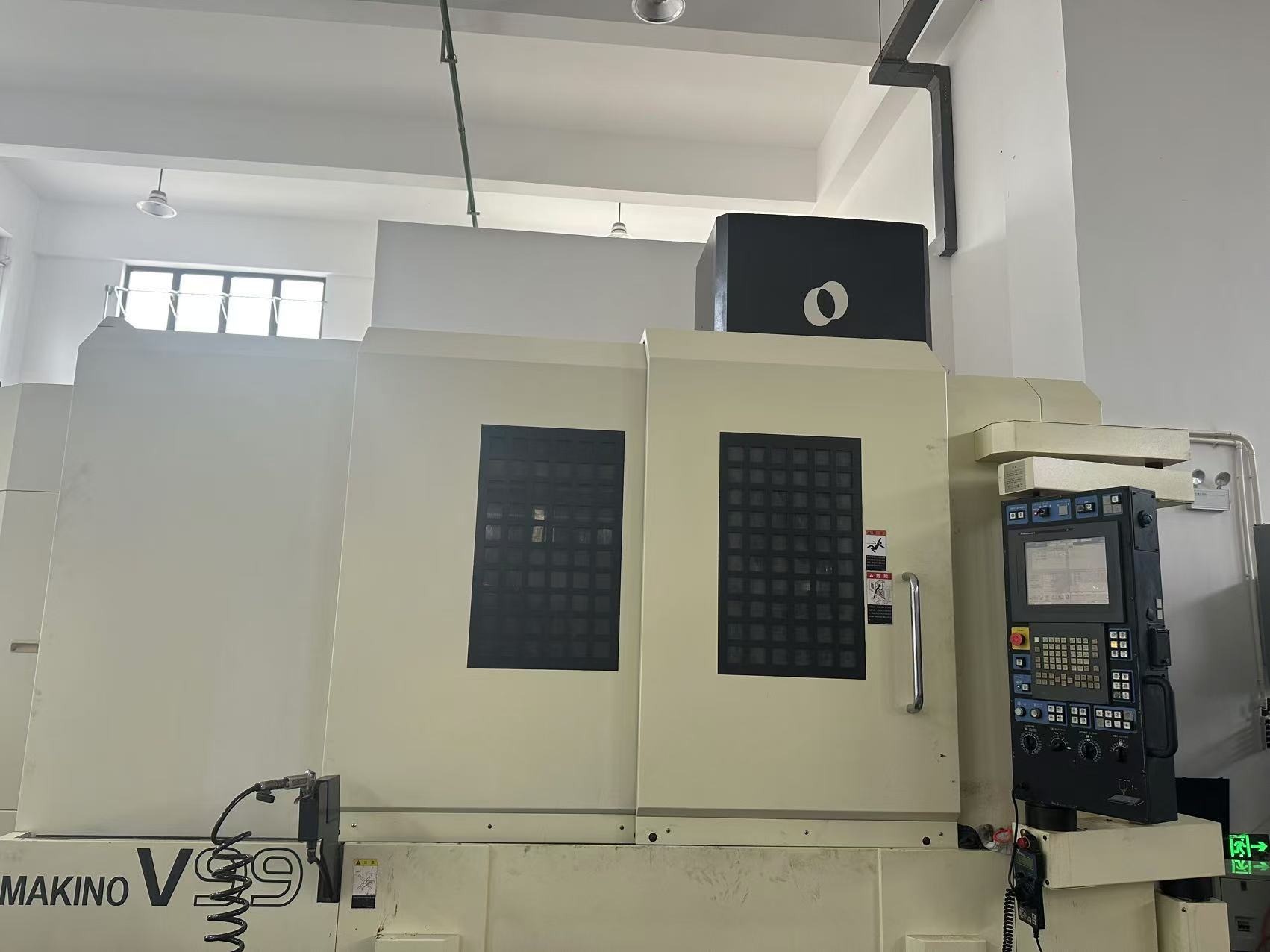
Expert Review: This article is reviewed by the UsedUltra Senior Equipment Inspection Engineering Team. Chief Inspector Chris (12 years evaluating used industrial equipment, 1,500+ CNC machines inspected — 200+ covering Makino, Mori Seiki, YASDA, Haas) is accountable for every technical determination and measurement standard below. Data sources: the in-stock machine's nameplate (Kunshan, China) + manufacturer-published typical specifications + on-site inspection records.
Core Summary
Bottom line first: the Makino V99 is NOT in the same class as the other three used VMCs — don't price-compare them as "just verticals." With 23,000 kg machine weight, an HSK-A100 dual-face-contact spindle, closed-loop linear scales on all 3 axes, and only 1,427 spindle hours, the V99 is built for heavy die/mold steel and large-workpiece high-precision machining. Its static and dynamic rigidity far exceed the Haas VF-2YT (~4,500 kg, BT40, semi-closed loop). The US$120,000 list price is higher than the VF-2YT's, but on per-ton rigidity, per-spec accuracy and per-hour value, it is the best of the four. On a tight budget with only small-to-medium parts → choose the NVD5000 or YBM950V. For large molds, long-term stability and big workpieces → the V99 wins.
Why Machine Class — Not Brand — Decides Your Mold Machining Cost
Pain 1 — Buying the wrong class, not the wrong brand. Buyers often chalk the price gap up to brand premium, but the real difference is machine class. A lightweight VMC (4–5 t) vibrates in the column and spindle head when heavy-cutting hardened mold steel, so the target surface finish is unreachable and you compensate with smaller depths of cut and extra passes — machining time up 30%+, tool life down 40%, with electricity and machine-hours rising together. A 500 kg mold base takes three roughing passes at 0.4 mm depth of cut; at 1.2 mm it is one pass. Class differences show up directly on the invoice.
Pain 2 — Looking only at list price, not "hours × accuracy decay." A used machine with 6,000+ hours, no linear scales and a semi-closed loop will lose roughly 0.01 mm of nominal accuracy to leadscrew backlash and spindle play. Guideways, leadscrews and spindle bearings wear by the hour; remaining life at 1,427 h versus 6,800+ h differs by 3–5×. If accuracy drift only shows up at acceptance, the return/shipping and spindle overhaul (US$5,000–15,000) eat the price difference you thought you "saved."
Pain 3 — Accuracy specs that can't be compared. Some list positioning accuracy, some list repeatability; some have closed-loop linear scales, some only motor-encoder semi-closed loop; some "±0.005 mm" figures are under factory climate control, some under daily conditions. Without a laser-interferometer test, you cannot tell whether an accuracy figure is a nameplate number or real capability.
Pain 4 — Hidden costs of high-speed/heavy-load conditions. A BT40 taper micro-seats under centrifugal force at ≥15,000 rpm, while HSK end-face contact stays stable. A 20,000 rpm spindle without oil-air lubrication and scale compensation can drift 0.01 mm or more in Z during high-speed machining — and one scrapped mold core costs US$2,000+.
Makino V99 vs Haas VF-2YT vs Mori Seiki NVD5000 vs YASDA YBM950V: Full Spec Comparison
Note: The V99 figures are from the actual in-stock machine's nameplate; the VF-2YT / NVD5000 / YBM950V figures are manufacturer-published typical specifications for used machines — verify against the machine nameplate at arrival. All prices are in US dollars (US$) and are used-market references; see usedultra.com live listings
| Parameter | Makino V99 | Haas VF-2YT | Mori Seiki NVD5000 α1A/40 | YASDA YBM950V |
|---|---|---|---|---|
| Spindle taper | HSK-A100 | CT/BT 40 | HSK-A63 | HSK-A63 |
| Max spindle speed | 20,000 rpm | 10,000 rpm (12k/15k optional) | 12,000 rpm (20k optional) | 15,000 rpm |
| Spindle motor | 22 / 18.5 kW | 22.4 kW (30 hp) | 22 / 18.5 kW | ~22 kW |
| Bearing lubrication | Oil-air (typical) | Grease (typical) | Oil-air (high option) | Oil-air (typical) |
| Travels X/Y/Z (mm) | 1,500 / 1,000 / 800 | 762 / 508 / 635 | 800 / 500 / 450 | 900 / 550 / 510 |
| Table (mm) | 1,800 × 1,000 | 1,568 × 457 | ~1,000 × 500 | ~1,000 × 500 |
| Max workpiece (mm) | 1,800 × 1,000 × 650 | ~1,568 × 457 × 635 | ~1,000 × 500 × 450 | ~1,000 × 500 × 510 |
| Rapid traverse (mm/min) | 20,000 | 25,400 | 40,000 | ~36,000 |
| ATC | 30 | 30+1 | 30 | 30 |
| Linear scales (3-axis) | Standard | None (semi-closed) | Partial option | Standard |
| Guideway | Heavy roller/boxway | Roller linear | Linear | High-rigidity roller linear |
| Positioning accuracy | ±0.005 mm | ±0.005 mm | ±0.004 mm | ±0.002 mm |
| Repeatability | ±0.003 mm | ±0.0025 mm | ±0.002 mm | ±0.001 mm |
| Through-spindle coolant | Standard | Optional | Optional | Optional |
| Control | Makino Professional 5 | Haas NGC | FANUC/MAPPS | FANUC |
| Machine weight | ~23,000 kg | ~4,500 kg | ~8,000 kg | ~12,000 kg |
| Spindle hours | 1,427 | 6,823 | 2,833 | 7,566 |
| Used price (US$) | US$120,000 | ~US$35,000–55,000 | ~US$55,000–80,000 | ~US$85,000–110,000 |
| Capability class | Heavy mold / large-part high precision | General small-to-medium parts | General high-speed | High-precision small-to-medium parts |
HSK-A100 Dual-Face Contact vs BT40 Taper: Where Rigidity Comes From
BT/CAT40 toolholders lock by taper friction; under high speed and heavy load the taper micro-seats, capping radial and bending rigidity. The HSK (hollow taper shank) provides dual-face contact — end face plus taper — with clamping deformation measured in micrometers. Spec-wise, the HSK-A100 flange (φ100) and torque-transmitting area are far larger than the BT40 taper (φ44.45), giving roughly an order of magnitude higher theoretical bending rigidity. For deep passes on mold steel (40–55 HRC), tool overhang rigidity directly controls chatter and tool life. That is the physical root of the machining-quality gap between the V99 and VF-2YT at equal spindle speed — an interface-spec gap, not a brand gap.
23,000 kg Machine Weight: Rigidity, Damping & Heavy Cutting
Rigidity ≈ material distribution + closed structural loop. At roughly 5× the VF-2YT's weight and 3× the NVD5000's, the V99 carries thicker column walls, a larger box base and higher structural damping. Damping dictates how fast vibration energy dissipates: at equal depth of cut the V99's residual vibration amplitude is lower, surface finish is steadier (Ra below 0.8 in one pass), and vibration-induced edge chipping of tools is less likely. On a 23 t machine, the 1,800 × 1,000 mm table lets you clamp 500–900 kg mold bases in a single setup, cutting error accumulation from re-clamping. Machine weight is the most honest, hardest-to-fake rigidity parameter.
Linear Scales (Closed-Loop) vs Semi-Closed Loop: Accuracy Is Measured, Not Claimed
A semi-closed loop feeds back only the motor encoder; leadscrew thermal growth and backlash are not compensated. Closed-loop linear scales measure actual table displacement and write thermal deformation and backlash into the error loop. The V99 and YBM950V come standard with 3-axis linear scales; the VF-2YT is semi-closed by default. For ±0.005 mm-class long-term stability in finishing, linear scales are a hard requirement, not a nice-to-have — without them, a machine's real accuracy after two hours of warm-up is a guess.
Spindle Hours Are the Value Code: 1,427h vs 6,823h Degradation Logic
Guideways, leadscrews and spindle bearings wear by the hour. 1,427 h is roughly 1–2 years of operation after leaving the factory — squarely in the post-break-in optimum window. At 6,823 h / 7,566 h, machines have entered the mid-life wear zone of guideways and spindle bearings. For the same model, when hours differ by 5× but price differs by less than 2×, the low-hour machine carries the higher residual-life value. At acceptance, high-hour machines must be re-verified for spindle runout, backlash and test-cut accuracy — three direct witnesses of wear.
Thermal Compensation: Who Corrects Drift, Who Guesses
High-speed spindles and heavy cutting both heat the column and spindle; Z-axis thermal growth can reach 0.01–0.03 mm per hour. The V99 compensates thermal drift directly via Makino spindle and column temperature control plus closed-loop scale feedback. YASDA has its own proprietary thermal-growth control. The Haas VF-2YT, semi-closed by default with no measured feedback, can only "guess" thermal drift through program compensation. For finishing runs lasting 4+ hours, thermal-compensation capability matters more than the nameplate accuracy number.
Boxway vs Roller Linear Guides: Damping vs Speed Trade-off
- Boxway: large-area guide/slide contact, highest static and dynamic rigidity and damping, but higher friction and rapids limited by the oil film — for heavy-duty cutting.
- Roller linear: balances rigidity, speed and friction; mainstream heavy VMCs use widened roller trucks — the V99 and YBM950V fall in this class (confirm on the machine).
- Standard linear (small roller/ball): speed-first, weak damping under heavy cutting — the VF-2YT is a typical lightweight linear design.
How to judge: for heavy mold steel, look at guideway size and truck count first, then rapid speed. A machine with fast rapids is not necessarily capable of heavy cuts.
20,000 rpm Isn't a Number: Bearing Lubrication, Balance & Scales
A 20,000 rpm spindle must solve three things: ① Oil-air lubrication feeds the high-speed bearings and carries heat away — grease lubrication cannot control temperature rise under sustained high speed. ② HSK tooling balance: tool assemblies should reach G2.5 class (≤2.5 mm/s), otherwise unbalanced force at high speed degrades both spindle life and Ra. ③ Scales + temperature compensation to prevent high-speed thermal drift. The V99's 3-axis scales and HSK-A100 exist precisely to support these three — high-speed capability is a system, not a single rpm number.
20 m/min Rapid ≠ Slow: Settling Time Is the Real Cycle Metric
A 40 m/min air-cut rapid looks fast, but acceleration/deceleration capability and positioning settling time are the real cycle drivers. A 23 t table needs a longer deceleration stroke and settling time to stop from 40 m/min; frequent fast rapids can actually slow the real cycle. Heavy machines spend 20,000 mm/min on safe, repeatable positioning and win cycle time through cutting-power release and single-pass depth of cut. Do not cross-compare rapid-traverse numbers across machine classes — it is a design trade-off, not a performance label.
Makino Professional 5: Mold-Specific CNC Control Capability
The V99 runs Makino's in-house Professional 5 control, built for mold machining with look-ahead path smoothing to reduce acceleration/deceleration shock, chatter suppression, nanometer interpolation and macro cycles. Compared with generic FANUC/Haas controls, it shows a clear edge in tool-path smoothing and consistency for complex free-form finishing. For buyers machining molds, the control system matters as much as the mechanical body.
Decision Matrix: Weighted Scores for Rigidity, Accuracy & Value
Weighted scoring (1–5, weights for a typical mold/heavy-cut scenario): Rigidity 25%, Accuracy 25%, Value per unit (performance/price) 20%, Maintenance convenience 15%, Workpiece-size coverage 15%.
| Machine | Rigidity (25%) | Accuracy (25%) | Value (20%) | Maintenance (15%) | Coverage (15%) | Weighted total |
|---|---|---|---|---|---|---|
| Makino V99 | 5 | 4 | 4 | 3 | 5 | 4.25 |
| YASDA YBM950V | 3.5 | 5 | 3 | 3 | 3 | 3.63 |
| Mori Seiki NVD5000 | 3 | 4 | 4 | 4 | 3 | 3.60 |
| Haas VF-2YT | 2 | 3 | 4 | 5 | 2 | 3.10 |
Reading the scores: for heavy parts, molds or heavy cutting, the V99 ranks first overall and is the only machine covering the 1,800 × 1,000 mm platform. For high-precision small-to-medium parts only, the YBM950V ranks first in accuracy (±0.002 / ±0.001). Under a hard budget cap for general parts, the VF-2YT has the lowest absolute price. Re-run the matrix with your own product mix to change the outcome.
12-Month Field Case: An Indian Mold Shop Switches to the Makino V99
Client profile: A mold shop in Bangalore, India, making automotive interior injection molds, machining 500–900 kg, 45–55 HRC P20/H13 mold bases and cores. It previously used a lightweight VMC (~5 t, BT40): large mold bases vibrated, finishing surface finish was stuck at Ra 3.2, manual polishing was required, and the rework rate ran about 6%.
Bottlenecks: long per-part finishing time (many small-depth passes), fast tool wear, and delivery delayed by rework.
Solution: Purchased this Makino V99 (HSK-A100 / 20,000 rpm / 3-axis linear scales / 1,427 h). The UsedUltra team completed remote video inspection, factory test cut and a laser-interferometer report before shipment; commissioning on site took one week.
Cycle-time breakdown (client-reported, P20 45HRC mold core):
| Operation | Old machine (BT40 lightweight) | Makino V99 (HSK-A100) | Change |
|---|---|---|---|
| Roughing (depth 0.4 → 1.2 mm) | 3 passes / 180 min | 1 pass / 90 min | -50% |
| Finishing passes (600 → 1,200 mm/min) | 2 passes / 120 min | 1 pass / 105 min | -12% |
| Manual polishing (Ra3.2 → 0.8) | 90 min | 0 (direct Ra0.4–0.8) | eliminated |
| Finishing section total | 300 min | 195 min | -35% |
| Full-part output time | 390 min | 195 min | -50% |
Measured 12-month results:
- Finishing-section time -35% (full-part output -50%, polishing eliminated);
- Surface finish: mold steel finished directly at Ra 0.4–0.8 (previously Ra 3.2 + manual polishing);
- Tool life: ball-nose end mills +40% (less vibration chipping);
- Quality cost: rework rate 6% → 1.2% (-80%);
- Energy per part: -18% (shorter cutting time, less air cutting);
- Capacity: 11 → 15 molds/month (+32%); 48 extra molds/year × client-reported margin of ~US$2,500–3,000 each ≈ US$120,000–144,000/year — the US$120,000 machine investment was recovered within 12 months, excluding labor and rework savings.
FAQ: Used VMC Rigidity, HSK vs BT40, Spindle Hours & Value
Q1. Why is the used Makino V99 so much more expensive than the Haas VF-2YT?
A: The difference is machine class and residual value, in four points:
- Rigidity class: 23,000 kg vs ~4,500 kg machine weight — the V99 can heavy-cut large molds; the VF-2YT suits small-to-medium finishing/light work;
- Toolholder system: HSK-A100 dual-face contact vs BT40 taper — an order-of-magnitude difference in high-speed heavy-load rigidity;
- Closed-loop accuracy: the V99 ships with 3-axis linear scales; the VF-2YT is semi-closed by default;
- Residual value: 1,427 h is in the post-break-in optimum window; 6,823 h is in the mid-life wear zone — the cost to rebuild or restore to new-machine accuracy is completely different.
In one sentence: the V99 is a "heavy high-precision" platform, the VF-2YT is a "general lightweight" platform — the price difference buys platform capability, not a logo.
Q2. HSK-A100 vs BT40 spindle — does my mold really need HSK?
A: Decide by workpiece and operation:
- Hardened mold steel (40–55 HRC) with deep cuts → HSK-A100 is clearly better (bending rigidity, clamping torque, chatter resistance);
- Aluminum/copper, small-to-medium parts, light fast cutting → BT40 is sufficient, with better tool commonality and cheaper toolholders;
- At high speed (≥15,000 rpm), the BT40 taper micro-seats under centrifugal force; HSK end-face contact is more stable.
Conclusion: heavy work / high-speed finishing → HSK is required; routine 3-axis light work → BT40 is acceptable.
Q3. 1,427 hours vs 6,800+ hours on a used VMC — which is the smarter buy?
A: Never judge on hours alone — run three checks:
- Major-component life: spindle bearings, leadscrews and guideways have hour-based life; 1,427 h leaves far more margin than 6,800+ h;
- Rebuild cost: high-hour machines need a budget for spindle overhaul (US$5,000–15,000) and accuracy adjustment — add it to the purchase price before comparing;
- Measured bargaining: demand a laser-interferometer report and test-cut CMM data on high-hour machines; if data is short of spec, negotiate the price down by the rebuild cost.
Conclusion: for the same model, if hours are 5× lower but the price gap is under 2×, buy the low-hour machine; if the price gap exceeds rebuild cost, the cheaper high-hour machine wins.
Q4. How much do linear scales (closed-loop) actually improve machining accuracy?
A: Three levels of impact:
- Thermal compensation: closed-loop scales correct leadscrew thermal growth in real time — drift stays small over long runs (standard on the V99);
- Backlash compensation: the loop measures actual table position, so reverse gap is no longer estimated from parameters;
- Usability: a machine without scales (semi-closed) can still do ordinary-accuracy work in short, climate-controlled runs — but for ±0.005 mm-class long-term stability, standard scales are recommended.
Conclusion: "works" depends on whether the machine has them; "stable accuracy" depends on whether it measures them.
Q5. Used Japanese VMC vs used US VMC: which costs less to maintain?
A: Evaluate on three axes:
- Parts channel: Makino/YASDA spindles, servos and control cards are mostly proprietary — order through authorized agents or Japanese channels, 2–8 week lead time; Haas has global reach and highly standardized parts, faster lead times;
- Electrical/control cost: Japanese proprietary controls (e.g., Makino Professional 5) need brand support and cost more to repair; Haas controls are more generic;
- Life accounting: a Japanese heavy machine (V99, 23 t) typically has a longer design life and longer service intervals — annual maintenance cost is not necessarily higher.
Conclusion: Haas is cheaper and faster per repair; over a ten-year total cost, structural rigidity and design life mean the Japanese heavy machine is not necessarily dearer.
Q6. Is the V99's 20,000 mm/min rapid traverse slow — is it outdated?
A: No — look at three dimensions:
- Settling time: a 23 t table needs a longer deceleration stroke and settling time to stop from 40 m/min; a higher rapid number does not mean a shorter cycle;
- Where cycle time comes from: heavy machines win on single-pass depth of cut (0.4 → 1.2 mm) and cutting-power release, not on air-cut rapids;
- Design trade-off: 20,000 mm/min is a safe, repeatable positioning speed for a 23 t platform — 40 m/min would be over-design.
Conclusion: comparing rapid numbers across classes is meaningless; within a class, compare acceleration curves and settling time instead.
Q7. What is the max workpiece size and table load of the Makino V99?
A: Judge from the nameplate and measured data:
- Work envelope: 1,800 × 1,000 mm table, 1,500 / 1,000 / 800 mm travels, max workpiece 1,800 × 1,000 × 650 mm;
- Table load: large-machine table capacity is typically 2–3 t class — confirm the exact value on the nameplate before ordering;
- One-setup capability: 500–900 kg mold bases can be roughed and finished in one clamping, avoiding second-setup error.
Conclusion: molds around 600 × 400 × 300 mm and large parts within the 1,800 × 1,000 mm table are both covered; loads beyond the nameplate rating must be confirmed with the team first.