

Reviewed by usedultra Chief Technical Expert / Senior Engineer Senior Engineer Chris (12 years in used surface grinder inspection & remanufacturing evaluation at usedultra)
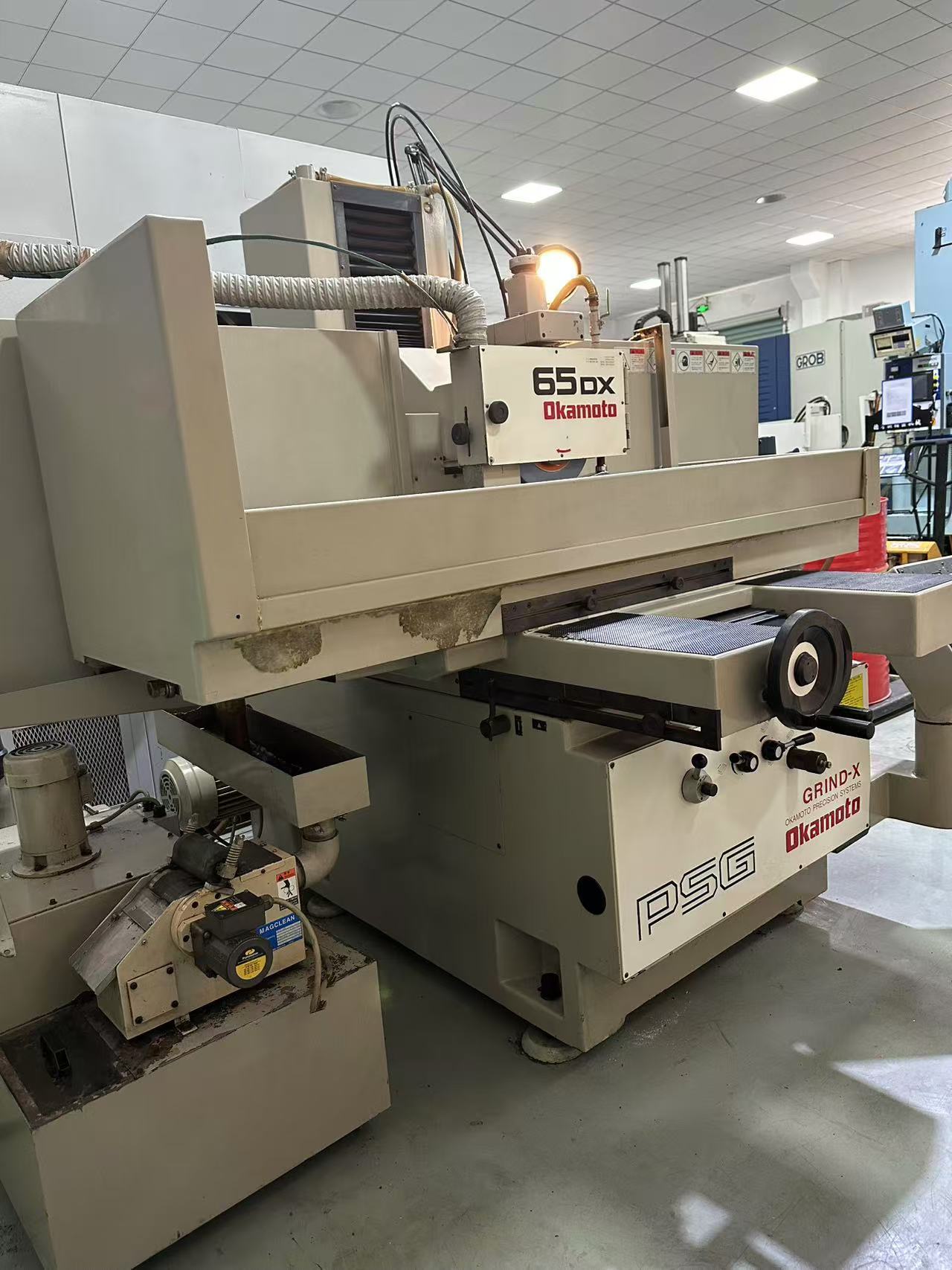
At the same price point (USD 5,500–7,000), a used Okamoto surface grinder offers a higher accuracy ceiling and longer guideway life than a new entry-level machine: after passing acceptance testing, flatness stays within 0.005 mm over 300 mm long-term. But you take on acceptance-test risk, a 200V→380V power-conversion cost (USD 900–2,100) and zero warranty. Shops with in-house inspection and repair capability get a lower per-unit accuracy cost from used Okamoto; buyers who want peace of mind and after-sales support are better off with a new entry-level machine.
Browse usedultra's certified inventory of used okamoto surface grinders for sale — every unit ships with a laser-interferometer inspection report and a load-test record before delivery.
3 Traps Purchasing Managers Hit Before Buying a Used Okamoto Surface Grinder
Trap 1: Paying top dollar for a "reconditioned-as-new" Japanese machine that is anything but. Sellers re-polish the paint, dials and wheel guard so it looks "90% new," while the guideway contact surfaces are worn and the spindle bearing has radial clearance. Once installed, flatness drifts from 0.01 mm toward 0.05 mm, and the rework bill (spindle bearing replacement + guideway scraping) can reach 30% of the purchase price — without restoring factory accuracy.
Trap 2: Comparing only the sticker price, not total cost of ownership (TCO). Three items are the easiest to miss in a same-price comparison: Japanese-built machines are mostly 200V 3-phase, so a 380V shop needs a transformer or VFD conversion (USD 900–2,100, installed); hydraulic seals and gear pumps are aging and need replacing up front; and used machines carry no warranty, so downtime is on you. Together these often cost more than the "savings" of USD 1,400–2,800 you thought you were getting.
Trap 3: Not knowing what standard to accept to, and being led by "original factory accuracy" talk. The seller says "Japanese JIS standard," but the purchasing manager cannot explain the difference between JIS B 6022 and the industry accuracy standard, has no measured spindle-runout or guideway-straightness data, and ends up signing on the feel of the handwheel.
Used Okamoto vs New Entry-Level Surface Grinder: Key Spec Comparison & Selection Notes
The conclusion first: at the same price, the used Okamoto has a higher accuracy ceiling — but whether that accuracy lands depends on the acceptance test; the new entry-level machine has a guaranteed accuracy floor but shorter retention (guideway life). Here is the hardcore spec comparison across three representative machines/scenarios:
| Parameter | Used Okamoto ACC-6-18 (~15–20 yrs) | Used Okamoto PSG-64 (~10–12 yrs) | New entry-level machine (typical specs) |
|---|---|---|---|
| Table size | 152×457 mm (6"×18") | 605×400 mm (24"×16") | 150×450 mm (6"×18") |
| Max grinding area | 460×160 mm | 750×440 mm | 460×180 mm |
| Spindle motor | 1.5 kW (2 HP) | 3.7 kW (5 HP) | 1.5 kW |
| Spindle speed | ~2,800 rpm | ~1,450 rpm (belt drive) | ~2,850 rpm |
| Spindle radial runout (acceptance) | ≤0.005 mm | ≤0.005 mm | ≤0.003 mm |
| Ground flatness / 300 mm | ≤0.005 mm (JIS B 6022) | ≤0.005 mm (JIS B 6022) | ≤0.005 mm (industry standard) |
| Surface roughness | Ra 0.2–0.32 μm | Ra 0.2–0.32 μm | Ra ≤0.32 μm |
| Table speed | Hydraulic, ~25 m/min | Hydraulic, 0.3–25 m/min | Manual/hydraulic, ~20 m/min |
| Grinding wheel | 180×13×31.75 mm | 305×38×76.2 mm | 180×13×31.75 mm |
| Max workpiece weight | ~100 kg | ~420 kg | ~100 kg |
| Factory power supply | 200 V 3-phase 50/60 Hz | 200 V 3-phase 50/60 Hz | 380 V 3-phase 50 Hz |
| Indicative price (USD, 2026, estimate) | 4,000–7,000 | 7,000–14,000 | 5,500–8,500 |
| Warranty | None (sellers typically ≤3 months) | None | 1-year full |
| Guideway/spindle residual | Condition-dependent — inspect | Hydraulic parts aging — evaluate | Brand new |
| Accuracy retention (guideway life) | 5–10 yrs if well maintained | Wear-dependent; higher potential | Usually degrades after 2–3 yrs of heavy use |
Data note: PSG-64 table size, max grinding area and load capacity per the actual Okamoto PSG-64DX listing (605×400 mm table, 750×440 mm grinding, ~420 kg load); this is a 24"×16" (600×400) class hydraulic surface grinder.
Note: the PSG-64 is a larger 24"×16" class machine in a higher price band — the "same price point" comparison strictly applies to the ACC-6-18 vs the entry-level new machine; the PSG-64 is listed as an upgrade alternative.
Note: ACC-6-18 and entry-level figures are typical/representative values — verify against the actual unit or a manufacturer sample. Max grinding area is quoted on table-travel basis (including overtravel), so it can slightly exceed the table surface size.
Core of Accuracy Life: How Spindle Bearings & Guideway Wear Decide a Used Okamoto's Residual Accuracy
The real value of a used Okamoto is not its "factory accuracy" (a number on an old nameplate) but its residual accuracy life. Okamoto beds are high-grade cast iron with stress-relief aging; guideways are hardened-and-ground with hand-scraped contact surfaces. Empirically, a well-maintained 15–20-year-old machine still holds 50%+ guideway contact ratio. A new entry-level machine passes factory accuracy (flatness ≤0.005 mm/300 mm) but typically has lower guideway hardness and scraping contact ratio than a Japanese machine — under heavy three-shift use, accuracy drift usually appears within 2–3 years. The deciding question is not "which is newer" but "which can still hold 0.005 mm five years from now."
Power Conversion: Adapting Japanese Okamoto's 200 V to a Local 380 V Grid
This is the easiest cost item to forget in a same-price comparison. Japanese-built Okamoto machines are mostly 200 V 3-phase 50/60 Hz; connecting them straight to a 380 V shop grid burns the motor. Three options:
- 380V→200V 3-phase dry-type transformer (recommended, USD 1,100–2,100, installed): leaves the original electricals untouched and preserves factory characteristics;
- VFD inverter step-down (USD 900–1,700, installed): adds variable spindle speed as a bonus, good for slow heavy-roughing passes;
- Rewiring or rewinding the motor (not recommended): breaks factory insulation and torque characteristics — not worth it.
Hydraulic System Check: Where Used Okamoto Hydraulic Grinders Fail Inspection
The most fragile parts of a hydraulic model like the PSG-64 are the gear pump, directional valve and oil seals. During acceptance, listen for hydraulic whine, watch for table reversal shock, and check oil temperature (≤60 °C after one hour of continuous running). Hydraulic-part aging is not like guideway wear — it cannot be restored by scraping; it must be replaced as an assembly, at USD 400–1,100 per item. This item decides whether a used Okamoto's TCO stays under control.
Case Study: 12-Month Validation of a Used Okamoto ACC-6-18 in a Precision Mold Shop
Note: this is a demonstration case to illustrate the acceptance and power-conversion flow — replace with a real case or clearly mark it as a demo before publishing.
Customer background: an automotive precision stamping-die shop. Die inserts required flatness ≤0.005 mm; the shop's three entry-level grinders had degraded to 0.012 mm after one year of heavy use, causing repeated rework and late mold deliveries.
Technical bottleneck: new entry-level machines lack guideway hardness and scraping contact ratio, so accuracy retention is poor; buying the same-spec new machine costs about USD 9,700, and it would face the same accuracy decay two years later.
usedultra's tailored solution: after completing full acceptance testing and technical evaluation, usedultra sourced a 2010 Okamoto ACC-6-18 (purchase USD 5,300) with a 380V→200V transformer conversion (USD 1,700) plus pre-emptive spindle bearing replacement (USD 830) — total investment USD 7,800, below the same-spec new machine.
Quantified results after 12 months in production:
- Ground flatness stable at 0.004 mm (beating the customer's 0.005 mm requirement);
- Insert rework rate down from 18% to 3%;
- Per-part grinding cost down 22% (fewer stoppages and rejects);
- Total investment ≈ 80% of the same-spec new machine, with an assessed 5+ years of remaining accuracy life.
Used Okamoto Surface Grinder FAQ: Acceptance Standards, Voltage Conversion & Spare Parts
Q: Which accuracy standard should I use to accept a used Okamoto surface grinder, and how do I actually test it?
A: Accept against JIS B 6022 (Japanese surface grinding machine accuracy test) for the Japanese machine, and the industry accuracy standard for an entry-level new one. Execute four steps on site:
- Dial-indicate the spindle taper for radial runout — ≤0.005 mm;
- Laser-interferometer the guideways for straightness — ≤0.005 mm/300 mm;
- Grind a 300×100 mm test block, then check flatness with a straightedge + feeler gauge;
- Run empty for 1 hour, record oil temperature (≤60 °C) and bed thermal growth.
Any step failing the limit is grounds for a price concession or a walk-away.
Q: The used Okamoto is 200V; how do I run it on a 380V shop grid?
A: Three options, in order of preference:
- 380V→200V 3-phase dry-type transformer (USD 1,100–2,100, installed): does not alter the original electricals — most reliable;
- VFD inverter step-down (USD 900–1,700, installed): also gives variable spindle speed for variable-speed grinding;
- Motor rewiring: not recommended — breaks original torque and insulation, and motors above 2.2 kW tend to overheat after rewiring.
Q: How do I tell whether a used Okamoto is worth the seller's asking price?
A: Use a "base price × condition factor" quick valuation:
- Identify the model and year; use the last year's comparable sales as the base (ACC-6-18 ≈ USD 4,000–7,000, PSG-64 ≈ USD 7,000–14,000);
- Score condition item by item: guideway contact ratio ≥50% adds a factor, quiet spindle adds a factor, no hydraulic whine adds a factor;
- Subtract hidden conversion costs: voltage conversion, seals, possible bearing replacement;
- Only negotiate further when condition-factor × price minus conversion cost comes in 15%+ below the seller's quote.
Q: Are grinding wheels, original spare parts and hydraulic parts still available for a used Okamoto?
A: Split into three buckets:
- Grinding wheels: 180×13×31.75 mm and 305×38×76.2 mm are international standard sizes with ample local supply;
- Spindle bearings and seals: order original parts through Okamoto's factory after-sales service (Japan) or an authorized dealer, lead time ~4–8 weeks;
- Hydraulic parts: gear pumps and directional valves can be replaced with generic industrial parts at roughly 60% of original cost — but parameters must be matched by a qualified technician.
Q: Compared to the entry-level machine, what is the practical roughness-ceiling difference on a used Okamoto?
A: As-new, the difference is small: the entry-level machine ships at Ra ≤0.32 μm, and an accepted used Okamoto reaches Ra 0.2–0.32 μm. The real difference is accuracy retention — after 2–3 years of heavy use the same entry-level machine drifts toward Ra 0.5 μm, while a well-maintained Okamoto guideway keeps Ra within 0.32 μm. If you need long-term consistency, the used Okamoto's ceiling is higher; if you want short-term hassle-free, the new entry-level machine is steadier.
Q: Where can I buy a certified used Okamoto surface grinder, and what documents should come with it?
A: Buy through a certified used-machinery dealer who provides acceptance documentation. The unit should ship with at minimum:
- Laser-interferometer inspection report — guideway straightness and spindle runout measured on site;
- Load-test record — a documented test run with temperature and vibration data;
- Written warranty terms — coverage period and what is excluded (hydraulics, control, table);
- Power-conversion notes — whether the 380V→200V transformer or VFD is included and its installed cost.