
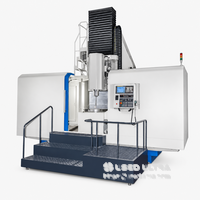
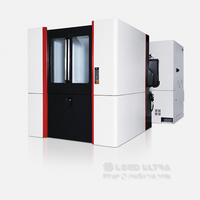
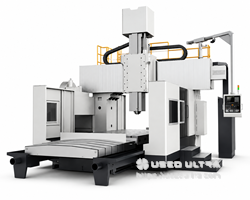
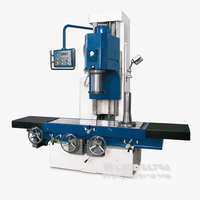
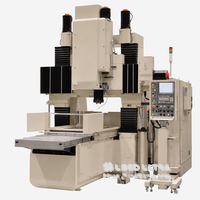

This article is reviewed by the UsedUltra Senior Equipment Inspection Team. Lead Inspection Engineer Chris (12 years in used industrial equipment appraisal, 1,500+ CNC machine tools inspected, including 60+ Mikron HSM/MILL/VCP-series machines) is accountable for every technical determination below. Both units described here are current company-owned inventory; every figure is taken from the listing documentation and cross-checked against manufacturer-published platform data. Unit-level numbers must always be confirmed against the machine's nameplate and acceptance report.
Published 2026-09-22 · Last updated 2026-09-22
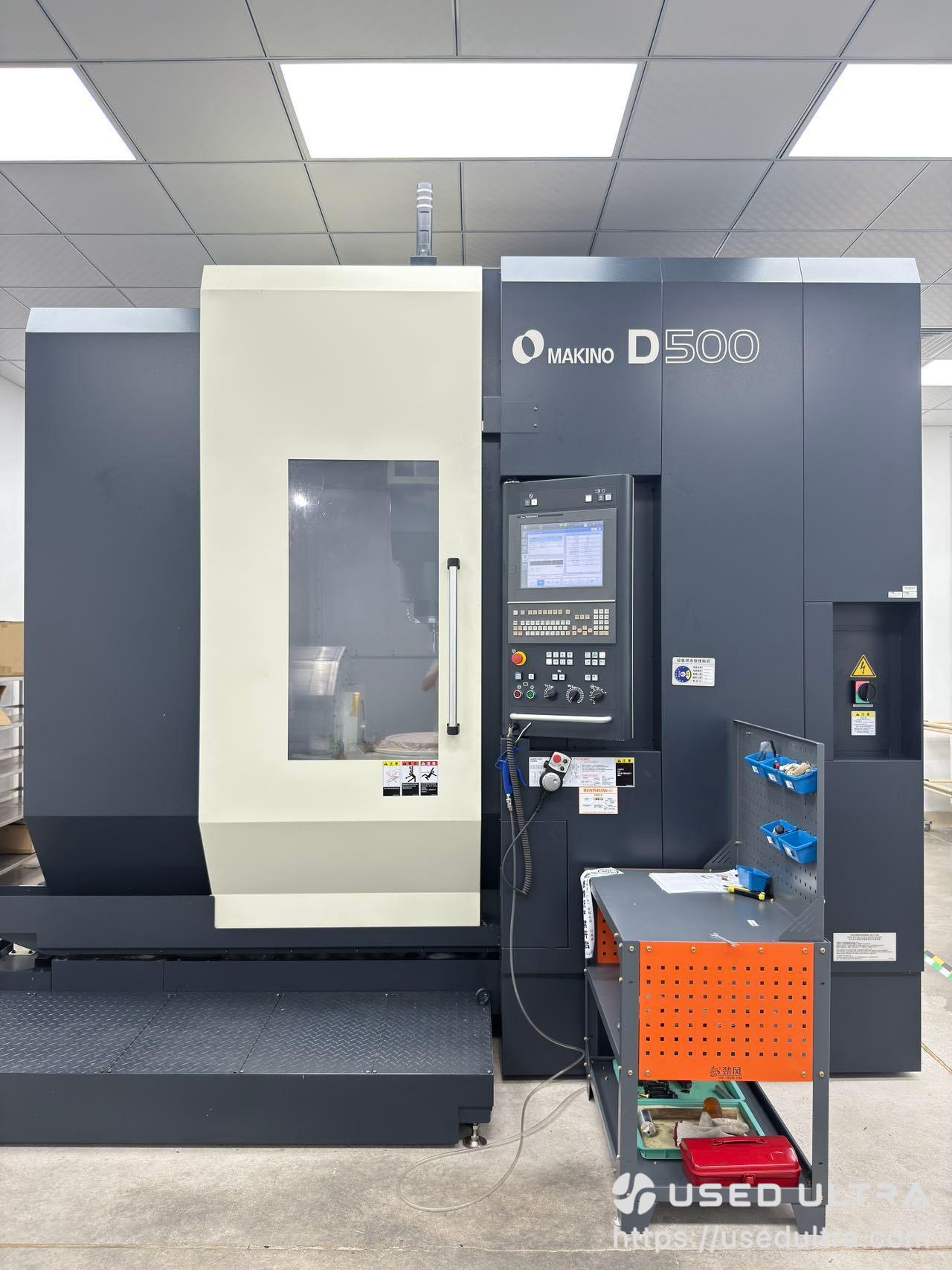
Core answer: The used Mikron VCP 600 in current stock lists at $45,000 and the used Makino D500 at $450,000 — a 10× gap on two machines quoted with the same 9-day delivery window. Almost none of that gap is brand prestige. The VCP 600 is a 2008 Swiss 3-axis precision mill on HEIDENHAIN iTNC 530 with a Step-Tec spindle; the D500 is a 2024 Japanese 5-axis trunnion platform on Makino Professional 6 with a 20,000 rpm HSK-A63 spindle. What the money actually buys is axis kinematics, control generation and build year. If your parts do not need five axes, the D500 is not a "better" VCP 600 — it is a different purchase. And if you searched for a DA500 price, read the naming section below before assuming this is the machine you quoted.
What Do These Two Used Machining Centers Cost? $45,000 vs $450,000
| Mikron VCP 600 | Makino D500 | |
|---|---|---|
| Asking price | $45,000 | $450,000 |
| Year of construction | 2008 | February 2024 |
| Manufacturer / origin | Mikron Agie Charmilles AG, Nidau, Switzerland | Japan |
| Machine type (as classified) | CNC vertical machining center — no axis count published | 5-axis vertical machining center (trunnion) |
| Number of axes (documented) | Not published | 5 Axis |
| CNC control | HEIDENHAIN iTNC 530 | Makino Professional 6 |
| Spindle system | Step-Tec | Up to 20,000 rpm, HSK-A63, core-cooled |
| Rotary axes | None published | A-axis 150° (−120° to +30°); C-axis 360° continuous |
| Table | Not disclosed in listing | Ø500 mm circular rotary, max load 350 kg |
| Travels (X × Y × Z) | Not disclosed in listing | 550 × 1,000 × 500 mm |
| Linear scale feedback | Not disclosed in listing | X/Y/Z, 0.1 μm specification |
| Tool magazine | Not disclosed in listing | 40 tools, approx. 4.2 s tool-to-tool |
| Connected load | 16 kW (3 × 400 V + PE, 50 Hz, 32 A prefuse) | 80 kVA rated (380 VAC, 3 phase / 50 Hz, 122 A) |
| Machine weight | 6,500 kg | 15,700 kg |
| Recorded utilisation | 1,423 h processing time | 991 h 59 min operating / 699 h 28 min cutting |
| Serial number | 107.30.98:915 | 661 |
| CE marking | Yes | Not stated |
| Delivery time | 9 days | 9 days |
| Stock | 1 unit | 1 unit |
Read that table twice, because it tells you something the two brand names hide: these machines are not interchangeable purchases. One is a 6.5-tonne, 16 kW vertical precision mill. The other is a 15.7-tonne, 80 kVA five-axis platform. The 10× price gap is not a Mikron-versus-Makino verdict. It is a description of two different jobs — and the capability relationship between them is asymmetric, which the selection section below sets out.
What Does the 10× Price Gap Actually Buy?
Break the $405,000 difference into its components and there is very little mystery left.
Axis Count and Kinematics: 3-Axis Milling vs 5-Axis Trunnion
The evidence on the two sides is not symmetric, and it is worth being precise about that. The D500's listing states Number of Axes: 5 Axis outright, and documents a 150° tilting A-axis and a continuous 360° C-axis on a trunnion with direct-drive rotary technology and A/C-axis rotary encoders. The VCP 600's listing publishes no axis count at all and no rotary axis; it classifies the machine as a CNC vertical machining center. A vertical machining center of this class is a three-axis machine — but that reading comes from the machine classification, not from a documented axis list, and a buyer should ask for the axis configuration in writing rather than assume it. Either way the commercial point is unchanged, and it is not an accessory difference. It changes which parts the machine can make at all: several faces and complex 3D contours in a single setup versus repositioning the workpiece between operations. Five-axis kinematics is the most expensive capability in this comparison, and it is the one that is either required by your part or irrelevant to it — there is no middle ground.
Build Year: 2008 vs February 2024
Sixteen years is not merely "older." It is a different control generation with a different support horizon, a different spare-parts situation, and a different accuracy class — and it is the reason the two hour counters read the way they do. Note that the reported utilisation is similar in magnitude: 1,423 h on the Mikron against 991 h operating on the Makino. Low hours on a 2008 machine is not the same asset as low hours on a 2024 machine.
Control and Spindle Generation: iTNC 530 + Step-Tec vs Professional 6 + HSK-A63
The VCP 600 runs a Step-Tec spindle system behind a HEIDENHAIN iTNC 530 — a combination with an excellent reputation for precision milling work and a well-understood support profile across Europe. The D500 runs a 20,000 rpm core-cooled HSK-A63 spindle behind Professional 6, with Tool Center Point Control, 3D cutter compensation, high-speed smoothing and Super GI/SGI functions. The Makino package is a higher-speed, higher-power spindle with a substantially more capable simultaneous-5-axis control feature set.
Electrical Load and Floor Loading: 16 kW vs 80 kVA, 6,500 kg vs 15,700 kg
The VCP 600 lists a connected load of 16 kW (3 × 400 V + PE, 32 A prefuse). The D500 lists a rated power capacity of 80 kVA and a duty power capacity of 48 kVA at 380 VAC with a 122 A rated load current. Those two headline figures are not the same quantity in the same unit — a connected load in kW against a rated capacity in kVA — and the D500 listing publishes no power factor, so the documentation alone does not let you convert one into the other. Treat the direction as certain and any ratio as approximate: the D500 needs substantially more electrical infrastructure. The directly comparable pair is 6,500 kg against 15,700 kg, and that is the number to price for rigging and flooring. This is the part buyers forget to price. The D500 may require a service upgrade, a different foundation arrangement and rigging equipment the VCP 600 does not. On some sites that cost is trivial; on others it changes the total by a figure worth negotiating over.
Cost per Kilogram: $6.92 vs $28.66 — the Premium Is Not the Brand
As a sanity check rather than a valuation method — mass does not drive machine-tool price — divide it out and the picture sharpens. The VCP 600 asks about $6.92 per kilogram; the D500 asks about $28.66 per kilogram — roughly 4.1× more per kilo, on top of being 2.4× the mass. You are not paying for iron. You are paying for axes, accuracy class, control capability and sixteen years of engineering progress. Any buyer who frames the $450,000 as "the premium brand costs more" has the story backwards.
Used Mikron VCP 600: Specifications, Price and What It Is For
If you are evaluating mikron machining for precision work, this specific unit is a useful place to start because its documentation is unusually complete for a machine of its age.
VCP 600 Documentation and Identity Record
Manufactured by Mikron Agie Charmilles AG, Nidau, Switzerland, in 2008, serial 107.30.98:915. The listing documents a wiring diagram number (212.30.73.105, revision 04), a nameplate validity date of 07.11.2008, a power factor of cos φ 0.9, a sound level of 75 dB(A), and CE marking. That last item matters more than it looks: for EU-facing or regulated applications, machines without a documented conformity trail create a paperwork problem that no discount fixes.
VCP 600 Working Package: Control, Spindle and Electrical
HEIDENHAIN iTNC 530 control, Step-Tec spindle system, 3 × 400 V + PE supply at 50 Hz with a 32 A prefuse and a 24 V DC control circuit, 16 kW connected load, 6,500 kg machine weight, 1,423 h recorded processing time.
What the Mikron VCP 600 Is the Right Machine For
Mold and die components — inserts, cavities, cores — and toolroom work. Precision components with complex profiles, pockets, holes and finished surfaces. Fixtures, jigs, dies and electrodes in low-volume or high-mix production. Prototypes, replacement components and production tooling in automotive and general engineering. The listing positions it squarely as high-value, low-volume capability: a way to add recognised European CNC milling capacity without new-machine investment.
The VCP 600 Specification Gap You Must Close Before Buying
The VCP 600 listing does not disclose axis count, travels, table dimensions, spindle speed range, tool magazine capacity, rapid traverse rates or positioning accuracy. Those fields are blank in the documentation, and they are not cosmetic — spindle speed range and tool capacity decide what work you can quote. Ask for them in writing, and cross-check against the machine nameplate before purchase. A 2008 machine with a complete electrical and conformity record but an incomplete mechanical specification sheet is a machine you negotiate with your eyes open, not one you assume.
Used Makino D500: Specifications, Price and Recorded Hours
The makino d500 in the same inventory is the opposite kind of listing: modern, heavily specified, and documented down to the counter.
D500 Core Architecture and Specification
550 × 1,000 × 500 mm travels; 150° A-axis (−120° to +30°); continuous 360° C-axis; Ø500 mm circular rotary table with a 350 kg maximum load; workpieces to approximately Ø650 × 500 mm under applicable clearance conditions. 15,700 kg, 380 VAC 3 phase / 50 Hz, 80 kVA rated, 122 A rated load current.
D500 Spindle and Tool Magazine
Up to 20,000 rpm, HSK-A63, core-cooled. 40-tool magazine at approximately 4.2 s tool-to-tool; maximum tool Ø70 mm (Ø140 mm with adjacent-pocket restriction), 300 mm length, 8 kg weight.
D500 Measurement and Control Package
0.1 μm X/Y/Z linear scale feedback, A/C-axis rotary encoders, Renishaw OMP60 workpiece probing, non-contact automatic tool-length measurement, broken-tool detection, Tool Center Point Control, 3D cutter compensation, tilted working plane commands, high-speed smoothing, adaptive control, Collision Safe Guard, rigid tapping and helical interpolation.
D500 Recorded Machine Hours: What the Counters Actually Say
| Counter | Recorded time |
|---|---|
| Power-on time | 2,091 h 42 min |
| Operating time | 991 h 59 min |
| Cutting time | 699 h 28 min |
| Spindle rotation time | 866 h 47 min |
For a machine built in early 2024 those are genuinely low figures, and they are the strongest single argument in the listing. But roughly half the power-on time was not operating time. Ask what the machine was doing during those hours — an energised, idle machine is not worn out, but its production history deserves the question.
The 14,000 vs 20,000 rpm Discrepancy to Resolve Before Purchase
The base equipment document refers to a standard 14,000 rpm spindle, while the installed package specification identifies a 20,000 rpm HSK-A63 spindle. UsedUltra takes the installed 20,000 rpm specification as operative, subject to final inspection and spindle verification. That is the right commercial position and it is also an instruction: get the 20,000 rpm specification and the taper condition confirmed in writing.
D500 Price, Stock and Inspection Support
Company-owned inventory, in stock, $450,000, delivery 9 days, with inspection support covering appearance, control power-on, spindle and axis movement, electrical cabinet photography, nameplate verification, remote video inspection and optional third-party inspection.
Makino D500 vs DA500: Which Machine Did You Actually Quote?
If your search was for a makino da500 price, be clear about what is in front of you: this listing is a D500, and the DA500 is a different machine. They share a manufacturer and the shape of a model number. They do not share a spindle, a control generation or a capability set.
The DA500 was launched by Makino at the AMB exhibition in Stuttgart in September 2024, following the DA300. Per Makino's own launch material, it is one of the first general-production machines capable of both milling and turning to a high standard of reliability — combining the two operations to reduce setups, cycle time and setup-error risk. Structurally it uses a symmetric design to limit thermal influence and maximise rigidity, a slant column carried over from Makino's a1 series to cut moving inertia and raise Z-axis rigidity, a ring-type tool magazine with cam ATC, and Two Vision visual checks on tool and workpiece. On the metrology side it carries 0.05 μm scales, a direct-drive motor and Super GI 5 control.
The sharpest split is the spindle. Makino states that the DA500's new 20,000 rpm spindle delivers 50% more torque, twice the power and one-third the acceleration time of the D500 spindle, with axis speeds around 60,000 mm/min.
| D500 (this listing) | DA500 (2024 launch) | |
|---|---|---|
| Primary capability | 5-axis milling | Milling and turning |
| Control | Makino Professional 6 | Super GI 5 |
| Scale feedback | 0.1 μm | 0.05 μm |
| Traverse / axis speed | 48,000–50,000 mm/min rapid | ~60,000 mm/min axis speed (per Makino) |
| Spindle | 20,000 rpm, core-cooled | 20,000 rpm, +50% torque, 2× power, 1/3 accel |
| Tool magazine | 40 tools, HSK | Ring-type, cam ATC |
| Setup-error protection | Collision Safe Guard | Collision Safe Guard + Two Vision |
So be specific in your inquiry. "A D500-class trunnion 5-axis for milling" and "DA500-class mill-turn" are two different requests, and the difference decides whether this listing answers it.
Should You Buy the Mikron VCP 600 or the Makino D500?
Machine Selection by Workload
| Your dominant workload | Machine that fits |
|---|---|
| Mold and die components — inserts, cavities, cores — and toolroom work on small/medium parts | Mikron VCP 600 |
| Electrodes, fixtures, jigs and precision tooling in low-volume / high-mix production | Mikron VCP 600 |
| Precision components with complex profiles, pockets, holes and finished surfaces | Mikron VCP 600 |
| Aerospace impellers, blisks, structural brackets, multi-face parts in one setup | Makino D500 |
| Complex 3D surfaces and simultaneous 5-axis contouring at high accuracy | Makino D500 |
| Milling and turning in one setup | Neither — that is DA500-class mill-turn |
| Simple parts that a 3-axis machine handles comfortably | Mikron VCP 600 — do not pay 10× for axes you will not use |
When Neither Machine Is the Right Answer
The capability relationship is asymmetric, and it is worth stating plainly: the D500 can machine the parts a VCP 600 machines — it simply brings five-axis capability you may not need — while the VCP 600 cannot do simultaneous five-axis work at any price. That asymmetry is the whole decision. These two machines do not compete for the same purchase order, and the 10× gap is not evidence that one is ten times the machine. If your workload is precision three-axis milling, the VCP 600's $45,000 is not a compromise — it is the correct buy, and the D500's additional $405,000 would be spent on capability your parts do not require. If your workload needs simultaneous five axes, the VCP 600 cannot do the job at any price, and no amount of Swiss build quality changes that. Decide the kinematics your parts demand first; the price comparison resolves itself immediately afterwards.
How to Verify Either Machine Before You Buy
Verification Checklist for the Mikron VCP 600
- Close the specification gap in writing. Axis count, travels, table size, spindle speed range, tool count and accuracy are absent from the listing. Obtain them and verify against the nameplate.
- Spindle condition. Step-Tec spindles are precision-critical; request runout measurement and a warm-condition check.
- Control support horizon. Confirm iTNC 530 support and, critically, whether the software options you need are licensed on this unit.
- European conformity trail. The CE marking and full wiring diagram record are assets — confirm the documentation set transfers with the machine.
Verification Checklist for the Makino D500
- Resolve the 14,000 vs 20,000 rpm discrepancy in writing before agreeing a price.
- Read the hour counters as a set, not as a headline — 2,091 h power-on against 991 h operating and 699 h cutting.
- Verify scale and encoder condition — 0.1 μm linear scales and A/C rotary encoders are how the machine claims its accuracy.
- Budget for installation: 15,700 kg, 80 kVA rated, 122 A rated load current.
Checks That Apply to Both Machines
A displayed counter is not spindle-on time; a brochure specification is not a nameplate; and on older machines the purchase price and the cost of restoring precision-critical components belong in the same budget line. Price them together, or the cheap machine becomes the expensive one.
Frequently Asked Questions
Is a used Makino D500 a good investment?
It depends entirely on whether your parts need five axes. At $450,000 for a February 2024 build with 991 operating hours and a complete package — Professional 6, 20,000 rpm HSK-A63 spindle, 40-tool magazine, 0.1 μm scales, Renishaw OMP60 — the value case rests on the low recorded hours and on the installed package documented on this unit — a 20,000 rpm HSK-A63 spindle, 40-tool magazine, 0.1 μm scale feedback and Renishaw OMP60 probing. The two things to price before you commit are the 14,000 vs 20,000 rpm documentation discrepancy and the fact that about half the recorded power-on time was not operating time.
What is the difference between the Makino D500 and the DA500?
They are different platforms. The D500 is a 5-axis milling trunnion machine on Makino Professional 6 with 0.1 μm scale feedback and 48,000–50,000 mm/min rapids. The DA500, launched in September 2024, is a mill-turn platform on Super GI 5 with 0.05 μm scales, roughly 60,000 mm/min axis speeds, and a new 20,000 rpm spindle that Makino states delivers 50% more torque, twice the power and one-third the acceleration time of the D500 spindle.
How much does a used Mikron VCP 600 cost?
The unit currently in stock on UsedUltra is listed at $45,000, a 2008 machine of Swiss origin with 1,423 h recorded processing time. Note that brand pages on this site do not display prices — individual machine pages do — so always open the unit's own listing rather than judging availability or budget from a brand page.
Can a Mikron VCP 600 do 5-axis machining?
No. This unit is classified as a CNC vertical machining center, publishes no rotary axis and carries no five-axis designation — which for this class of machine means three axes, and is worth having confirmed in writing rather than assumed. Mikron does build 5-axis machines, but they sit in the U-suffix models such as the HSM 400U and MILL P 800 U. If your parts need simultaneous five axes, a VCP 600 is not the machine, and no configuration of it will become one.
What should I check before buying a used 5-axis machining center?
Five checks decide most purchases. Read the hour counters as a set rather than a headline, because power-on time is not cutting time. Verify spindle runout and thermal drift at operating temperature. Confirm scale and encoder condition, since that is where the accuracy claim lives. Confirm the control generation is supported in your region and the options you need are licensed on that machine. And resolve every documentation-versus-nameplate discrepancy in writing before agreeing a price.
View Both Machines on UsedUltra
- The Mikron side — the brand page carries the VCP 600 and the current family overview; the unit's own listing holds its full electrical and conformity record.
- The Makino side — the D500 machine page carries the complete specification table, recorded hours and inspection support.
State your axes and your operation in the inquiry — "3-axis precision milling" or "D500-class simultaneous 5-axis" — and the routing is immediate.
UsedUltra is an independent marketplace for pre-owned industrial equipment. Brand names, trademarks and model names are used only to identify the machines listed. UsedUltra is not affiliated with or endorsed by the original manufacturers unless explicitly stated.