

This article is reviewed by the UsedUltra Senior Equipment Inspection Team. Lead Inspection Engineer Chris (12 years in used industrial equipment appraisal, 1,500+ CNC machines inspected, including 60+ Mikron HSM/MILL-series machines) is accountable for every technical determination below. Machine-line classifications and control generations are cross-checked against the GF Machining Solutions catalog and manufacturer-published typical specifications; unit-level numbers must always be confirmed against the machine's nameplate and acceptance report.
Published 2026-09-07 · Last updated 2026-09-07
Choosing a Used Mikron Machining Center Line
Start by dropping the phrase "HSM vs MILL vs U-series." "U" is not a machine line. It is a 5-axis suffix. HSM and MILL are the lines, and the U suffix (HSM 400U, XSM 600U, MILL P 800 U) tells you the machine is the 5-axis tilt-table version of a base model. On the used market you are picking among three purchase intents. ① High-speed finishing, for graphite and copper electrodes, hardened-steel mold finishing, and micro-detail: HSM 500/700 (3-axis) or HSM 400U, XSM U, MILL S-X (5-axis), roughly 30,000–42,000 rpm with a small HSK-E taper and iTNC 530/TNC 640. ② High-performance production 5-axis: the MILL P 800 U, about 20,000 rpm, HSK-A63, high torque, TNC 640. ③ General-purpose 3-axis: MILL E 800/1200 or VCE Pro, with 12,000–20,000 rpm spindle options on MILL E (VCE Pro tops out near 16,000 rpm), ball screws, and the lowest entry price. Match the machine to the work. Electrodes and micro-detail finishing belong on the high-speed line. Big simultaneous-5-axis housings and mold plates belong on the P 800 U. Mixed general production at the lowest cost belongs on MILL E or VCE Pro. The high-speed line is also the most thermally sensitive, so budget for warm-up and spindle verification no matter which you pick.
Why Buyers Mis-Compare Used Mikron Machining Centers
Used-Mikron buyers make four recurring errors. Each one is answered later in this guide with data, a case, or a check procedure.
Mistake 1: Treating "U" as a Machine Class
A 5-axis U is not a higher class of machine than a 3-axis HSM. It is the same high-speed spindle and drive package mounted on a tilt table. Put a HSM 400U (5-axis) next to a HSM 500 (3-axis) and the difference is kinematics, not class. Some buyers pay for a U they never use, because they assume a plain 3-axis HSM 700 "lacks U-series accuracy." It does not. Others buy a 3-axis HSM when their parts actually need 5-axis work, and discover the gap on the first impeller quote. Kinematics is the deciding spec. Get it wrong and price does not matter.
Mistake 2: Treating Spindle Speed as Quality
42,000 rpm on an HSK-E40 high-speed spindle is not automatically a better machine than 20,000 rpm on an HSK-A63 P-series spindle. The two sit in different torque and rigidity ranges for different cuts. A high number only helps if the drive, taper, and structure can hold the contour under load. That is why some high-speed models finish cleanly on ball screws while others need linear or direct drives to reach the same result. A small high-speed taper cannot carry a heavy rougher. Read rpm as a regime indicator, not a quality score, especially for heavy 5-axis mold-plate roughing.
Mistake 3: Assuming Every Mikron Runs the Same Control
The used market spans three control generations. iTNC 530 shows up on the legacy HSM/XSM machines and earlier VCE units. TNC 640 is standard on MILL P, the successor S/X line, and MILL E U models. VCE Pro carries TNC 620 or TNC 640 depending on the build year, and published data conflicts, so confirm the exact unit. If your shop is standardized on TNC 640 postprocessors and you buy a 2008 iTNC 530 XSM, every program needs re-posting and you inherit an older parts channel. Choose the control before you choose the machine.
Mistake 4: Skipping the Thermal and Spindle Verification Budget
The 30,000–42,000 rpm lines run small preload margins and are the most thermally sensitive machines in the family. Skip the staged warm-up and Z-axis thermal drift reaches 8–15 µm/h in the first two hours. A cold start straight to high speed spikes bearing temperature 12–18 °C and accelerates preload loss. A used-spindle rebuild runs US$14,000–28,000. On any high-speed unit, verification is part of the purchase price, not an optional extra.
Used Mikron Machining Center Spec Comparison by Purchase Intent
How to Read a Mikron Model Name: HSM → MILL S, XSM → MILL X, and the "U" Suffix
Read the name before the price. Mikron's lines (HSM, later renamed MILL S; XSM, later MILL X; plus MILL P, MILL E, and VCE Pro) are 3-axis or 5-axis platforms. GF carried out this rebrand between 2015 and 2020. The trailing U is the 5-axis marker (HSM 400U, XSM 400 U, MILL P 800 U, MILL S/X 400 U), meaning the machine carries a swivel/rotary tilt table instead of a fixed one. The tilt axis is lettered A or B depending on model and generation. The compact 400U class is usually listed with a B-axis swivel of ±110° and a 360° C-axis; larger U models use an A-axis with different swing ranges (XSM 600U swings −110° to +30°, MILL P 800 U +91°/−121°). Check the datasheet or nameplate for the actual lettering and swing. There is no standalone "MILL U" family in the GF catalog, and no "MILL M." If a listing shows either, verify the real model
| Parameter | High-speed finishing 3-axis (HSM 500 / HSM 700; successor 3-axis = MILL S 500) | High-speed 5-axis (HSM 400U / XSM 400 U / MILL S-X 400 U) | High-performance production 5-axis (MILL P 800 U) | General-purpose 3-axis (MILL E 800 / VCE Pro) |
|---|---|---|---|---|
| Kinematics | 3-axis (fixed table) | 5-axis (swivel/rotary tilt table; 400U-class typically B ±110°/C 360°) | 5-axis (swivel/rotary tilt table; P 800 U tilt +91°/−121°, rotary 360°) | 3-axis (fixed table) |
| Max spindle speed | 42,000 rpm (HSM 500/700, HSK-E40) | 42,000 rpm (HSM 400U / XSM 400 U) | 20,000 rpm (HSK-A63) | VCE Pro: up to 16,000 rpm (ISO/BT40); MILL E: 12,000–20,000 rpm options |
| Taper / interface | Small high-speed taper (HSK-E40 class) | HSK-E class (high-speed) | HSK-A63 (dual-face-contact) | ISO/BT 40 class (VCE Pro conventional spindle) |
| Drive type | Varies by model — do not assume (see drive note) | Varies by model: XSM 400 U: ball-screw feed; HSM 400U LP (2010+) & current MILL X 400 U: linear/direct-drive — verify per unit | X/Y/Z feed: confirm per machine; B/C swivel/rotary: direct torque motors | Ball screws (documented on MILL E 800/1200 & VCE Pro) |
| Control generation | iTNC 530 (HSM era); TNC 640/TNC 7 on successor S/X | iTNC 530 (HSM/XSM era, e.g., 2008 units); TNC 640/TNC 7 on S/X U | TNC 640 (also TNC 7 / Siemens on current) | VCE legacy: TNC 426/iTNC 530; current VCE Pro: TNC 620 or 640 (data conflict — confirm); MILL E U: TNC 640 |
| Typical travels (mm) | HSM 500: X500 / Y450 / Z350; HSM 700: X700 / Y550 / Z450 (older) or X700 / Y600 / Z500 (2012+) — confirm build | XSM 400 U: X400 / Y240 / Z350 | P 800 U: X/Y/Z 800 / 800 / 550 | VCE 1000-class: X/Y/Z 1,020 / 560 / 600 |
| Spindle power / torque | High-speed, low-torque regime (finishing focus) | High-speed, low-torque regime | High torque (rated ~120 N·m on P 800 U, ~36 kW) | Moderate (VCE 1000-class: ~12–16 kW) |
| Positioning accuracy (typical) | Scale-closed-loop; e.g., HSM 700 (2016 unit): ±0.006 mm positioning / ±0.003 mm repeat per ISO 230-2 — verify per unit | Same as left | GF-published 24-h process/cycle figures ±2–4 µm (process-reliability claims, not ISO 230-2 axis accuracy) — verify axis accuracy per unit | Verify per ISO 230-2 — no consistent published value across VCE listings |
| Best-for | Graphite/copper electrodes, hardened-steel finishing (45–55 HRC), micro-detail, thin-wall | Electrode 5-side, sculpted mold cores, impeller finishing at high rpm | Big simultaneous-5-axis: housings, mold plates, aerospace structure, heavy rough-to-finish | General box/sheet work, steel & aluminum, budget entry, less thermally sensitive |
| Used-market watch-point | Spindle hours + thermal management; taper condition; control generation | Same + verify B/C axis backlash and swivel locks; high-speed spindle rebuild budget | Verify torque-vs-speed regime fits your roughers; HSK-A63 tooling availability | Lowest entry cost; confirm actual spindle speed, not the family name |
The values above are manufacturer-published typical figures plus the classification basis UsedUltra inspection records. A specific used machine can differ by build year and options. Confirm every number against the nameplate, and ask for the laser-interferometer (ISO 230-2) report before you commit. Control generation is the most common surprise on used units, so ask for the exact control model and software build in the listing.
What "U" Means on a Used Mikron
The U suffix is the most misread character in used-Mikron listings. In the high-speed HSM family, a U model such as the HSM 400U (5-axis) shares the same high-speed spindle and drive package as 3-axis siblings like the HSM 500. The U simply adds a swivel/rotary tilt table so the workpiece can be tilted and rotated. On the compact 400U class the tilt axis is commonly a B-axis with ±110° swivel plus a 360° C-axis. Larger U models letter the tilt axis A with a different swing range (the XSM 600U swings −110° to +30°), so check the datasheet. The U does not raise spindle speed, accuracy class, or rigidity. When a 5-axis U costs more than a 3-axis machine of the same family, the extra money buys kinematics: two rotary axes, their servos, and their scales. Conversely, a 5-axis U used only for 3-axis work is idle capital, two axes plus their maintenance doing nothing.
Decision rule: count the axes the part actually needs. Electrodes, micro-cores, and hardened-steel finishing done in three-axis positioning are correct on a 3-axis high-speed HSM or MILL S. Parts that need 5-side access or simultaneous tilt, like impellers, sculpted cores, and angled ports, belong on a U model. Verify the B/C axes with a ballbar, not just the linear axes.
High-Speed HSM/XSM vs MILL P: Two Torque–Speed Regimes for Different Cuts
The split here is the spindle, taper, and drive package, not the brand.
- High-speed line (HSM, XSM, MILL S/X). High spindle speed, 30,000–42,000 rpm, on a small HSK-E taper built for low-torque finishing. Cutting force per pass stays deliberately low; accuracy and finish come from speed and drive dynamics rather than chip load. Drive type is not uniform across the family, so do not infer it from the name. A compact XSM 400U (2008 era) is documented with ball-screw X/Y feed axes, while the larger XSM 600U and the current MILL X generation use linear motors or direct drives. This line is the wrong tool for hogging 800 mm steel plates.
- MILL P 800 U (high-performance production). About 20,000 rpm on an HSK-A63 dual-face-contact taper, a high-torque spindle (roughly 120 N·m rated torque, 36 kW class), and heavy feed axes on a stiffer structure. Published data does not state the X/Y/Z feed drive type, so confirm it on the machine; the B/C swivel and rotary axes use direct torque motors. GF positions the P 800 U as its flagship 5-axis, against the Hermle C 400, DMG DMU 80P, and Mazak Variaxis i-700, for one-setup roughing and finishing of housings, mold plates, and aerospace structure.
Selection logic. For micro-detail high-speed finishing, torque capacity above roughly 20,000 rpm goes unused, and a smaller high-speed machine runs faster and cheaper. For large-part 5-axis work that must rough and finish in one setup, the P-series torque and HSK-A63 rigidity decide it; a high-speed machine stalls in the rougher. "42,000 rpm" is not universally better. It is a different regime.
Linear-Motor vs Ball-Screw Drives
- High-speed-family drives are not uniform. Verify each unit. A compact XSM 400U (2008 era) has ball-screw X/Y feed axes, documented in machine service logs. The larger XSM 600U runs linear motors or direct drives on its axes, as does the current MILL X generation. Classic (pre-LP) HSM 400U/500 drive types are largely unverified in dealer data; one HSM 500 data sheet lists ball screws, while the LP generation (2010 onward) is documented as linear direct-drive. Linear and direct-drive axes have no ball-screw backlash to compensate, but they are sensitive to guideway, scale, and thermal condition. Ball-screw high-speed axes develop backlash with hours. Confirm the drive type from the parts list or inspection rather than the family name.
- MILL E 800/1200 and VCE Pro are documented ball-screw machines. They handle torque and are cheap to maintain, but backlash and leadscrew wear grow with hours and need a ballbar and laser-interferometer check. MILL P's X/Y/Z feed drive type is not stated in published data, so confirm per machine.
For a used unit, ask which failure mode you must verify, not which drive is better. On a linear or direct-drive high-speed machine, check scale condition, guideway preload, and run a thermal cycle; spindle hours and a cold-start warm-up record matter most. On a ball-screw machine, run ballbar circularity (reverse spikes mean backlash), check leadscrew end-play, and verify positioning repeatability per ISO 230-2.
iTNC 530 vs TNC 640: Control Compatibility
Used Mikrons span three control generations.
- iTNC 530. The legacy HSM/XSM-era control, confirmed on 2008 HSM 400U and XSM 400 U units, and on earlier VCE machines. Mature and widely supported, but with an older parts and software channel.
- TNC 640. Standard on MILL P (including the P 800 U), the successor S/X generation, and MILL E U models.
- VCE Pro's own line. Carries TNC 620 or TNC 640 depending on build year. Published data conflicts, so confirm the exact control on the machine.
Before you buy: confirm the exact control model and software build on the nameplate. Check that your CAM postprocessor and the machine's Heidenhain conversational cycle set match; re-posting a legacy program library to a new control is a real cost. On iTNC 530 units, confirm spare-parts and remote-support availability with the seller. For a shop standardized on TNC 640, that compatibility is often worth a price premium.
Thermal Verification: A High-Speed Spindle Is a Thermal System
High-speed Mikron spindles (30,000–42,000 rpm) run with small preload margins and depend on oil cooling and a staged warm-up. The physics is linear thermal expansion. Take the spindle, toolholder, and tool chain at roughly 300 mm effective length, mixed aluminum/steel construction with an effective α near 15×10⁻⁶/°C. A ΔT of 10 °C alone grows the tool tip about 45 µm. The glass scale cannot see that error because it sits below the spindle. On a used machine with worn preload, friction heat is higher and the problem compounds. Budget for a warm-up routine judged by temperature rather than fixed time, ask for a 90-minute unloaded thermal-cycle curve at acceptance, and treat a US$14,000–28,000 spindle rebuild as the cost of getting this wrong.
UsedUltra Acceptance Protocol: Verifiable Evidence on a Used Mikron
| Inspection item | Method / instrument | Acceptance criterion on a used Mikron |
|---|---|---|
| Linear-axis positioning & repeatability | Laser interferometer (Renishaw XL-80), per ISO 230-2 | Degradation vs factory value ≤20%; state standard in report |
| Circularity / backlash (linear axes) | Ballbar (Renishaw QC20-W) | No reverse-spike backlash beyond limits; note per-axis |
| B/C tilt-table axes | Ballbar arc tests on rotary axes | Swivel/rotary backlash within limits; locks and clamps engage cleanly |
| Spindle health | Spindle-hours record + vibration analyzer (ref. ISO 10816-1/-3) | RMS <1.8 mm/s, no peaks beyond 1×; hours consistent with taper/runout state |
| Thermal stability | 90-min unloaded thermal cycle | Z-drift converges <5 µm; spindle-nose rise <15 °C and recoverable |
| Spindle taper / drawbar | Visual + drawbar-force test | No pitting/scoring on HSK-E/HSK-A taper |
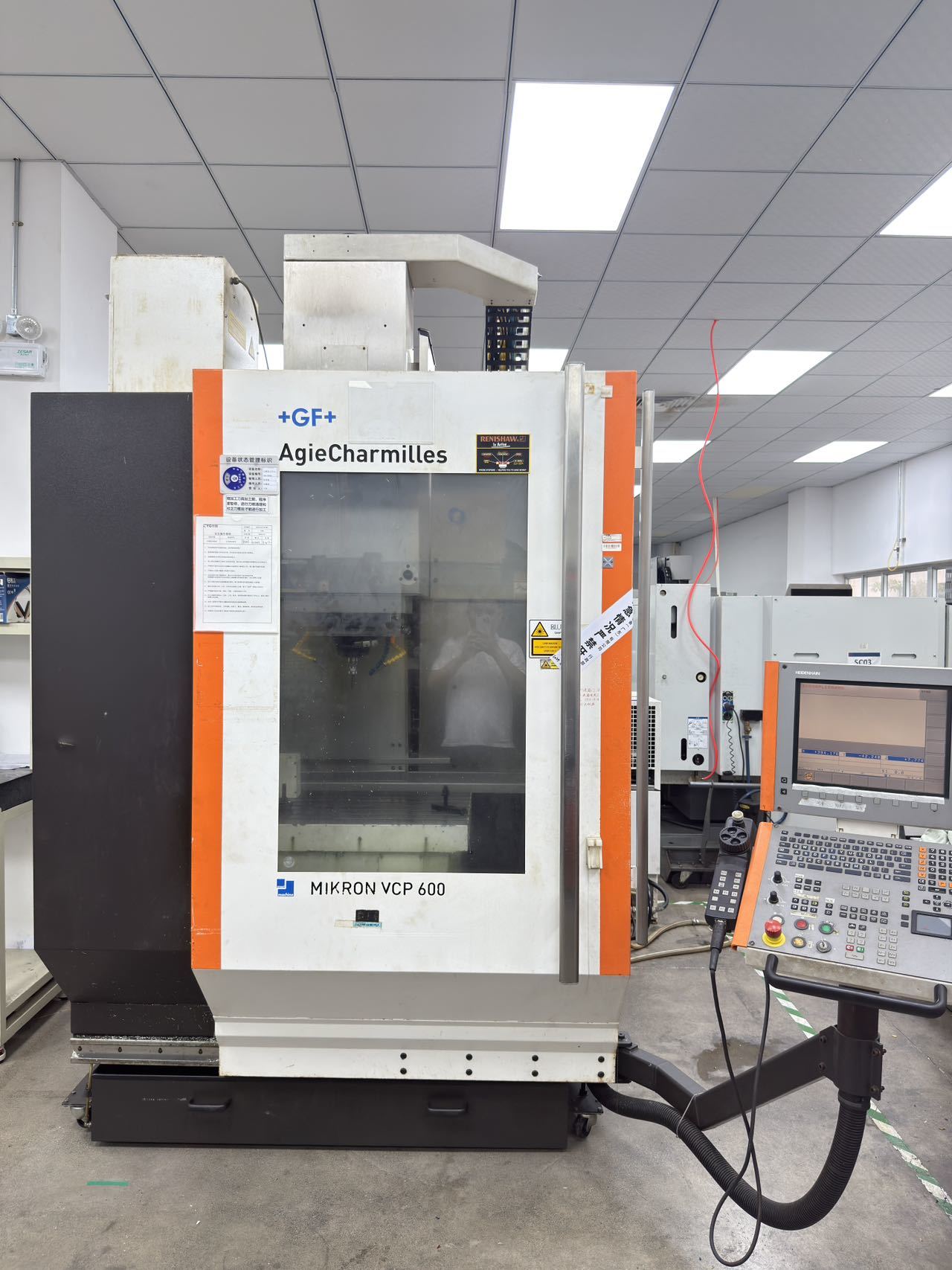
Real In-Stock Example: Mikron VCP 600 (Live Unit on usedultra.com)
To see this guide applied to a machine you can inspect today, a Mikron VCP 600 vertical machining center is live in UsedUltra inventory — view the machine and its listing. It is currently the only in-stock MIKRON unit on the UsedUltra MIKRON brand page; as new units arrive from our Japanese and Swiss sourcing channels, that page is where the live MIKRON inventory is shown.
VCP is a separate Swiss precision line from the HSM/MILL families compared above: launched ~1999 in Mikron AG Nidau's Futura family (a distinct line, not a renamed VCE), a 3-axis vertical with a Step-Tec spindle (20,000 rpm standard; the HS variant offers higher speed), polymer-concrete base and HSK-A63 interface — aimed at job-shop and tool-and-die work across the conventional-to-HSC range. Do not confuse it with the high-speed HSM/MILL S lines: it is a 3-axis precision vertical, so the "count the axes you need" rule says a fixed-table machine of this class is the right call unless your parts genuinely need 5-axis
| Parameter | Listed value (this unit) | Basis |
|---|---|---|
| Model / type | Mikron VCP 600, vertical machining center | Live listing |
| Year / origin | 2008 / Switzerland (Mikron AG Nidau) | Live listing. Caveat: publicly documented VCP units top out at 2007 (VCP 800) — confirm the year on the nameplate |
| Control | Heidenhain iTNC 530 | Live listing + dealer sources |
| Spindle | Step-Tec | Live listing + manufacturer/dealer sources |
| Serial no. | 107.30.98:915 | Live listing (meaning not publicly decodable — verify on nameplate) |
| Connected load / machine weight | 16 kW / 6,500 kg | Live listing; matches dealer data |
| Processing time | 1,423 h | Live listing |
| X/Y/Z travels | 600 / 450 / 450 mm | Dealer/manufacturer cross-check (not printed on listing page) |
| Table | 850 × 530 mm, max load 400 kg | Dealer/manufacturer cross-check |
| Tool magazine | 30 | Dealer/manufacturer cross-check |
| Positioning accuracy | Not published — verify per ISO 230-2 at acceptance | No source value found |
12-Month Field Results: Electrode Shop on 3-Axis HSM vs Job Shop on 5-Axis P
Case A — a graphite-electrode mold shop stays on 3-axis high-speed. A producer of graphite and copper electrodes for automotive molds ran a lightweight general VMC. Electrode finishing was slow, and graphite dust was wearing out the spindle seal. The shop moved to a used 3-axis high-speed Mikron (HSM line, 42,000 rpm class, small HSK-E taper). Graphite finishing dropped from two passes to one:
| Operation (typical electrode) | Old general VMC | Used high-speed Mikron | Change |
|---|---|---|---|
| Finishing passes | 2 passes / 45 min | 1 pass / 24 min | -47% |
| Surface finish | Ra 1.6, hand dressing needed | Ra 0.4–0.8 direct | dressing eliminated |
| Tool life (micro tools) | chipping at higher feed | +35% | vibration reduced |
Measured over 12 months: finishing time down 47%, hand dressing eliminated, micro-tool life up 35%, and spindle-seal downtime gone. The shop did not buy a 5-axis U, because no electrode needs tilted simultaneous machining. That choice saved the capital and the upkeep of two rotary axes.
Case B — a 5-axis housing and mold-plate shop picks the torque regime. A shop machining large aluminum housings and steel mold plates, with parts that need 5-side access and simultaneous-5-axis features, compared a used high-speed 5-axis against a high-performance production 5-axis (MILL P 800 U class, 20,000 rpm, HSK-A63, high-torque spindle). For steel roughers cutting at depth, the small high-speed taper cannot hold the chip load; the P-series torque and the HSK-A63 dual-face-contact taper carry it. After 12 months the shop reported roughing depth of cut up 2×, roughing time down about 40%, and no re-fixturing error because 5-axis finishing ran in one setup. The buyer says the premium over a high-speed U paid back in under 12 months on rougher throughput alone.
Both cases are representative client-reported outcomes on file with the UsedUltra team. Actual results depend on part mix, tooling, and machine condition. Individual machine reports are available on request. Neither case argues one line is best for everyone; each shop picked the line that matched its dominant operation.
Case C — a real machine to run this framework against. Rather than a retrospective client report, you can apply the decision framework now to a machine in UsedUltra inventory: the Mikron VCP 600, 2008, Switzerland. It is a 3-axis Step-Tec-spindle vertical (iTNC 530, HSK-A63, roughly 16 kW, 6,500 kg, 1,423 h), a fixed-table precision vertical rather than a 5-axis U. For a buyer whose work is 3-axis electrodes and mold finishing, the kinematics match, so there is no reason to pay the 5-axis premium. For anyone whose parts genuinely need simultaneous 5-axis, the VCP 600 is the wrong class regardless of condition. Its acceptance file (laser-interferometer ISO 230-2 report and spindle check) is available on request.
FAQ: Buying Used Mikron Machining Centers — Selection, Verification & Controls
Q1. What does the "U" in Mikron HSM 400U / XSM 600U / MILL P 800 U actually mean — a model or a class?
A: It is a 5-axis kinematic marker, not a machine line or class. The base machine carries a swivel/rotary tilt table instead of a fixed table, which gives 5-side and simultaneous-5-axis work. On the compact 400U class the tilt axis is usually a B-axis with ±110° swivel plus a 360° C-axis; larger U models letter it A with different ranges (the XSM 600U swings −110° to +30°), so check the datasheet. The same family also exists as a fixed-table 3-axis model without the U. There is no standalone "MILL U" family; MILL is the brand umbrella. Choose U only if your parts need tilted or simultaneous-5-axis machining. Otherwise you pay for two rotary axes, their scales, and their upkeep without using them.
Q2. Mikron HSM (high-speed) vs MILL P — which is the better used buy for mold work?
A: They serve different mold operations. Decide by cut regime, not brand.
- Electrodes, micro-detail, hardened-steel finishing (45–55 HRC). Use the high-speed line (HSM/XSM/MILL S-X, about 30,000–42,000 rpm, small HSK-E taper, linear-motor or ball-screw drives depending on the model). Low torque, high feed, fine finish.
- Large mold plates and housings that need simultaneous-5-axis roughing and finishing in one setup. Use the high-performance MILL P 800 U (20,000 rpm, HSK-A63 dual-face-contact, roughly 120 N·m torque). Heavy chip load and torque. Confirm the feed-drive type on the machine.
- Mixed general production on a budget. Use MILL E or VCE Pro (12,000–20,000 rpm spindle options on MILL E; VCE Pro up to about 16,000 rpm; ball screws, lowest entry cost).
Rule of thumb: above about 20,000 rpm the machine optimizes finish, not metal removal. Match the operation first.
Q3. Is a used 5-axis Mikron (a "U" model) automatically "better" than a used 3-axis high-speed Mikron?
A: No. The U is a kinematics upgrade, not a class upgrade. Compare on three points.
- Kinematics. The U adds tilt and rotary axes. On the 400U class that is commonly a B-axis swivel of ±110° and a 360° C-axis; larger models use an A-axis with different ranges. That is the whole difference. It does not raise spindle speed or accuracy class.
- Operating regime. A 3-axis HSM and its U sibling share the same high-speed spindle and drive world (HSM class, roughly 42,000 rpm on 2008-era units, iTNC 530). Same thermal sensitivity, same verification needs. Price the U as more axes, not more precision.
- Per-unit verification. Check travels, spindle hours, control software build, scale condition, and tilt/rotary backlash with a ballbar. Choose U only if the parts need 5-side or simultaneous-5-axis work.
Q4. Is an older iTNC 530 control (2008 HSM/XSM era) a dealbreaker on a used Mikron?
A: Not on its own. It is a compatibility decision. Check three things.
- Postprocessor match. If your CAM and program library target TNC 640, re-posting legacy programs is a real cost. If you already run iTNC 530 elsewhere, an iTNC 530 unit may actually be a plus.
- Parts and support. Confirm with the seller that spare parts and remote support are available for that exact iTNC 530 build.
- Condition, not control age. An iTNC 530 unit with verified ISO 230-2 results and a clean thermal record can outperform a neglected machine with a newer control. Evaluate the whole machine, then discount only if a control-generation mismatch forces rework.
Q5. How do I verify a used high-speed Mikron's spindle before I buy — and why does warm-up matter so much?
A: Three checks. The 30,000–42,000 rpm spindle is the costliest and most failure-prone subsystem.
- Spindle hours, taper, drawbar. Confirm hours are consistent with taper and runout state. Inspect the HSK taper for pitting or scoring. A rebuild runs US$14,000–28,000, so budget it into the price rather than discovering it after delivery.
- Vibration and thermal. Run a vibration check per ISO 10816-1/-3 (RMS under 1.8 mm/s) and a 90-minute unloaded thermal cycle. Z-drift should converge under 5 µm and spindle-nose rise under 15 °C. A cold start from 0 to 42,000 rpm spikes bearing temperature 12–18 °C and accelerates preload loss.
- Warm-up protocol. Expect a staged warm-up (spindle ramped 3,000 rpm up to operating speed, axes run full stroke) before production, judged by a temperature criterion (under 1 °C change over 3 minutes) rather than a fixed time. If the seller has no thermal record, treat the machine as thermally unverified and price it accordingly.